The Lincoln Bible

For over 25 years I’ve been fortunate to have worked in one of the most unique and impressive, if sometimes notorious, places on the planet: The U.S. Capitol or “Capitol Hill.” I realize there are many negative things we could say about the U.S. Congress, I suspect that’s always been the case, but if we’re honest with our mostly hypocritical and righteous selves we’d admit the problems are just a reflection of us, the mostly fickle, many times ill informed voter. But enough of that. I’ll save a elaboration on those thoughts for another time. 

For now, I’d like to note my thoughts on an experience I had at the Library of Congress recently. But before I go on about that let me provide some background.

Let’s go back a little in history for a moment. In the lead up to Abraham Lincoln’s first inauguration (March 4, 1861), the federal government believed there was an assassination plot against President-elect Lincoln. Because of this, the President-elect arrived in Washington DC, via train, under the cover of darkness. In the rush to get Lincoln into Washington during the night, Lincoln’s baggage was misplaced and along with it the Lincoln family Bible. The bags and the Bible would not make it to Washington in time for the inauguration and swearing-in ceremony at the U.S. Capitol Building.

abraham_lincoln_inauguration_1861
(Image credit: Wikipedia) U.S Capitol Building: Lincoln’s First Inauguration, March 4, 1861

Saving the day was the Clerk of the Supreme Court, William Thomas Carroll, who provided a Bible he’d kept for official occasions. And it was this Bible, which Abraham Lincoln would place his left hand on and take the official oath of office, that became known as The Lincoln Bible. The only other U.S President to use the Lincoln Bible for the oath of office was President Barack Obama for both of his swearing-in ceremonies in 2009 and 2013. And then recently, September 14, 2016, the newly appointed Librarian of Congress, Carla Hayden, used the Lincoln Bible for her swearing-in ceremony. It was just prior, literally maybe 20 minutes, to Carla Hayden’s swearing-in that I got my chance for a personal viewing of the Lincoln Bible.

Reverence. In some sense, I think, reverence for events, people, or things that serve as important connections to the past is a waning virtue right now in our history. The “mystic chords of memory,” to quote Lincoln, connect us to a shared fate and a shared destiny.

I believe, have always felt, that some things should invoke a feeling of respect for great things and people and the sacrifices made in forming this great, if not perfect, nation. There’s a good reason the constitution begins with the words “to form a more perfect union.” A perfect union wasn’t possible. From the very beginning the founding of this nation was a compromise deal. The nation’s birth was only the beginning of a task, a continual building and improvement upon an experiment in democracy. The task of improving, of making a more perfect union, would always be the task of those who’d inherited this Democratic Republic. Abraham Lincoln’s presidency, and the civil war brought on by it, were the first great test to determine whether this experiment in democracy, this union, this “nation so conceived,” could be saved and preserved through the growing pains of forming a more perfect union. Lincoln and his vision, his leadership, thank God, prevailed. 

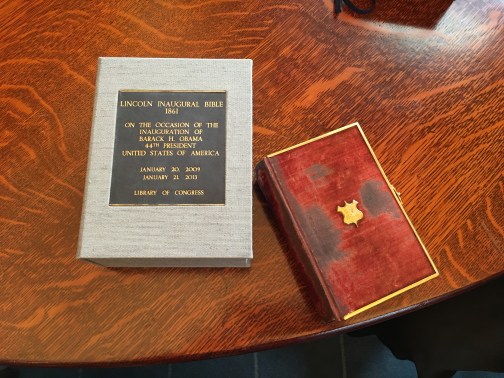
And so there I was, standing there listening to Mark (a Library curator and guardian of the Bible) give me a brief history of the Lincoln Bible. I actually stepped up to the table and stood for a moment almost as if I were viewing a deceased friend or loved one at a wake. I looked down on the Bible and thought of the so many events and people that have come and gone since Lincoln laid his left hand on this Bible and took the oath of office and then, after his destiny complete, passed into “the ages.” 
img_3922
Image Credit: Jeff Wills

What immediately grabs you about the Lincoln Bible is how small it is. The Bible is an 1853 Oxford Press KJV edition. It’s 6 inches long by 4 inches wide and about 1.75 inches thick. The Bible is bounded in a burgundy red velvet with gilt edges. The front cover is stained, worn, and faded with blackened stains along the spines edge. I thought of Lincoln’s left hand resting on the Bible as he began to recite the oath, the emotions he must have felt, and how his mind must have been occupied with the gathering storm of rebellion. And I thought of all the subsequent people who’ve held this Bible and reflected on Lincoln, his times, and what his presidency and leadership meant to the nation.

For those brief but solemn moments I felt privileged for this opportunity to be touched by those mystic chords of memory.

Upping my Twain

My study and my home, for that matter, are starting to become overrun with books. Actually, this started a long time ago but I prefer to ignore the realization as long as possible. Regardless of sagging shelves, loaded boxes and growing stacks, I continue to collect books. I recently told my wife I would address this addiction immediately. I would attack it with energetic vigor and a dogged determination. I will hold the line!

So with that in mind this past week, I added three more books to my Mark Twain collection.

IMG_3753

I already have the Complete 29 Volume Oxford Collection of Mark Twain’s works, a CD collection of his private letters, and a couple boxes of his books in various paperback editions. You see, when I read I use a pencil to underline memorable passages and make marginalia. I’m a slow reader, taking in every word and every punctuation mark. If I don’t underline passages I’m not likely to find them when I go looking for them. I can’t bring myself to write in most of my hardcover books. That’s irreverent! Well at least not in the one’s I consider my collection stock. This means I collect the hardcover books and in some cases, like my Mark Twain collection, I buy a paperback version so I can write in that book.

If you don’t already, one day I’ll have to write a post on why you should read Mark Twain. But that’s for another day.

So as for the books pictured above:

Well if you weren’t already aware, Mark Twain’s writings, beside being humorous, a work of art and fun to read, mark a transition in the history of American literature. Ernest Hemingway famously commented:

“All modern American literature comes from one book by Mark Twain called Huckleberry Finn. American writing comes from that. There was nothing before. There has been nothing as good since.”

That’s high praise coming from a winner of the nobel prize for literature. A part of Hemingway’s renown as a writer comes from his adopting a Twainesque style of writing. Not the humor so much, but the rule that a writer “Employ a simple and straightforward style,” and “Eschew surplusage.” Of course there’s a lot more to Hemingway’s particular art but he was clearly influenced by Twain.

Anyone who likes to read and write is usually attentive to prose style. I pick up books all the time and skim a few passages in order to get some feel for the writer’s prose. For me, this attentiveness to writing tends to spill over into an attentiveness to everyday speech, because good writing, as Robert Louis Stevenson once said, is “the shadow of good talk.” This has become a habit. I find listening carefully to good talkers can help improve your writing. I listen for organization, rhythm, cadence, word choice, and structure. All the elements of an individual style or personality. People’s individuality and their particular way of thinking and expressing themselves is truly fascinating.

So naturally with a writer I admire, I’m interested in how they developed as a writer. What influenced and shaped their style. This is why I picked up The Bohemians by Ben Tarnoff. This history book outlines the beginning of Samuel Clemens’s (Mark Twain’s) career and how he and some other prominent writers of that time helped reinvent American literature.

Then we have the recently released Chasing the Last Laugh  by Richard Zacks. This book is about Twain’s great world wide tour. Mark Twain didn’t have much luck with investments and business ventures. He made a lot of money and he lost a lot of money. He got heavily in debt. He decided this wasn’t the way his story was going to end, he wasn’t leaving his family with massive debts to pay off. So Twain set out on very successful world wide tour. This book focuses on Twain’s tour around the world—chasing the last laugh.

Now, I haven’t read this book yet but I know Twain was able to pay back his debts and substantially rebuild his wealth. Full length biographies typically require a good investment of time, whereas books aimed at capturing a brief period or event in a Life are usually shorter reads and yet very informative. So this book along with, say, Man in White are good, short reads if you’re interested.

Finally, I picked up the 125th edition of Mark Twain’s Adventures of Huckleberry Finn.  This edition is a copy of the original first edition with illustrations and notes as Twain originally approved. My goal is to read this one through carefully and write a review—eventually.

Reading Biography

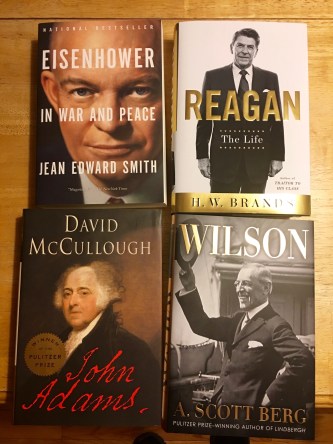
A colleague at work gave me these 4 autographed biographies of American presidents.

IMG_3588

These books arrived at my office after a meeting where business and the pleasure of reading seem to go naturally together. My colleague had obviously discovered my love of books and thought she’d indulge it. We didn’t talk about any particular genre so I was pleasantly surprised to be given 4 biographies, my favorite kind of reading.

The great English lexicographer and essayist, Samuel Johnson, once said: “I esteem biography, as giving us what comes near to ourselves, what we can turn to use.” By studying the lives of other people, specifically those who’ve risen to great renown, we can learn a lot about the workings of human excellence and human vice. We can put to use what we learn from these biographies in our own lives.

Humanities departments have long argued that one of the best ways to improve yourself, both morally and culturally, is to study the arts and literature; more specifically novels and other works of the imagination. By experiencing the world imaginatively through the lives of others we’re able to sympathize, to “move with” them, as our protagonists experience the world, its triumphs, trials, and tribulations. It’s through this sympathetic process that we expand our own moral and cultural horizons. We understand them and ourselves better. This has the potential to create new intellectual and moral connections we did not have before. We grow.

In the modern age biography has replaced the novel in this respect. Just notice how the fiction section of the Barnes and Noble Book Shop is shrinking and the biography section is expanding. Most modern biographers write their story with the skill of a good novelists, and with biography you’re dealing with facts, with characters from history, not fiction. I think there’s a greater demand these days for the literature of fact, because it touches our need for what P.G. Wodehouse once said about good conversation being “a feast of reason and a flow of soul.”

A Ghost Writer’s Regret

Donald Trump’s best selling book, The Art of the Deal, opens with this paragraph:

I don’t do it for the money. I’ve got enough, much more than I’ll ever need. I do it to do it. Deals are my art form. Other people paint beautifully on canvas or write wonderful poetry. I like making deals, preferably big deals. That’s how I get my kicks.

It’s a good opening. I can imagine a film about Trump opening with a sweeping view of New York City’s skyline and a voice-over of Donald Trump speaking these words as a sort of epigraph to the story that’s about to unfold.

The Art of the Deal was a big best seller and helped launch Donald Trump’s persona as a talented businessman who rose to wealth and fame by his skilled art of deal making. When Donald Trump launched his Presidential campaign, he referenced his book as one of his main credentials: “We need a leader that wrote The Art of the Deal,” Trump said. The book is one of Trump’s main legitimacy cards.

There is one big problem with Trump’s above statement. He didn’t write the Art of the Deal. Not one word of it. And Trump didn’t say the words quoted above. The entire book was a creation of Tony Schwartz, Trump’s ghost writer. Now if you’re thinking, “Well, that’s what ghost writers do, they gather information and write the book,” you won’t be wrong but you won’t be entirely right either. The ghost writer’s job is to paint the main author in the best possible light. That’s true. But there is something unique about this case.

Typically a ghost writer collaborates in writing the book. Meaning, the ghost writer collects materials and does a large number of lengthy interviews with the central author and then begins drafting a book for review by the main author, in this case Trump. Yes, the ghost writer does a lot of the writing. The interviews allow the main author to work out what they believe and tell the story for the ghost writer to capture and use to create the narrative, the book. But in this case that didn’t happen. Trump never told his story.

Tony Schwartz said he was unable to conduct those essential interviews. He was reduced to listening in on phone calls to grasp how Trump dealt with people and traveling with Trump to observe how Trump operated. A lot of what he saw and heard, we now know, was not positive according to Schwartz. Ultimately Schwartz had to put the book together on his own from the riot of materials he could gather. He had to be very creative.

Getting to know who Trump really was and then seeing Trump run for President—and possibly win the White House—has really caused some angst for Schwartz recently. He has a case of ghost writer’s regret. He’s kept quite all these years (the book was published in 1987) because Trump remained in the private sector. But not anymore. Knowing what Trump is really like, compared to how Schwartz falsely portrayed Trump in the book, has caused Schwartz to come forward to tell the world what he knows.

On NPR Schwartz tells us why he couldn’t conduct those book interviews with Trump and what he learned from that:

“One of the chief things I’m concerned about is the limits of his attention span, which are as severe as any person I think I’ve ever met,” Schwartz says. “No matter what question I asked, he would become impatient with it pretty quickly, and literally, from the very first time I sat down to start interviewing him, after about 10 or 15 minutes, he said, ‘You know, I don’t really wanna talk about this stuff, I’m not interested in it, I mean it’s over, it’s the past, I’m done with it, what else have you got?”

There you have it. Trump was incapable of telling his story. He couldn’t sit still long enough and he wasn’t really interested talking about “this stuff.” So Schwartz wrote the entire book from notes and handed it to Trump for review. Trump made no changes, no edits, no revisions, and handed the book back to Schwartz. So the voice you hear on the page, like the opening paragraph quoted above and the ideas you get from the text, are primarily the creation of Tony Schwartz not Donald Trump.

So that’s why when Schwartz saw Trump announce his candidacy and state: “We need a leader that wrote The Art of the Deal, Schwartz immediately tweeted: “Many thanks Donald Trump for suggesting I run for President, based on the fact that I wrote ‘The Art of the Deal.'” Schwartz felt that “If he could lie about that on Day One–when it was so easily refuted–he is likely to lie about anything.”

Schwartz tells us that what he learned about Donald Trump was not flattering at all. Trump was not some great mind or leader or some great dealmaker. He was “pathologically impulsive and self-centered,” “Had no attention span,” and “Lied strategically…[with] a complete lack of conscience about it.” In writing the book, Schwartz felt he’d “Put lipstick on a pig.”

Now, beyond what Schwartz thinks about Trump, my main reason for posting has to do with my thoughts about writing and personality. It confirms a hunch I’ve had about Trump and the craft of writing. Listening to Trump talk and observing his public behavior made me suspect that Trump wasn’t capable of writing a book like The Art of the Deal. He probably hasn’t written any of his own books. Writers, at least the one’s who dedicate themselves to the craft, are typically careful and precise with words in both writing and speaking. Trump, if you’ve listened to him talk for any length of time, is typically imprecise and sloppy with words. I don’t detect any profound respect for the power and effect of words, which comes natural from a craftsman. And the truth is Trump doesn’t come across as very intelligent. He doesn’t sound like a man who reads much or has seriously wrestled with ideas. 

Secondly, from a moral perspective, I find it interesting that Trump’s behavior has stayed pretty consistent since The Art of the Deal was published in 1987. I don’t detect a lot of growth unfortunately. He still seems like the same guy he was almost 3 decades ago: loose with the truth, struggling with attention deficit, and lacking good impulse control. Not that any of this disqualifies him to be President of the United States or so it seems in this bizarro election season. Maybe Trump will win, I really don’t know. But it won’t be because of Trump’s character or abilities, but more likely because of a populist anger and the failure of Hillary Clinton to inspire confidence as the alternative.

Of course Tony Schwartz has been threaten by Donald Trump with litigation over his revelations. That’s to be expected Schwartz admits. I’ll note that Trump’s lawyer in his letter to Schwartz was careful not to say Trump wrote the The Art of the Deal. Trump’s lawyer knows that would be a lie. Schwartz, whom by the way kept a journal (great piece of evidence to substantiate his claims) while writing The Art of the Deal, refused to retract anything. He knows what he’s saying is the truth will not back down.  

I think there is some connection between how one thinks and speaks and the quality of their writing. I think, though I may be totally wrong, that you can listen to some people talk, which is a reflection of how they think and organize information, and estimate just what the quality of their writing would be. I’ve experimented with this idea for years and so far I’ve be proven correct in the vast majority of cases. And so listening to Trump all these years, I have a hard time believing he’s a good writer and even capable of creating a book or a good essay, for that matter, on his own.

This Morning’s View


Sitting alone this morning, listening to the sound of the water lapping against the dock, the faint sound of birds chirping, feeling the nice temperate air, enjoying the smell of coffee, and loving a good book. 😃📚