The Art of Swifting

Right now I’m reading a superb biography on Jonathan Swift (1667 – 1745) by Leo Damrosch. Swift is one of the most memorable personalities in the history of literature. This biography is hard to put down. The book is a masterpiece of prose and storytelling itself. Swift was an essayist and satirist with a sharp mind and a burning wit. For me, Swift’s most memorable quotes, the ones that remain in my mind when I think of Swift, are:

“The latter part of a wise man’s life is taken up in curing the follies, prejudices, and false opinions he had contracted in the former.”

“Falsehood flies, and truth comes limping after it, so that when men come to be undeceived, it is too late; the jest is over, and the tale hath had its effect: like a man, who hath thought of a good repartee when the discourse is changed, or the company parted; or like a physician, who hath found out an infallible medicine, after the patient is dead.”

“If a man would register all his opinions upon love, politics, religion, learning, etc., beginning from his youth and so go on to old age, what a bundle of inconsistencies and contradictions would appear at last!”

“There is nothing in this world constant, but inconstancy.”

“…the most pernicious race of odious vermin that Nature ever suffered to crawl upon the surface of the earth.”

Swift is mostly known for his satirical story called Gulliver’s Travels. If you’re over 40 you may have had to read this story in middle school or high school. George Orwell, himself probably one of the top 5 English language essayists to ever pick up a pen, thought Gulliver’s Travels probably meant more to him than any other book ever written. Orwell said there was rarely a year that went by without him dipping into Swift’s classic. Orwell wrote an excellent essay on Swift well worth reading.

What brought me to writing this post was a rather humorous passage in Damrosch’s biography that highlights Swift the writer and Swift the personality. Swift was not, at least in many of his writings, a politically correct writer. He didn’t suffer fools gladly and he had little patience for literary cant. On Page 209 of Damrosch’s book he writes:

Commenting on a history of the Church, he [Swift] once rewrote an overelaborate passage in order to bring it to life. Here is the original text, describing unworthy clergymen: “They are an insensible and degenerate race, who are thinking of nothing but their present advantages; and so that they may now support a luxurious and brutal course of irregular and voluptuous practices, they are easily hired to betray their religion, to sell their country, and to give up that liberty and those properties which are the present felicities and glories of this nation.” That’s barely readable. Swift’s version gets rid of the big words and abstractions, and leaps from the page: “The bulk of the clergy, and one third of the bishops, are stupid sons of whores, who think of nothing but getting money as soon as they can. If they may but procure enough to supply them in gluttony, drunkenness, and whoring, they are ready to turn traitors to God and their country, and make their fellow subjects slaves.”

We could almost say this bitting, straightforward, no pulling punches writing style, is what we might call Swifting or the Art of Swifting.
Strive to Belong to the Community of Creators

Where joy is, creation has been. — Henri Bergson

While skimming through my favorite old philosophy textbook, I had the pleasure of discovering these comments in the book’s preface:

There are great multitudes of good and decent people out there in the world who belong to the category of creators rather than destroyers. But they are not the ones who are most visible or most audible, not the ones who talk mindlessly and endlessly on television, not the ones who have a judgmental reaction to everything that differs from their way of seeing. They make up a beautiful though silent community. But they are there.

While my wife, Lori, and I were lunching in a restaurant one day, she said to me, “How can you not feel alive if you are creating?” And Bergson once wrote, “Where joy is, creation has been.” This may be, for many of us, as near the answer to the meaning of life as we will find in this life. You’re alive as long as you’re creating. Ray Bradbury insists that it matters not what happens in the world; your moral obligation is keep on creating. It is the greatest of privileges to strive to belong to the community of creators.

Ask yourself, Do you strive to be a member of the Community of Creators? I would like to think I do, even if my membership is in need of constant renewal.

Tolstoy’s Calendar Of Wisdom

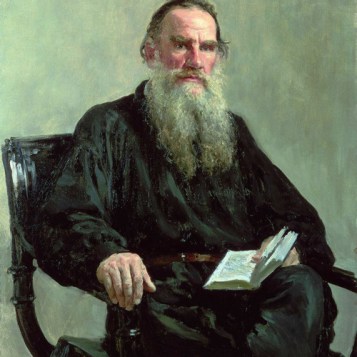
Tolstoy Reading his Calendar of Wisdom
Leo Tolstoy reading A Calendar of Wisdom

One of the most fascinating figures in the history of literature is Leo Tolstoy. Unlike most people, who discover Tolstoy through his novels and short stories, I was introduced to Tolstoy through his religious writings.

Many years ago I remember reading William James’s book, The Varieties of Religious Experience. As I recall, I was fascinated by James’s analysis and commentary on some of Tolstoy’s religious writings. (James’s book was perspective altering and left a big impression on me. I hope to read it again some day. I highly recommend you give it a go if you enjoy philosophical psychology and religious studies.)

So I picked up a Penguin Classic of Tolstoy’s writings called A Confession and Other Religious Writings. This book, the imagines and ideas, still haunt my memory. After reading this book, I started dipping into the rest of Tolstoy’s works. It was, like Tolstoy’s Russia, a vast and consuming experience. Tolstoy is not just a writer or moralist with something to say, he’s more like the yogi who wants to change your consciousness and reveal a world hidden from your view. This is Tolstoy’s mission in life.

Tolstoy’s deeply philosophical and religious mind get full range in his greatest novel, War and Peace, a large—and seemingly endless—canvas where Tolstoy paints his ideas about determinism and contingency in history, which he brilliantly elaborates on in an essay at the end of the novel.

Tolstoy’s writings and ideas have been highly influential. Mahatma Gandhi and Martin Luther King Jr. were both influenced by Tolstoy’s principle of non-violent resistance. The great 20th century philosophical genius Ludwig Wittgenstein was highly influenced by Tolstoy’s religious book, The Gospel in Brief. The popular historian and biographer, Niall Ferguson, credited Tolstoy, specifically War and Peace, with making him a historian. And who can forget the tragic story of Chris McCandless, the young idealist who appears to have been influenced to go hiking alone in the Alaskan wilderness (see Into the Wild) to commune with nature after reading Tolstoy’s Family Happiness.

Now, when it comes to novels, Tolstoy is not your casual read. If you’re use to reading popular novelists then you’re probably going to find Tolstoy, at times, difficult to follow. Tolstoy is not looking to just entertain, though he does, but to impart wisdom through the medium of art. Tolstoy is using words and story to cast the mind’s eye upon what Rudyard Kipling called “the impenetrable plinth of things.” Immersion in Tolstoy’s work has the real potential to alter your perspective on life.

But most people, other than for work, don’t have time for reading much at all, especially a large book like War and Peace or a book of Tolstoy’s religious writings. And Tolstoy understood this.

So in the mid 1880s Tolstoy came up with the idea for A Calendar of Wisdom: “A wise thought for every day of the year, from the greatest philosophers of all times and all peoples.” He added, “I have to create a circle of reading for myself: Epictetus, Marcus Aurelius, Lao-Tzu, Buddha, Pascal, The New Testament. This is also necessary for all people . . . I would like to create a book . . . in which I could tell a person about his life, and about the Good Way of Life.”

Instead of a big novel or philosophical treatise on the meaning of life, Tolstoy decided one of his last works (he updated and edited the book in the last years of his life) would be a book of daily thoughts to nourish the soul:

The difference between real material poison and intellectual poison is that most material poison is disgusting to the taste, but intellectual poison, which takes the form of cheap newspapers or bad books, can unfortunately sometimes be attractive.

(January 1)

Knowledge is real knowledge only when it is acquired by the efforts of your intellect, not by memory.

Only when we forget what we were taught do we start to have real knowledge.

(Henry David Thoreau, January 9)

A constant flow of thoughts expressed by other people can stop and deaden your own thought and your own initiative…. That is why constant learning softens your brain…. Stopping the creation of your own thoughts to give room for the thoughts from other books reminds me of Shakespeare’s remark about his contemporaries who sold their land in order to see other countries.

(Arthur Schopenhauer, January 9)

Real wisdom is not the knowledge of everything, but the knowledge of which things in life are necessary, which are less necessary, and which are completely unnecessary to know. Among the most necessary knowledge is the knowledge of how to live well, that is, how to produce the least possible evil and the greatest goodness in one’s life. At present, people study useless sciences, but forget to study this, the most important knowledge.

(Jean Jaques Rousseau, March 16)

There is only one real knowledge: that which helps us to be free. Every other type of knowledge is mere amusement.

(Vishnu Purana, Indian Wisdom, June 23)

The way to true knowledge does not go through soft grass covered with flowers. To find it, a person must climb steep mountains.

(Josh Ruskin, September 20)

Intellect is the quality that makes us different from animals.

Buddha said: “In meditation, in speech, in life, in studies, I never forget about the most important thing: the requirements of the intellect.”

The moral and the intellectual are always in harmony.

(June 13)

Each morning, for the past few months, I’ve started my day by opening to the current date in Tolstoy’s Calendar of Wisdom. It has helped put my mind in the right frame, or for lack of a better word, rhythm for the day.

“I cannot understand,” Tolstoy wrote, “how some people can live without communicating with the wisest people who ever lived on earth . . . I feel very happy every day, because I read this book.”

In this busy world we rarely have time to dedicate to our spiritual an intellectual growth. Regardless of where you’re at in life or what’s going on, it’s important to imbibe the nourishing water of wisdom.

Tolstoy has provided a cup. I recommend you take those brief moments and drink daily.

Changing our Mind

I’m currently reading Robert Skidelsky’s single-volume biography of John Maynard Keynes. Keynes was one of the most remarkable economist, thinkers and writers of the 20th century. His letters and books are full of witty remarks and unique turns of phrase. Here’s some examples:

  • “But this long run is a misleading guide to current affairs. In the long run we are all dead.”
  • “Words ought to be a little wild, for they are the assault of thoughts on the unthinking.”
  • “If you owe your bank a hundred pounds, you have a problem. But if you owe a million, it has.”
  • “There is no harm in being sometimes wrong — especially if one is promptly found out.”
  • “Markets can remain irrational longer than you can remain solvent.”
  • “Practical men who believe themselves to be quite exempt from any intellectual influence, are usually the slaves of some defunct economist. Madmen in authority, who hear voices in the air, are distilling their frenzy from some academic scribbler of a few years back.”
  • “The difficulty lies not so much in developing new ideas as in escaping from old ones.”

One of my favorite Keynes quotes involves his reply to a criticism of him for changing his mind on a policy position he’d taken in the past. In a sharp and arresting retort Keynes replied, “When the facts change, I change my mind. What do you do, sir?”

Keynes was insinuating two things in this remark: One, changing our mind is naturally what we do as we become more educated on a subject over time. That’s just common sense old chap! And two, “What do you do, sir?” is Keynes’s way of asking his critic if he’s one of those people who prefers the “hobgoblin” of consistency over intellectual integrity. A question we should all be asking ourselves.

Changing our mind is something honest and thoughtful people must sometimes do. Changing our mind about various ideas and beliefs is something we should be doing over our lifetimes as we experience and learn. It’s the true sign of a mature mind. This is especially true in politics, where many people’s beliefs are based more on gut and party than a thoughtful evaluation of people, policy, facts, and sincere interests. “Life is,” as James Barrie said, “one long lesson in humility.”

The safest course is to always remain humble about knowledge and certainty while remaining open minded and intellectually curious.

The Siren Song of Nostalgia

John_William_Waterhouse_-_Ulysses_and_the_Sirens_(1891)
Odysseus and the Sirens, by J. W. Waterhouse

I’ve been reading a beautifully written book by Adam Nicolson called Why Homer Matters. I highly recommend the book. The book is mostly the memoir of Nicholson discovering that “Homerity is Humanity,” that Homer is ultimately a guide to understanding life. Nicolson was inspired to write the book after reading the story of the Sirens in the Odyssey. For Nicholson, the story of the Sirens is the main thread, the central metaphor, that connects the Iliad and the Odyssey. In a very memorable passage from his book, Nicholson describes what the story of the Sirens means:

The Sirens sing the song of the heroic past. . . . They want to draw Odysseus in with tempting stories of what he once was. . . . The prospect of clear-cut heroism summons him, and he struggles to escape his bindings. But his men, like the poem itself, know better, and they tie him tighter to his ship. They won’t be wrecked on the illusions of nostalgia, the longing for that heroized, antique world [of the Iliad], because, as the Odyssey knows, to live well in the world, nostalgia must be resisted; you must stay with your ship, stay tied to the present, remain mobile, keep adjusting the rig, work with the swells, watch for a wind-shift, watch as the boom swings over, engage, in other words, with the muddle and duplicity and difficulty of life. Don’t be tempted into the lovely simplicities that the heroic past seems to offer.