“I cannot remember the books I’ve read any more than the meals I have eaten; even so, they have made me.” ― Ralph Waldo Emerson
Yesterday was World Book Day. A friend of mine graciously reminded me on Facebook. So being a book lover, let me take this opportunity to catch up.
Just as there’s been people in my life who’ve influenced and shaped my thinking, there’s also been books and writers who’ve been spiritual mentors that have, in some way, shaped who I am—as I’m sure they have many others. So here’s a short list of books that I recommend for reading when you have time. These are all books that, as Thoreau said, should “be read as deliberately and reservedly as they were written.” Each book presents a unique perspective that has the potential to change how you see the world. This list is a very small representation of so many great books, but it’s a start for those interested in a good, perspective changing book.
Samuel Johnson by Walter Jackson Bate. This book won all three of the nation’s highest literary awards: The National Book Award, the National Book Critics Circle Award and the Pulitzer Prize. Here is the life of a man who had so many personal challenges and yet through sheer force of mind rose to become one of the most quoted and admired writers in history.
William James: In a Maelstrom of American Modernism by Robert D. Richardson. James has been called the father of American psychology. He is also America’s greatest philosopher. This well written and engaging biography is the intellectual story of a towering figure in the life of the mind.
Death in the Afternoonby Ernest Hemingway. This unique book is Hemingway’s treatise on bullfighting and writing.
The Story of Philosophy by Will Durant. A history of philosophy told through the lives of great philosophers. Durant is one of America’s greatest gifts to storytelling. The book is a real gem of wisdom and Durant is a writer you’ll constantly be underlining for the insightful quotes.
The Righteous Mind: Why Good People are Divided by Politics and Religion by Jonathan Haidt. Dr Haidt is a social psychologist who’s done research in moral psychology for decades. This book is, in part, a summing up of what he’s learn from his research over those years. You learn so much about human beings and why it’s so difficult for us to change our mind or to think outside the accepted beliefs of our political or religious tribe. A truly fascinating book that’s sure to alter your perspective.
Gates of Fireby Steven Pressfield. The one novel on my list is a story about the 300 Spartans who perished at the battle of Thermopylae in 480 BC. This book is far better than the movie 300, which was mostly just fantasy. Pressfield’s book is true to life and history and is told with mastery and a psychological depth thatmatches any of the greatest literary masters of the past. A real page turner and well worth your time.
Waldenby Henry David Thoreau. If you haven’t already read this spiritual classic then you may be one of the mass of people who leads a life “of quiet desperation.” This is a truly beautiful book full of poetry and truth about life and living.
I hadn’t originally planned on seeing the movie American Sniper, but the brewing controversy around the film piqued my interest. For those who don’t know, American Sniper is a film based on the book by the same name written by former Navy SEAL Chris Kyle.
Kyle served 4 tours in Iraq and ended the war as the most lethal sniper in U.S. Military history. The controversy over the movie, as I take it, centers around whether the film actually represents Chris Kyle as the man he actually was, according to his own memoir, or did Clint Eastwood, the film’s director, engage in creative license as many have claimed.
I read Kyle’s book—every word of it—before I went to the movie. I also watched a large number of Youtube videos of Kyle, where he discusses his book, his life, and his views.
So did the movie portray Kyle as he portrayed himself in his own book? My answer is, well, no and yes.
First, why do I say no? The movie portrayed a Chris Kyle that appeared more sensitive and emotionally affected by the war and the killing than the book portrays. The Chris Kyle of his memoir makes it clear he enjoyed war and had no problem with anyone he killed — men, women, or in some cases, young boys whom he judged a threat to American soldiers. At times Kyle does come across a little raw in his book, which I think we can mark down as part warrior mindset, part bravado. The Chris Kyle of his book, for example, can say things like “I don’t shoot people with Korans—I’d like to, but I don’t.” That scene, those words, aren’t in the movie.
Kyle is credited with killing somewhere around 160 Iraqi insurgents. At least, as he would tell you, that’s the “official number.” The impression he likes to leave in the book, and I believe he admits somewhere else, is that he killed a lot more Iraqis than the official number he’s credited with. No one knows exactly how many people Kyle killed unofficially, or under what circumstances, since only the official kills had, as he reminds us multiple times, a “witness” to each of them.
In the book, Kyle has the habit of reminding us there is “the official” side of the story and then there’s — wink and a nod — the unofficial side of the story. Of course we all know there’s an unofficial side in war. But most of us probably wouldn’t highlight or hint at that in regards to the number of people we killed without witnesses around. In fact, Kyle says he wished he could have “killed more.”
I will also add the movie took a number of liberties with events. For example, there is one paragraph in Kyle’s memoir about an Iraqi sniper by the name of Mustafa. Kyle said he never saw Mustafa and he “believed” Mustafa was killed by some other U.S. soldiers. However, one of the movie’s main themes is the hunt for Mustafa. At the end of the movie, in typical heroic Hollywood style, Kyle kills Mustafa with an incredible 2000 yard sniper shot. This is pure fiction. The movie has a number of other scenes and events that aren’t in the book and appear to have been added to the movie for the sake of dramatic tension.
On the yes side of the movie—that it did portray Chris Kyle’s life. Well, I think the movie did a good job of showing the strained relationship between Chris Kyle and his wife, Taya. The movie was faithful in following the struggles they personally went through as a military family and as husband and wife.
Bradley Cooper, who plays Kyle in the movie, also did a good job of playing Kyle. I thought Cooper did a good job with Kyle’s mannerisms, speech, and Texas twang. The movie did show some scenes right from the book, such as when Chris and Taya first met at a bar in California. I thought Bradley Cooper, while not giving an entirely accurate portrayal, which is not possible anyway, did give us a version of Chris Kyle. A version we should expect when Hollywood writers and movie making are involved. I wasn’t surprised, in fact, I rather expected it.
I think the controversy over the movie is partially driven by the fact that the war in Iraq was (and is) controversial. I think it’s fair to say now the war in Iraq was an epic mistake. I don’t think an honest person can disagree. But it’s also important to remember that soldiers have no vote in the wars they fight. They sign up to serve their country and are tasked with fighting the wars the nation’s commander-in-chief directs them to fight, regardless of whether any of us agrees with the decision. That’s a soldier’s duty and it’s important point to keep in mind.
When people began seeing the movie and the media began referring to Chris Kyle as “a hero” the critics jumped. In their mind, an illegitimate war doesn’t have legitimate heroes. It has legitimate victims: Iraqis and American soldiers. Secondly, the critics felt the portrayal of a more humane and sensitive Chris Kyle in the movie was nothing but Hollywood sugar coating, not an honest portrayal of a man who actually enjoyed killing “savages.”
Critics are correct in saying the movie doesn’t give us an accurate portrayal of the Chris Kyle of his memoir. So, again, they do have a legitimate point there. Kyle was, according to his own words, unmoved by the large numbers of people—basically a small village—he killed personally while in Iraq. In his mind these killings, each and every one of them, were justified. None of us, I remind critics, have any evidence at this time that Kyle killed anyone unlawfully or without justification while serving in Iraq. As far as we know “officially” (Kyle is grinning…believe me), everyone Kyle killed deserved it.
I have mixed feelings about Kyle the man of his memoirs. But I can say without hesitation, if I’m going to war I’d want Chris Kyle on my team. Regardless of whether we agree with the war, our mission must be to win it once we’re in it. Chris Kyle was a warrior to the core. Some of us may not like his manner or his bloodthirsty spirit, but when the shooting starts and you’re fighting for your lives Chris Kyle is the man you want there fighting beside you. It’s because of warriors like Kyle, sitting at his position of overwatch, that many American families were spared the loss or maiming of a loved one in Iraq. For that he certainly is a hero.
To conclude, as a movie I recommend seeing American Sniper. While the movie does take license in its portrayal of the protagonist, and does have some factual flaws, it isn’t such a break from the Chris Kyle of the book that we can’t get a slightly blurred picture, or modified version, of the real Chris Kyle and the struggles our military men and women and their families go through in war. And the plain truth is, it’s a good war movie. It does give an accurate portrayal of the harsh realities of war—the life and death decisions, the struggles, the costs, the sacrifices and even, while some of us may not always feel comfortable with it, the type of people it takes to win.
Note: Chris Kyle was tragically killed at a Texas firearms range in February of 2013 by an Iraqi war veteran he was attempting to help. As of this writing the accused killer, Eddie Ray Routh, is about to go to trial for capital murder.
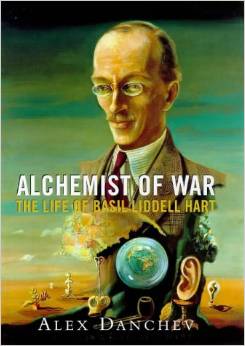
I’m reasonably well versed in WWI and WWII history. I’ve been a dedicated reader of Sir John Keegan’s books and various other well known war historians for years, but all through the thousands of pages of history I’ve read I don’t recall seeing the name Basil Henry Liddell Hart. I first heard the name B. H. Liddell Hart while reading Robert Greene’s 33 Strategies of War. Greene’s discussion of Liddell Hart and the quotes Greene provided of the great strategist were very interesting and stayed with me. Liddell Hart seemed more than just a war strategist. So it was a pleasure while recently scanning the shelves of a used bookstore that I came across Alchemist of War: The Life of Basil Liddell Hart by Alex Danchev. This biography is good, not only because its portrait is so interesting but because Danchev is so artful at the rendering.
Liddell Hart served as an officer in the first world war. His experience with the futility of trench warfare pushed him to find a better way “to ensure that if war came again there should be no repetition of the Somme and Passchendaele.” With theories like The Man in the Dark and the Expanding Torrent, Liddell Hart began his search to solve the problem of “continued impetus against defense in depth.” The problem, as the tactics of WWI showed, was once an attacking army penetrated the defensive lines (trenches) of the enemy, the attacking force quickly lost momentum as it bogged down in layers of additional defensive works. The attacking army, at this point, then occupied a salient within the enemy line. The enemy, having better communications within it’s own lines, quickly organized their reserve forces on 3 sides of the attaching armies salient and either stalled the break-through, defeated it entirely, or beat it back while inflicting heavy casualties. This would happen over and over in WWI. Successful breaks in the enemy line or “exploitations” could not be properly followed up and exploited fully. Decisive victory, hence, was illusive. The war would be a stalemate, a bloody war of attrition in the “mausoleums of mud.”
Liddell Hart would eventually develop the Indirect Approach. This theory involved the mechanization of the army, with infantry tactics playing support instead of the leading role. Liddell Hart wrote: “Of all the qualities of war it is speed which is dominant.” Celeritas, speed and swiftness, are the primary virtues of a successful army and the thinking of a successful commander. You must be able to stay ahead of your enemy in movement and decision making. WWI Infantry tactics were no match for the advances in weaponry. Weapons like the machine gun changed warfare forever and so tactics had to evolve to avoid needless slaughter and stalemate.
The Tank would be the answer to the tactical and strategic mobility needed on the battlefield to exploit a break-through in the enemy line. The Tank would be the battleship of the battlefield. A force of heavily armored Tanks could penetrate enemy lines and quickly exploit the break-through by driving further and further into the enemy’s defenses, disrupting communications and, more importantly in Liddell Hart’s view, affecting the mind of the opposing commander. Getting to victory is more than just defeating the enemy forces. The Indirect Approach was very much an attitude of mind and a psychology more so than strictly a battlefield tactic. As Danchev writes: “The indirect approach has usually been physical, and always psychological.”
On the battlefield, the Indirect Approach is about making the enemy commander quickly come to the realization in his mind that he’s defeated. This realization of defeat would hopefully bring the battle to a quick conclusion and avoid a needless slaughter. “In other words the strategy of the Indirect Approach is not so much to seek battle as to seek a strategic situation so advantageous that if it does not of itself produce the decision, its continuation by a battle is sure to achieve this.” As Ardant Pu Picq said: “Loss of hope rather than loss of life is what decides the issues of war.” The Indirect Approach is meant to bring the enemy commander to a quick realization that defeat is inevitable. As the battle quickly turns on the defeated commander and he sees the collapse of his defenses, the loss of communications, his mind comes to see the only option left.
The Indirect Approach would be Liddell Hart’s signature contribution to strategic theory. Like so many philosophical insights Liddell Hart saw the application of the Indirect Approach as applying to all human domains, not just warfare:
I have long come, with reflection on experience, to see that most of the fundamental military theories which I have thought out apply to the conduct of life and not merely of war — and I have learnt to apply them in my own conduct of life, e.g. the ‘man-in-the-dark,’ economy of force, the principle of ‘variability’ [flexibility], and the value of alternative objectives.
So also with the theory of the Indirect Approach, which I evolved in the realm of strategy in 1928-29, have I come gradually to perceive an ever widening application of it until I view it as something that lies at the root of practical philosophy. It is bound up with the question of the influence of thought on thought. The direct assault of new ideas sets up its own resistance, and increases the difficulty of effecting a change of outlook. Conversion is produced more easily and rapidly by the indirect approach of ideas, disarming the inherent opposition . . . Thus, reflection leads one to the conclusion that the indirect approach is a law of life in all spheres — and its fulfillment, the key to practical achievement in dealing with any problem where the human factor is predominant, and where there is room for a conflict of wills.
Whether it be in war, an argument with a friend, a discussion with your son or in the affairs of love, the Indirect Approach was a law of life that allows one who has mastered its application to overcome his opponent through adept indirect maneuvers rather than direct confrontation.
Alchemist of War is a great read. As far as I can tell it’s the only full length biography of Basil Henry Liddell Hart. Danchev does a superb job of drawing you in and holding your attention captive. At no point, in my view, did the narrative slow or become uninteresting. Danchev’s prose is entertaining for his incisive wit and verve. I found myself pulled along by my enthusiasm not only for the subject but for the enjoyment of Danchev’s style. A good biography written by a fine scribbler.

 Jeff Wills