For certain individuals, setting a positive example may be interpreted as a sign of weakness. It seems that some people in this world prefer to embrace a different approach, one that involves using crude language, constantly lying, and refusing to take responsibility for their actions. They proudly display an intellectual prowess that is limited to expressing themselves in grievance filled rants on social media.
But why do they choose this path? Their actions seem to suggest that they believe appealing to people’s baser instincts is more effective than promoting noble ideals. They argue that this is what it means to be real, to be genuine.
I believe that the majority of us know better.
In fact, it’s crucial to recognize the importance of setting a good example. While modeling negative behavior may be tempting, it rarely leads to positive outcomes or inspires others to be their best selves. On the other hand, demonstrating honesty, integrity, and responsibility can have a profound impact on those around us.
By choosing to be authentic in a positive way, we encourage others to do the same. We inspire them to strive for excellence, to prioritize kindness and empathy, and to take ownership of their actions. In a world where negativity and cynicism can often dominate, being a source of inspiration and embodying noble values is more important than ever.
So, while some may believe that behaving in a less-than-exemplary manner is the path to success, I remain firm in my belief that setting a good example is a far more powerful and meaningful way to make a positive impact in the world.
We should aspire to be the ones who uplift and inspire others, rather than succumbing to the allure of base behavior. Let us be the people who choose nobility over negativity, and in doing so, create a better, more harmonious world for all.
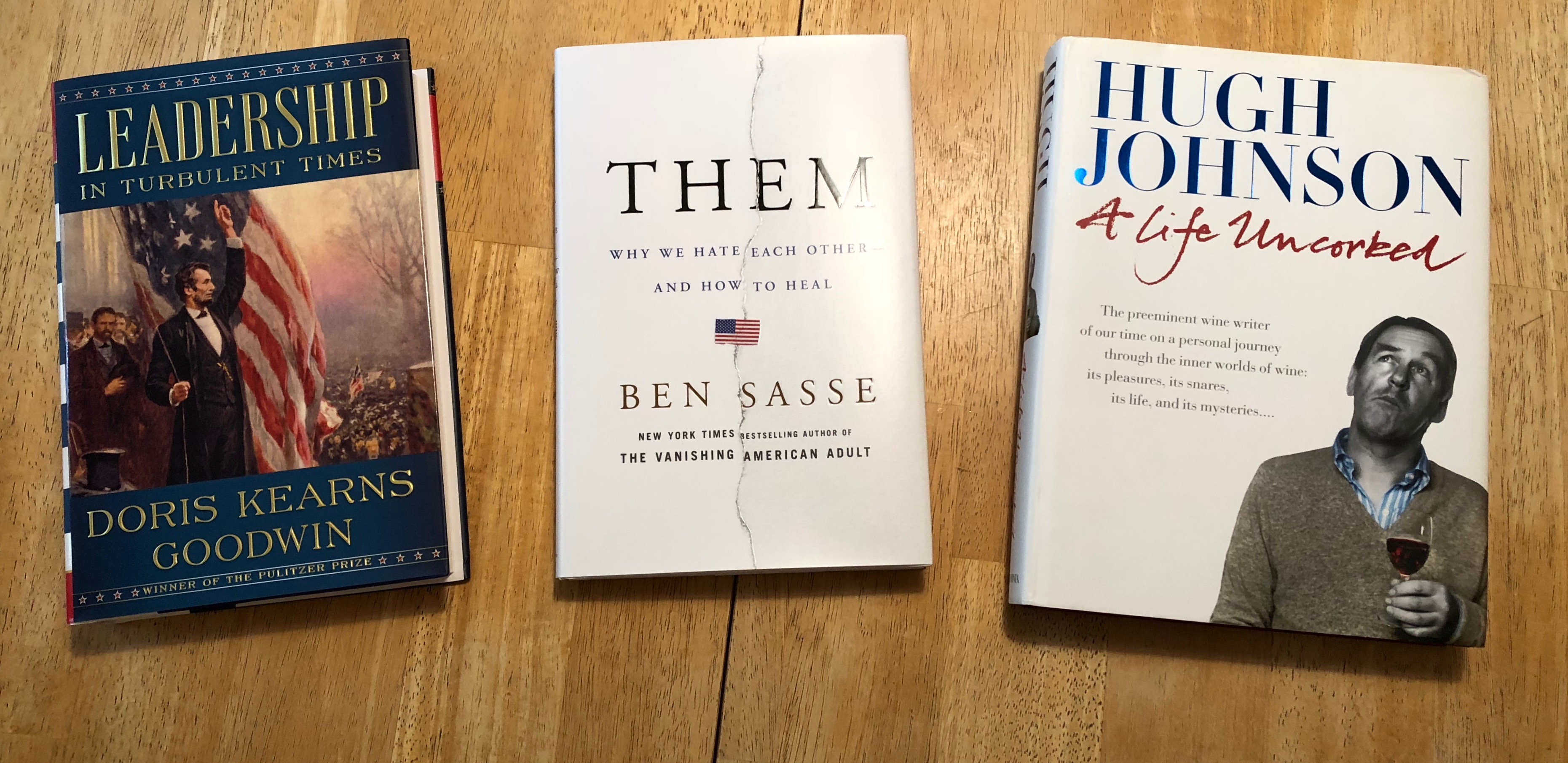
So I’ve got my reading list ready for the next month or so…or longer for me probably. It’s a short list, but a good one I think. If you haven’t considered what you’re reading going forward for the next month or so maybe you’ll consider these. Two of the books arrived from Amazon today, and I pulled one from the shelf that’s sat for a long time unread.
First, there’s Ben Sasses’s new book, Them. For the most part I find the Senator from Nebraska a relatively fair-mined man, who means well, and wants to actually solve problems, not just score partisan points. Note that Sasse is a Yale educated (PhD) historian and a former college president, so he brings a lot more than his position as a Senator to the subject matter of his book. Listening to Sasse talk about the book I think it might serve as a useful companion to two other books I’ve read: Coming Apart and Strangers in Their Own Land.
Second there is Doris Kearns Goodwin’s new book, Leadership in Turbulent Times. I can’t think of a more appropriate book or subject for those aspiring to lead or for those trying to understand what good leadership might look like during these very turbulent times in America.
And lastly, there is wine. As Ernest Hemingway wrote, “Wine is one of the most civilized things in the world and one of the most natural things of the world that has been brought to the greatest perfection, and it offers a greater range for enjoyment and appreciation than, possibly, any other purely sensory thing.”Yes, the first two books will create enough concern….and so I need some relief in a book about this most civilized of things, the wine life. Hugh Johnson’s memoir, A Life Uncorked, is about a life of drinking and thinking wine. For this short list, it seems an appropriate finish.
Recently Professor’s Amy Wax and Larry Alexander wrote an op-ed about Bourgeois culture and how, in their view, the measure of American social decline mirrors our societies falling away from Bourgeois cultural norms. Their piece has generated a small controversy that has highlighted some the problems within some of our universities.
Now if you’re asking what is “Bourgeois” (pronouced: boo r-zhwah), it’s a French word, which means, being French, it has no validity, is weak, and will flee at the first sign of a fight—which is your belief if you’re an American right winger. If you’re a left winger you pronounce the word correctly with your best French ascent and then apt your best attitude of distain for everything it stands for.
But putting humor aside, Bourgeois is the French word for middle-class culture, its norms and its values. Whatever you may feel about it, the striving to join the ranks of the Bourgeois has been in a large part of what the American dream has been all about. So along with French toast, French fries, and dear God thank you, French wine, most Americans have enjoyed tasting it!
Here’s how Wax and Alexander describe Bourgeois cultural norms in their op-ed:
That culture laid out the script we all were supposed to follow: Get married before you have children and strive to stay married for their sake. Get the education you need for gainful employment, work hard, and avoid idleness. Go the extra mile for your employer or client. Be a patriot, ready to serve the country. Be neighborly, civic-minded, and charitable. Avoid coarse language in public. Be respectful of authority. Eschew substance abuse and crime.
On it’s face, I find it very hard to disagree with them. This seems valid in a straightforward and obvious way and I think it’s confirmed by the experience of most adults. Now there is more to Bourgeois culture than this, but the above is the basic social script as Wax and Alexander see it. As academics, Wax and Alexander did some research, made some observations, developed some ideas, and then presented their opinion. The main point of Wax’s and Alexander’s piece is that not all cultural orientations (unlike Bourgeois) are as good at building the solidarity and the economic dynamism that viable democracies need to thrive.
All cultures are not equal. Or at least they are not equal in preparing people to be productive in an advanced economy. The culture of the Plains Indians was designed for nomadic hunters, but is not suited to a First World, 21st-century environment. Nor are the single-parent, antisocial habits, prevalent among some working-class whites; the anti-“acting white” rap culture of inner-city blacks; the anti-assimilation ideas gaining ground among some Hispanic immigrants. These cultural orientations are not only incompatible with what an advanced free-market economy and a viable democracy require, they are also destructive of a sense of solidarity and reciprocity among Americans. If the bourgeois cultural script — which the upper-middle class still largely observes but now hesitates to preach — cannot be widely reinstated, things are likely to get worse for us all.
The above quote was quoted by critics as insensitive and somehow proof of Wax’s and Alexander’s violation of saying and thinking something you’re not allowed (by their standard) of saying or thinking. I am perplexed at their reasoning, but so be it. Whether you agree or disagree with everything they said (above) or the way they said it, Wax and Alexander diagnosed the problem and concluded that a re-embrace of Bourgeois norms would significantly reduce our societies pathologies. That’s their opinion! And so they conclude:
But restoring the hegemony of the bourgeois culture will require the arbiters of culture — the academics, media, and Hollywood — to relinquish multicultural grievance polemics and the preening pretense of defending the downtrodden. Instead of bashing the bourgeois culture, they should return to the 1950s posture of celebrating it.
As I said, Wax and Alexander are academics. So doing research and presenting their findings, analysis, and opinions are part of what they do and it’s exactly what college professors should do. This generates debate and discussion; the forge of free societies. It challenges ways of thinking, and sometimes challenges our belief that new ways of thinking and acting are somehow better than old. Simply put, sometimes they’re not.
Again, while I may take issue with some minor points Wax and Alexander made, I find it hard to disagree with much of what they said. I’m open, however, to counter arguments and fair criticisms and would enjoy hearing them respectfully argued. Wax and Alexander have taken a lot of heat from some quarters on the left over their piece. Some of the criticisms have been downright hostile, and plenty from fellow academics and university student groups. If you believe Wax and Alexander are wrong, that’s fine. Make a reasoned and respectful argument as to why you think their wrong. But don’t assume bad faith or resort to character assassination and make demands from institutions.
Sadly what we’re seeing is a culture or university subculture where it’s not just about parrying the argument and having a rational debate, but about destroying the writer(s) or professors personally. Some of this, no doubt, can be blamed on the promotion of identity politics within the universities. This has aided in the rise of a grievance centered culture on campus. We have many on both sides of the political spectrum, to be sure, who have no problem engaging in some form of intimidation when confronted with ideas they find offensive. But right now we have a real problem with this at some of our universities in this country, the very places we shouldn’t be having a problem with debating ideas…even one’s we strongly disagree with.
For the sake of academic freedom and the flourishing of our democratic culture, I hope universities will strongly push back against this strain of intellectual and social intolerance and affirm their place as institutions of free thinking, debate, learning, and tolerance.
Plato, and before him poets like Hesiod, complained that society was going to hell. And think about it, western civilization was just getting started! Throughout the Platonic Dialogues (399 to 347 BC) there’s a sense of a longing for the past, the sense that something is being lost, that the youth (of Athens) were being corrupted by “the new ways.” The source of this corruption was the spread of immoral art (too much Homer), scientific explanations of nature (which angered the deniers), irreligiousness, and a disrespect for the old ways, i.e. tradition. So…really not much has changed.
It’s interesting because Plato isn’t really viewed as a conservative, thanks in part to Karl Marx, and yet Plato’s overall philosophy is about conserving the inherited forms of the moral and political order. Plato (through Socrates) is ultimately saying, in some form or another, that whatever you may believe it shouldn’t usurp the established moral and political order — because God knows what we’ll end up with! And for Zeus’s sake, Plato irritatingly prodded, if you’re going to challenge the traditional order, try to at least understand what you really believe and be able to explain it. Define your terms! Ask questions. Tell us how you know what you know and why it’s better than the way things are now. Because relativism — the bane of social cohesion — isn’t very solid footing!
Okay, so this brings me to David Brooks’s NYTs column lamenting the Crisis of Western Civ. Brooks starts his column by plugging one of the best set of books you can read if, and this is the big issue, you have the time. The Story of Civilization is an 11 volume set running almost 10,000 pages. Definitely not a “I’ll knock this out in a weekend” read. This is a reading project for, say, a year or two or more. Even though Will and Ariel Durant finished the series in 1975, the Story of Civilization is still one of the best liberal arts educations you can get on your own. The education is broad, the writing is excellent, and you’ll gather a whole stock of great quotes.
So back to Brook’s column. There is a Western set of values, a grand narrative — though you’d be hard-pressed to find many Western citizens who could explain it to you — that has animated the rise of Western Civilization. (Note to some of my fellow Americans reading this: You’re actually part of Western Civilization, just incase you missed that class). If ideas rule the world, as Lord Keynes assured us they do, then this set of ideas, known collectively as Western Civilization, have guided the rise of the most prosperous and free, most powerful, civilization in history. So probably not a bad idea to hold on to some of these values and ideas. But then who’s judging, that’s just so Western. Anyway, Brooks provides a brief explanation of what these Western values entail:
This Western civ narrative came with certain values — about the importance of reasoned discourse, the importance of property rights, the need for a public square that was religiously informed but not theocratically dominated. It set a standard for what great statesmanship looked like. It gave diverse people a sense of shared mission and a common vocabulary, set a framework within which political argument could happen and most important provided a set of common goals.
Now there’s a lot more to what makes up Western Civ or culture, but you get the gist. But regardless of how we define it, Brooks wants to remind us the whole project is in trouble, and has been for a while.
Starting decades ago, many people, especially in the universities, lost faith in the Western civilization narrative. They stopped teaching it, and the great cultural transmission belt broke. Now many students, if they encounter it, are taught that Western civilization is a history of oppression.
It’s amazing what far-reaching effects this has had. It is as if a prevailing wind, which powered all the ships at sea, had suddenly ceased to blow. Now various scattered enemies of those Western values have emerged, and there is apparently nobody to defend them.
Hmmm, grim. For the most part I agree with Brooks. There does appear to be some cracking in the Western Civ narrative, and generally speaking this is a bad thing for the long term health of Western Civ — if, and this is important, these cracks in the narrative are the beginnings of a break. Cracks are typical with wear and tear and require constant repair, some social and cultural chalking. But breaks are very hard to fix and mean things are definitely going to hell.
Brooks contends that the decline of Western Civ started “decades ago,” which I reasonably sure he means the 1960s. But the evidence seems to suggest, like Plato and Hesiod long ago, that the idea of cultural decline is an observation going back even further than the 1960s. The American poet and essayist T.S. Eliot, an astute observer of society, wrote these words in 1948, during the rise, please note, of the Greatest Generation: “We can assert with some confidence that our own period is one of decline. The standards of culture are lower than they were fifty years ago; and the evidences of this decline are visible in every department of human activity.” So Eliot sees decline all around him. It’s all going to hell! A Google search will reveal quotes from across Western history about the decline of society. So we can say with historical authority that the Idea of Decline is something built right into the Western narrative itself.
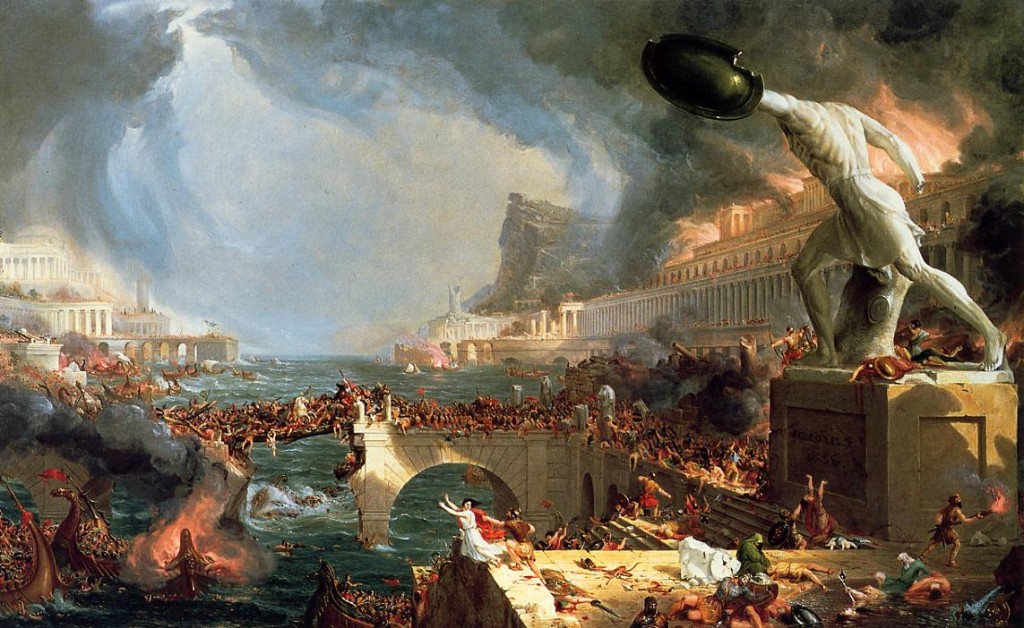
So Western Civilization is falling apart, but it seems to be taking so damn long and somehow it keeps recovering and then continues falling apart, recovering again, and then back to falling apart again. Might the current fracturing simply be symptoms of Western society going through a stage of development within Western Civilization? I might be wrong (yes, I’m hedging), but this seems very probable. Stages in the growth of a society or civilization, like with individuals, are typically disruptive events — they’re times of change, reflection, discovery, a sense of falling away from old ways, and the altering of perspective. Think of the Enlightenment. The old order, typically, isn’t going to be happy with the change. Now, of course, like Rome ultimately, the whole project could eventually fall into ruin. The course of empire and human nature has a strong tendency to assert itself. Let’s not forget, for those who paid attention in Sunday school growing up, this is a fallen world. One just doesn’t know if we’re experiencing a fall or a stumble…or a stumble leading to the fall; a crack or the beginnings of a break. Even so, remember Rome’s fall didn’t ultimately destroy Western Civilization. It turned out to be a set back, but Western Civilization ultimately recovered and marched on.
I think the real question, since the idea of decline has always been with us, is whether we’re actually facing a Germanic invasion (the cause of Rome’s immediate collapse, the beginnings of a break) or are some people simply reacting negatively, as many older generations do, to change, to the defeat of old politics and old ways, to a new generation not like them in many ways, with different ideas, and on the verge of taking power in the society. With new perspectives comes change in the moral and political order. It’s unavoidable. But does that mean the new generation is giving up on Western values? Does this mean we’re seeing the end of Western Civilization? Or is the new generation simply reinterpreting these Western values in light of their experience? Hasn’t every generation in Western history, to some degree, done this?
These are my thoughts as I sit here drinking coffee this morning. I’m trying to remain positive as you can see. But hey, tomorrow, after scanning my Facebook feed, I might think it’s all definitely going to hell!
This past Sunday, the Washington Post had an interesting piece by Bill Bishop. If you don’t know Bishop, and you have an interest in understanding American’s current social and political problems, then I suggest you pick up his book The Big Sort. It really is one of the best books I’ve read in the past 10 years. It’s was a fascinating read.
In this past Sunday’s piece, Bishop looks at why our trust in institutions is at such a low level. In 1964 roughly 75% of the American public trusted their government to do the right thing. By 1976 that trust level was down to 33%. A big swing in 12 years. Now, during that period we had the assassination of 2 major national figures, civil rights unrest, a major political realignment, an unpopular war, and the resignation of Richard Nixon over the Watergate scandal. But while all of these things may have added to a decline in trusting government, they aren’t, Bishop argues, the real story here.
Bishop points to two big trends in recent history. First, the decline in people trusting their government parallels a “falling trust in nearly ever institution,” both public and private. So it’s not just the government we’re talking about here, we need to be clear on that. Second, this trust deficit, though maybe not as bad as it is in the U.S., is a trend across most industrial democracies. So it’s not just America either.
Americans may have less trust in their government, but they’re also walking away (no longer trusting or wanting to be involved with) from organized religion and many other civic associations that use to serve in helping unify us. Bishop sees expanding diversity, the welfare state, and rising wealth as social engines that have brought about an “Enlightenment Individuality” in our society, which in many ways is inimical to the maintenance of community and trust. More than ever people are “artists of their own lives,” shedding traditions and cultural norms. While this is liberating in many ways, it’s also, when taken in the large, socially disrupting because it weakens social cohesion.
The interesting point, from a historical perspective, is that this trend is something much older than we think. Where ever there is an intersection of commerce, wealth, culture and diversity, you will have this pull toward “negation.”
As far back as the 1600s, travelers confronted by new cultures and novel deities began to question their own societies’ rules and institutions. “Not a tradition which escapes challenge, not an idea, however familiar, which is not assailed; not an authority that is allowed to stand,” historian Paul Hazard wrote. “Institutions of every kind are demolished, and negation is the order of the day.” This was the Enlightenment, a turning away from tradition and an anointing of reason, scientific inquiry and individualism.
And so while some people may point to Donald Trump as the personification of a movement against the so called “establishment,” it’s far more accurate to say he’s simply riding a wave, a historical trend that has little to do with him at all.
Bishop finishes his piece by saying there really isn’t anything we can do about this. Personally I think he’s wrong on that point. It will take, as William Hazlitt said, “a lot of fine writing,” strong leadership, good will and good government, all things in very short supply right now, to push this long term trend in another direction. But it can be done.

 Jeff Wills