Making George Orwell Great Again

george-orwell
George Orwell

The new Trump Administration has been a boon for sales of George Orwell’s book 1984. The novel is a literary masterpiece. Originally published in 1949, it’s a dystopian novel about authoritarianism. The most famous quote, which you’ve probably heard at one time or another, is “Big brother is watching you.” The novel introduces us to concepts like Newspeakdoublethink, and thoughtcrime. The decades old novel is suddenly back on the bestseller list (an Amazon #1 recently) because some of the book’s ideas are speaking to us at this unique time in American history. What this book does, or I should say what all good literature does, is provide us with a vocabulary for articulating our feelings and thoughts. Being able to speak about something allows us to better understand it. Freedom of thought, as the novel tells us, is partly brought about by an expansion of expression via language. Thought and language are tied together.

This brings me to a general theme in Orwell’s work. Like every good writer Orwell was concerned with the truth. For example, Orwell had fought in the Spanish civil war on the side of the Republic against the fascist. He had personally witnessed some of the key events in the war. After the war, he’d read a lot of reports about the war and found a lot of what he’d read contained blatant falsehoods. He knew what was happening. The fascist had ultimately won the Spanish civil war and they were now attempting to shape its history through propaganda…or as Orwell might say, they were purposely trying to create its fascist history. Authoritarian leaders, i.e. Franco, Hitler, and Stalin, where not just trying to control the present and the future, but also the past. Propaganda and lies were replacing history and fact and what actually happened. This terrified Orwell:

This kind of thing is frightening to me, because it often gives me the feeling that the very concept of objective truth is fading out of the world. . . . Nazi theory indeed specifically denies that such a thing as ‘the truth’ exists. There is, for instance, no such thing as ‘Science’. There is only ‘German Science’, ‘Jewish Science’, etc. The implied objective of this line of thought is a nightmare world in which the Leader, or some ruling clique, controls not only the future but the past. If the Leader says of such and such an event, ‘It never happened’ — well, it never happened. If he says that two and two are five — well, two and two are five. This prospect frightens me much more than bombs — and after our experiences of the last few years that is not a frivolous statement. (Underlining added)

I’ve read the entire 3 inch thick volume of the Everyman’s Library edition of George Orwell’s essays. It’s one of my top 5 all time favorite books. While Orwell’s novels are excellent, it’s in Orwell’s essays that I believe we get the best of Orwell as a writer and social critic. His essays are a first class education in the humanities and writing. Take my word on that. We could have a college level course just on Orwell’s essays and it would be a fascinating intellectual and moral adventure.

Being Orwellian, I think, should also mean having a scrupulous concern for precision, integrity, and facts in the way you think, write, and speak. The truth is usually complex and sometimes very difficult to get at, but it can only be genuinely approached through a moral courage and intellectual integrity we see on constant display in writer’s like George Orwell.
Good finds!


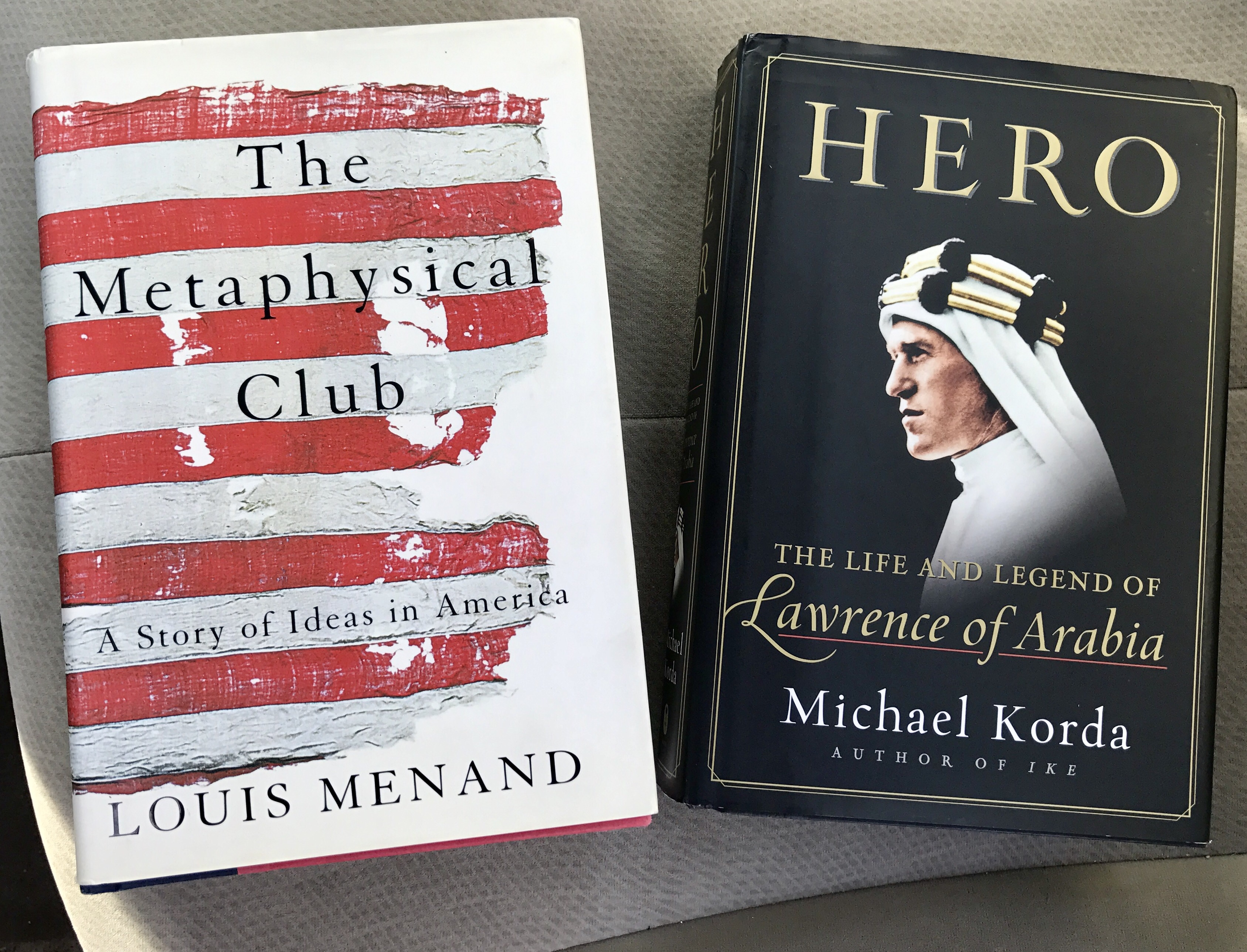
Found these two at a local used bookstore today. The Metaphysical Club won the Pulitzer Prize the year it was released. Menand is also an accomplished essayist. I’ve always been fascinated by pragmatism since reading William James’s work. Metaphysical Club elaborates elegantly on the origins of this American philosophy.

I studied management and leadership at undergraduate (and graduate) school and one of the books I reviewed as part of a course was T. E. Lawrence’s 7 Pillars of Wisdom. That was a very interesting book. I remember thinking I needed to find a good biography on Lawrence. So finally, many years later, I’ve finally picked one up for cheap. Great finds!

What Our Book Collections Can Tell Us About Ourselves

In a good bookroom you feel in some mysterious way that you are absorbing the wisdom contained in all the books through your skin, without even opening them. — Mark Twain


img_1605
From my Collection

I have a small study in my house. Well, it would be better to say I have a room in my house with books on shelves, books in boxes, and books stacked on a French Avignon desk that I don’t use. We moved into this house over a decade ago and I told my wife then, patient and tolerant woman that she is, that “You go ahead and decorate and finish all the other rooms first and then we’ll do my study last.” Well, as with various other projects around the house, I never followed through. I had grandiose ideas about my new study and what it would mean when we moved into our new house. “I would,” as Michael Dirda quipped “of course, wear a velvet jacket at my desk, take breakfast in the conservatory, and in the late afternoon go for long walks on graveled paths.” I know, that’s pathetic.

Anyway, the truth is I’m either sitting at the kitchen table or in a chair in our bedroom when I write (or read) at home. Oh, and I don’t have any graveled paths to walk on either. My study, or “bookroom” really, is just storage space for me to wander through (or trip), while searching for a book or just casually picking up books and dipping into them to get a taste of the author’s prose or find some inspiration. My bookroom ramblings remind me of a fine quote by Churchill, that nicely captures my state of mind:

“If you cannot read all your books…fondle them—peer into them, let them fall open where they will, read from the first sentence that arrests the eye, set them back on the shelves with your own hands, arrange them on your own plan so that you at least know where they are. Let them be your friends; let them, at any rate, be your acquaintances.” — Winston Churchill

IMG_0321
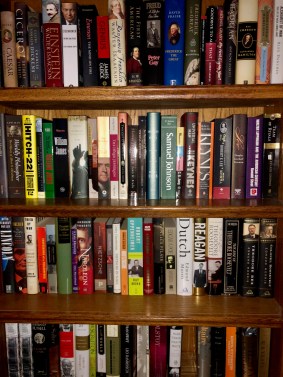
Part of my Biography Collection

Recently I decided to organize my books a little better. Instead of strictly by author, I organized them into large categories like history, philosophy, economics, etc, etc. A novel idea, I know. Of course this process, as I sifted through the boxes and shelves, forced me to see (by stack size, and word count) exactly what category had won my interests and taxed our budget over the years. In my case the winner, by sheer numbers and thickness of books, is biography. I’ve definitely read a lot of them over the decades.

Maybe it’s partially in the blood. My mother loves biographies and has a small collection herself. For me, I don’t know exactly when biography became my favorite genre, but I can remember two books that probably had the biggest influence on me early on in my reading life. Many years ago I read James Boswell’s biography of Samuel Johnson. Yes, I read the entire unabridged 1402 pages of the Oxford World Classic edition. I’m a slow reader, so believe me that took a while! But it was a great reading experience. Boswell’s biography was full of wit—which Johnson excelled at—and wisdom and fascinating details about 18th century English culture and art. It’s definitely a classic. I came away totally fascinated by Johnson’s unique life and powerfully quick, creative, and intelligent mind.

Boswell’s biography led me to Walter Jackson Bate’s biography of Samuel Johnson. This was an absolutely absorbing book and a captivating literary experience. I had no idea, at that point in my reading life, that biography could be so compelling, instructive, and psychologically insightful. I completed Bate’s biography of Johnson feeling my perspective on life and the dynamics of human potential had changed. It was, properly speaking, literature that inspired a reverence for the power of literature to alter how we see the world. The book, by the way, won all 3 of the major American literary prizes, something that rarely happens.

The next biggest book category in my study appeared to be classical history, followed by literature (mostly essay collections), general history, leadership, psychology, civil war, and economics. And of course I have a large collection of what can be called general non-fiction. Books by, say, Malcolm Gladwell would fall into the category. My collection of novels is not what it use to be. I actually don’t read that many novels anymore I’m sad to admit. My time is limited, as you can tell by the rather spare postings on this blog (hoping to change that), and so I need to prioritize my reading to make room for writing.

If there is anything I’m reminded of from reorganizing my bookroom, it’s that the books we collect don’t just represent what we like to read, but also through what discipline (or category) we enjoy discovery. For me, I’m attracted to biography, the story of people’s lives. It’s this form of literature that’s had the biggest influence in shaping how I’ve learned about the world. “I esteem biography,” Samuel Johnson said, “as giving us what comes near to ourselves, what we can turn to use.” I for one have always loved this quote and, as my bookshelves can attest, taken it to heart.

The Lincoln Bible

For over 25 years I’ve been fortunate to have worked in one of the most unique and impressive, if sometimes notorious, places on the planet: The U.S. Capitol or “Capitol Hill.” I realize there are many negative things we could say about the U.S. Congress, I suspect that’s always been the case, but if we’re honest with our mostly hypocritical and righteous selves we’d admit the problems are just a reflection of us, the mostly fickle, many times ill informed voter. But enough of that. I’ll save a elaboration on those thoughts for another time. 

For now, I’d like to note my thoughts on an experience I had at the Library of Congress recently. But before I go on about that let me provide some background.

Let’s go back a little in history for a moment. In the lead up to Abraham Lincoln’s first inauguration (March 4, 1861), the federal government believed there was an assassination plot against President-elect Lincoln. Because of this, the President-elect arrived in Washington DC, via train, under the cover of darkness. In the rush to get Lincoln into Washington during the night, Lincoln’s baggage was misplaced and along with it the Lincoln family Bible. The bags and the Bible would not make it to Washington in time for the inauguration and swearing-in ceremony at the U.S. Capitol Building.

abraham_lincoln_inauguration_1861
(Image credit: Wikipedia) U.S Capitol Building: Lincoln’s First Inauguration, March 4, 1861

Saving the day was the Clerk of the Supreme Court, William Thomas Carroll, who provided a Bible he’d kept for official occasions. And it was this Bible, which Abraham Lincoln would place his left hand on and take the official oath of office, that became known as The Lincoln Bible. The only other U.S President to use the Lincoln Bible for the oath of office was President Barack Obama for both of his swearing-in ceremonies in 2009 and 2013. And then recently, September 14, 2016, the newly appointed Librarian of Congress, Carla Hayden, used the Lincoln Bible for her swearing-in ceremony. It was just prior, literally maybe 20 minutes, to Carla Hayden’s swearing-in that I got my chance for a personal viewing of the Lincoln Bible.

Reverence. In some sense, I think, reverence for events, people, or things that serve as important connections to the past is a waning virtue right now in our history. The “mystic chords of memory,” to quote Lincoln, connect us to a shared fate and a shared destiny.

I believe, have always felt, that some things should invoke a feeling of respect for great things and people and the sacrifices made in forming this great, if not perfect, nation. There’s a good reason the constitution begins with the words “to form a more perfect union.” A perfect union wasn’t possible. From the very beginning the founding of this nation was a compromise deal. The nation’s birth was only the beginning of a task, a continual building and improvement upon an experiment in democracy. The task of improving, of making a more perfect union, would always be the task of those who’d inherited this Democratic Republic. Abraham Lincoln’s presidency, and the civil war brought on by it, were the first great test to determine whether this experiment in democracy, this union, this “nation so conceived,” could be saved and preserved through the growing pains of forming a more perfect union. Lincoln and his vision, his leadership, thank God, prevailed. 

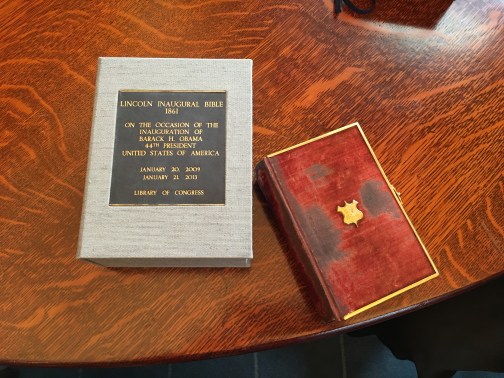
And so there I was, standing there listening to Mark (a Library curator and guardian of the Bible) give me a brief history of the Lincoln Bible. I actually stepped up to the table and stood for a moment almost as if I were viewing a deceased friend or loved one at a wake. I looked down on the Bible and thought of the so many events and people that have come and gone since Lincoln laid his left hand on this Bible and took the oath of office and then, after his destiny complete, passed into “the ages.” 

img_3922
Image Credit: Jeff Wills

What immediately grabs you about the Lincoln Bible is how small it is. The Bible is an 1853 Oxford Press KJV edition. It’s 6 inches long by 4 inches wide and about 1.75 inches thick. The Bible is bounded in a burgundy red velvet with gilt edges. The front cover is stained, worn, and faded with blackened stains along the spines edge. I thought of Lincoln’s left hand resting on the Bible as he began to recite the oath, the emotions he must have felt, and how his mind must have been occupied with the gathering storm of rebellion. And I thought of all the subsequent people who’ve held this Bible and reflected on Lincoln, his times, and what his presidency and leadership meant to the nation.

For those brief but solemn moments I felt privileged for this opportunity to be touched by those mystic chords of memory.

Reading Biography

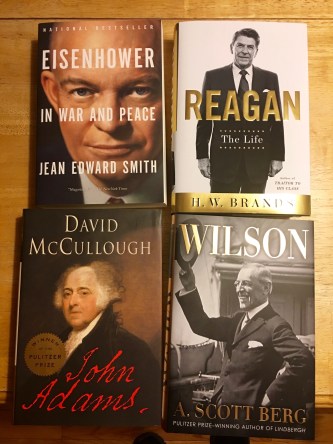
A colleague at work gave me these 4 autographed biographies of American presidents.

IMG_3588

These books arrived at my office after a meeting where business and the pleasure of reading seem to go naturally together. My colleague had obviously discovered my love of books and thought she’d indulge it. We didn’t talk about any particular genre so I was pleasantly surprised to be given 4 biographies, my favorite kind of reading.

The great English lexicographer and essayist, Samuel Johnson, once said: “I esteem biography, as giving us what comes near to ourselves, what we can turn to use.” By studying the lives of other people, specifically those who’ve risen to great renown, we can learn a lot about the workings of human excellence and human vice. We can put to use what we learn from these biographies in our own lives.

Humanities departments have long argued that one of the best ways to improve yourself, both morally and culturally, is to study the arts and literature; more specifically novels and other works of the imagination. By experiencing the world imaginatively through the lives of others we’re able to sympathize, to “move with” them, as our protagonists experience the world, its triumphs, trials, and tribulations. It’s through this sympathetic process that we expand our own moral and cultural horizons. We understand them and ourselves better. This has the potential to create new intellectual and moral connections we did not have before. We grow.

In the modern age biography has replaced the novel in this respect. Just notice how the fiction section of the Barnes and Noble Book Shop is shrinking and the biography section is expanding. Most modern biographers write their story with the skill of a good novelists, and with biography you’re dealing with facts, with characters from history, not fiction. I think there’s a greater demand these days for the literature of fact, because it touches our need for what P.G. Wodehouse once said about good conversation being “a feast of reason and a flow of soul.”