“A reader lives a thousand lives before he dies,” said Jojen. “The man who never reads lives only one.” — George R.R. Martin, A Dance with Dragons
Sometimes when I’m reading a good book I pause for a moment to think over a very insightful passage or section I’ve just completed. Something I’m sure all serious readers do. For me, the writer has connected a number of ideas and has set my mind to work reflecting on its larger significance. This, for me, is what true education is about. From time to time, I write my reflections in a journal or jot a note on a piece of paper and insert it in the back of the book. Recently, while going through some books in my bookroom, I found a piece of paper, a reflection, folded in the back of a biography I’d read years ago with the following written on it:
It is human personality that most interest us. All through the great writings of classical authors we are most moved by greatly drawn characters. The result of characters bumping up against circumstance and how individuals respond, this is what makes literature so powerful and meaningful. Think of Plutarch, Dickens, and Twain, these authors bring characters to life on the page. They live in our mind, if only briefly, sharing, in some sense giving us the experience of their emotions, their hopes, and their tragedies. We move with them. We learn through a process of association and empathy. Feeling—empathically—what has happened to others allows us to connect with people across time and space. We share in their humanity. We learn. It is through this process that we can hold hands with the past.
I cannot recall ever having an inferiority complex. By that I mean I don’t recall ever experiencing a sustained feeling that someone else’s greater natural or acquired status, intellect, talent, or abilities, in any way diminished me—that because I was not so endowed, I must be made of lesser clay. That’s not to say I haven’t felt envy from time to time, or that I haven’t felt inadequate for some task. I certainly have. Knowing my limitations, and accepting them, seems to me the better part of maturity and happiness.
On the flip side, I have experienced people who have a finely tuned superiority complex. I’m sure you know the type; they have the air of someone who wants you to think they’re naturally superior. Candidly speaking, I’m usually not bothered by these people. I’m actually rather amused…and curious.
The snobbery of wealth is typically hollow and fake, there’s usually not much depth there. You find out quickly in conversation. There are no spiritual or mental qualities worth admiring in money snobs. And typically speaking, they’re terrible bores, because they’ve got big pockets but not usually big minds or souls. The snobbery of beauty is, well, skin deep. We may find the snobbery unattractive and off-putting, even if we can’t help but admire the beauty.
A truly cultured and refined intellect or artistic sense…now that’s something different. The snobbery is bad and, yes, off-putting. But unlike the rich or the beauty snob, the intellectual or artistic snob may have something to truly offer beyond mere show. Their snobbery, in part, may actually be justified. Not in the class sense or “I’m superior than you” sense, but in the “I’m unique” sense. I have no problem recognizing and admiring superior minds. I’d like to think engaging these minds is good for my own. If you’re an avid reader, especially of the Great Books, you’re use to getting past the ephemeral and detritus of human folly and admiring the enduring gems of wisdom and art. If we seek a life of depth and meaning we cannot get “caught up in the thick of thin things.”* We must move past it to what truly matters.
I should note that I’m not saying that being a snob, in any way, is a good thing, because it’s not. I’m just saying that some self-regard may be deserved, even if most of the time, I find, it’s not. I’m saying that sometimes truly gifted people may be a snobs, but I don’t let that distract me from enjoying and learning from engagement with their mind—which is the only part of them you can truly learn anything of lasting value. I can look past the petty, even inwardly laugh at it sometimes, to recognize something unique and take from it those gems that edify my own mind and soul.
Plato, and before him poets like Hesiod, complained that society was going to hell. And think about it, western civilization was just getting started! Throughout the Platonic Dialogues (399 to 347 BC) there’s a sense of a longing for the past, the sense that something is being lost, that the youth (of Athens) were being corrupted by “the new ways.” The source of this corruption was the spread of immoral art (too much Homer), scientific explanations of nature (which angered the deniers), irreligiousness, and a disrespect for the old ways, i.e. tradition. So…really not much has changed.
It’s interesting because Plato isn’t really viewed as a conservative, thanks in part to Karl Marx, and yet Plato’s overall philosophy is about conserving the inherited forms of the moral and political order. Plato (through Socrates) is ultimately saying, in some form or another, that whatever you may believe it shouldn’t usurp the established moral and political order — because God knows what we’ll end up with! And for Zeus’s sake, Plato irritatingly prodded, if you’re going to challenge the traditional order, try to at least understand what you really believe and be able to explain it. Define your terms! Ask questions. Tell us how you know what you know and why it’s better than the way things are now. Because relativism — the bane of social cohesion — isn’t very solid footing!
Okay, so this brings me to David Brooks’s NYTs column lamenting the Crisis of Western Civ. Brooks starts his column by plugging one of the best set of books you can read if, and this is the big issue, you have the time. The Story of Civilization is an 11 volume set running almost 10,000 pages. Definitely not a “I’ll knock this out in a weekend” read. This is a reading project for, say, a year or two or more. Even though Will and Ariel Durant finished the series in 1975, the Story of Civilization is still one of the best liberal arts educations you can get on your own. The education is broad, the writing is excellent, and you’ll gather a whole stock of great quotes.
So back to Brook’s column. There is a Western set of values, a grand narrative — though you’d be hard-pressed to find many Western citizens who could explain it to you — that has animated the rise of Western Civilization. (Note to some of my fellow Americans reading this: You’re actually part of Western Civilization, just incase you missed that class). If ideas rule the world, as Lord Keynes assured us they do, then this set of ideas, known collectively as Western Civilization, have guided the rise of the most prosperous and free, most powerful, civilization in history. So probably not a bad idea to hold on to some of these values and ideas. But then who’s judging, that’s just so Western. Anyway, Brooks provides a brief explanation of what these Western values entail:
This Western civ narrative came with certain values — about the importance of reasoned discourse, the importance of property rights, the need for a public square that was religiously informed but not theocratically dominated. It set a standard for what great statesmanship looked like. It gave diverse people a sense of shared mission and a common vocabulary, set a framework within which political argument could happen and most important provided a set of common goals.
Now there’s a lot more to what makes up Western Civ or culture, but you get the gist. But regardless of how we define it, Brooks wants to remind us the whole project is in trouble, and has been for a while.
Starting decades ago, many people, especially in the universities, lost faith in the Western civilization narrative. They stopped teaching it, and the great cultural transmission belt broke. Now many students, if they encounter it, are taught that Western civilization is a history of oppression.
It’s amazing what far-reaching effects this has had. It is as if a prevailing wind, which powered all the ships at sea, had suddenly ceased to blow. Now various scattered enemies of those Western values have emerged, and there is apparently nobody to defend them.
Hmmm, grim. For the most part I agree with Brooks. There does appear to be some cracking in the Western Civ narrative, and generally speaking this is a bad thing for the long term health of Western Civ — if, and this is important, these cracks in the narrative are the beginnings of a break. Cracks are typical with wear and tear and require constant repair, some social and cultural chalking. But breaks are very hard to fix and mean things are definitely going to hell.
Brooks contends that the decline of Western Civ started “decades ago,” which I reasonably sure he means the 1960s. But the evidence seems to suggest, like Plato and Hesiod long ago, that the idea of cultural decline is an observation going back even further than the 1960s. The American poet and essayist T.S. Eliot, an astute observer of society, wrote these words in 1948, during the rise, please note, of the Greatest Generation: “We can assert with some confidence that our own period is one of decline. The standards of culture are lower than they were fifty years ago; and the evidences of this decline are visible in every department of human activity.” So Eliot sees decline all around him. It’s all going to hell! A Google search will reveal quotes from across Western history about the decline of society. So we can say with historical authority that the Idea of Decline is something built right into the Western narrative itself.
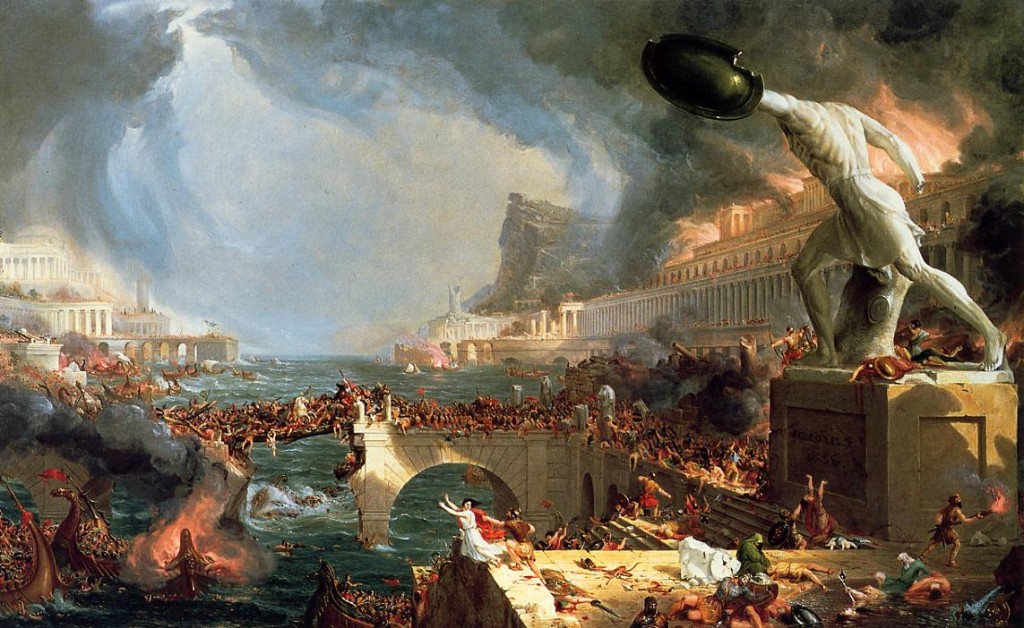
So Western Civilization is falling apart, but it seems to be taking so damn long and somehow it keeps recovering and then continues falling apart, recovering again, and then back to falling apart again. Might the current fracturing simply be symptoms of Western society going through a stage of development within Western Civilization? I might be wrong (yes, I’m hedging), but this seems very probable. Stages in the growth of a society or civilization, like with individuals, are typically disruptive events — they’re times of change, reflection, discovery, a sense of falling away from old ways, and the altering of perspective. Think of the Enlightenment. The old order, typically, isn’t going to be happy with the change. Now, of course, like Rome ultimately, the whole project could eventually fall into ruin. The course of empire and human nature has a strong tendency to assert itself. Let’s not forget, for those who paid attention in Sunday school growing up, this is a fallen world. One just doesn’t know if we’re experiencing a fall or a stumble…or a stumble leading to the fall; a crack or the beginnings of a break. Even so, remember Rome’s fall didn’t ultimately destroy Western Civilization. It turned out to be a set back, but Western Civilization ultimately recovered and marched on.
I think the real question, since the idea of decline has always been with us, is whether we’re actually facing a Germanic invasion (the cause of Rome’s immediate collapse, the beginnings of a break) or are some people simply reacting negatively, as many older generations do, to change, to the defeat of old politics and old ways, to a new generation not like them in many ways, with different ideas, and on the verge of taking power in the society. With new perspectives comes change in the moral and political order. It’s unavoidable. But does that mean the new generation is giving up on Western values? Does this mean we’re seeing the end of Western Civilization? Or is the new generation simply reinterpreting these Western values in light of their experience? Hasn’t every generation in Western history, to some degree, done this?
These are my thoughts as I sit here drinking coffee this morning. I’m trying to remain positive as you can see. But hey, tomorrow, after scanning my Facebook feed, I might think it’s all definitely going to hell!
Sitting alone this morning, listening to the sound of the water lapping against the dock, the faint sound of birds chirping, feeling the nice temperate air, enjoying the smell of coffee, and loving a good book. 😃📚
There is no shortage of people calling for more “deregulation” or for the dismantling (“the doing away with”) of entire government agencies. There is always a natural agitation to clear away rules and governing oversight, any “fence” that stands in our way.
But most laws, rules & regulations, and institutions of government come into existence after years, sometimes decades, of experience and debate. There is usually a good reason. There is a history that outlines why we have them. We need to know the exact history of why we have these institutions, laws or regulations, and the implications of not having them, before we tear them down. It may be that doing away with the fence doesn’t free the lambs so much as it fattens the wolves.
And so anytime we hear calls for reforming or removing any law, rule, regulation, or government institution we’d be wise to consider the principle of [G.K.] Chesterton’s Fence:
“In the matter of reforming things, as distinct from deforming them, there is one plain and simple principle; a principle which will probably be called a paradox. There exists in such a case a certain institution or law; let us say, for the sake of simplicity, a fence or gate erected across a road. The more modern type of reformer goes gaily up to it and says, ‘I don’t see the use of this; let us clear it away.’ To which the more intelligent type of reformer will do well to answer: ‘If you don’t see the use of it, I certainly won’t let you clear it away. Go away and think. Then, when you can come back and tell me that you do see the use of it, I may allow you to destroy it.'”



 Jeff Wills