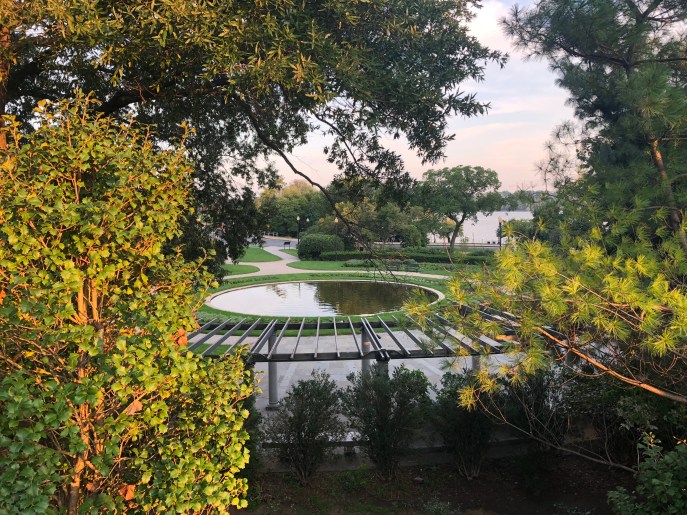
One of the nice things about early morning jogs on the National Mall is all the small gardens and memorials you come across by happenstance. This morning, because of a construction project blocking my normal path, I was detoured down some steps and into a small garden tucked away near the 14th street bridge along the Potomac river.
George Mason Memorial (Photo by Jeff Wills)
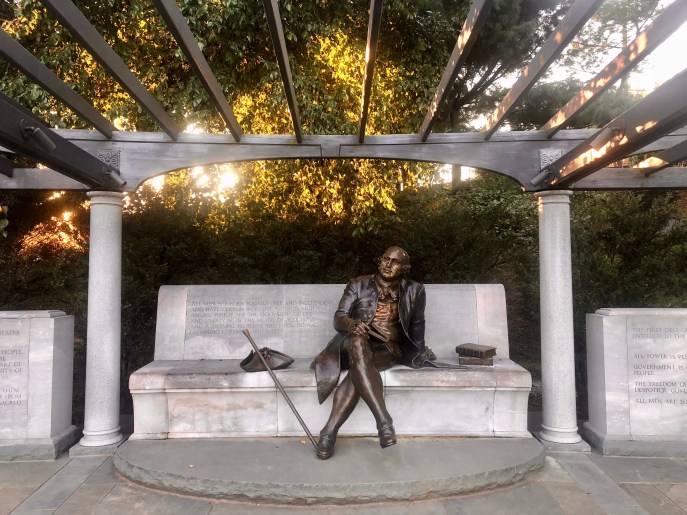
It’s a beautiful memorial garden dedicated to George Mason of colonial Virginia, one of the Founding Fathers of the United States. A life size bronze statue of Mason sits on a stone bench beneath a long trellis that curves along the southern end of the garden.
Statue of George Mason (Photo by Jeff Wills)
Mason appears relaxed and contemplative. On the bench to his right is his hat and walking stick, and on his left are two books; one by John Locke and the other by Jean-Jacques Rousseau.
Mason was one of the three Virginia delegates to the constitutional convention of 1787 who refused to sign the final draft of the Constitution. Mason actually wrote a paper entitled Objections to this Constitution of Government. Mason cited a lack of a Bill of Rights as his chief concern. But he also wanted an immediate end to the slave trade. He would eventually get his Bill of Rights when they were introduced by James Madison during the First Congress of 1789. The slave trade with America would not end until 1808, and, of course, slavery within the United States would not end until the Civil War.
It was George Mason, by the way, who gave Virginia its official title of the Commonwealth of Virginia. For Mason the state’s name would indicate that power stemmed from the people.
You may have noticed some writing to the left of Mason’s statue, engraved in the stone on the back of the bench. Let me note, these words were written before the Declaration of Independence was published in July of 1776.* The words just might ring familiar to you:
All men are born equally free and independent, and have certain inherent natural rights…among which are the enjoyment of life and liberty, with the means of acquiring and possessing property, and pursuing and obtaining happiness and safety.
— George Mason, May 1776
*The Declaration of Independence was written over the period between June 11th and July 4th of 1776.
This past Thursday’s Senate hearing was, as expected, a spectacle. I won’t go too deep into the politics and the performances, i. e. Senator Lindsey Graham, of those on the Senate Judiciary Committee, but I did want to note something I found disturbing.
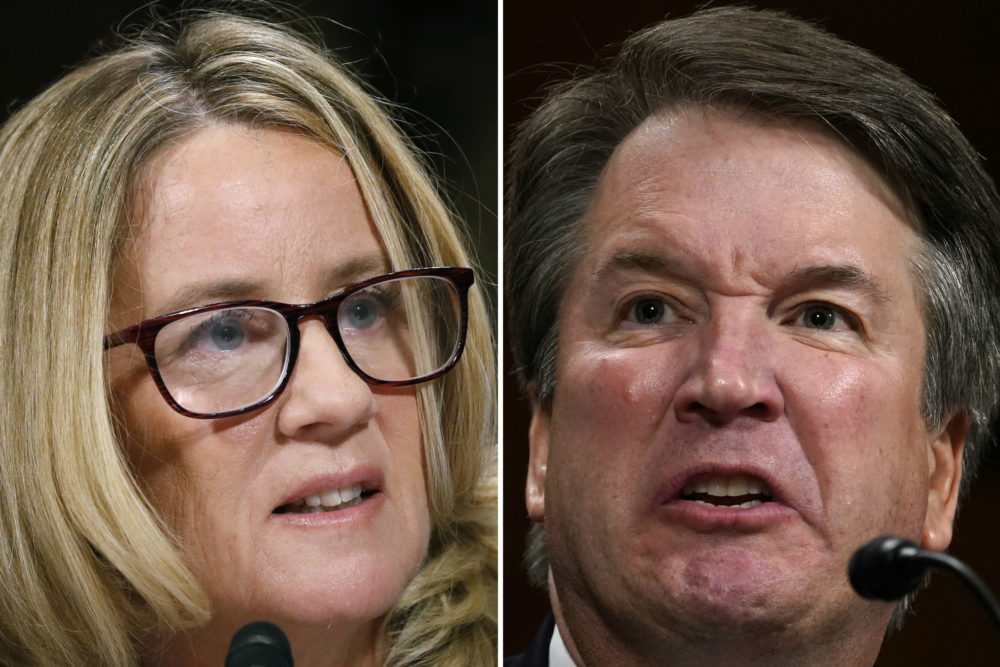
Dr. Ford gave very credible testimony in which she said she was “100% sure” that Judge Brett Kavanaugh had sexually assaulted her decades ago. She was poised for the most part and provided specific details. She made an allegation, but beyond that we have no corroborating evidence to back up her allegation. From a legal standpoint that’s important. No one should ever face legal jeopardy over an uncorroborated allegation. But let’s be clear, these Senate hearings aren’t legal proceedings. This is a political process. These confirmation hearings are about fitness for office and that is the central question under consideration.
So we heard from Dr. Ford. She made an allegation. She has the right to make that allegation, and we should want to hear and assess what she has to say against a nominee who’s being considered for a lifetime appointment to the highest court in the land. And since the Court, as with Congress, has itself gotten so highly partisan and dysfunctional we should be highly concerned about not making it even more so. I would argue that all this “he (or she) is qualified for the job” talk is trivial and beside the point in considering any nominee for any federal court. Most nominees that come before Senate confirmation are “highly qualified.” But being qualified is basic. It’s pretty damn clear the nominations are made with party politics in mind, not judicial independence. In fact, a solid record of judicial independence, of not towing the ideological line, is likely to get your name removed from consideration. So a judge’s politics has a big play in all this…and we should all be concerned with just how much it plays into a judge’s decision making.
And this brings me to my concerns about Judge Brett Kavanaugh. At first, prior to Thursday’s testimony of Ford and Kavanaugh, my feelings were that unless we have some corroborating evidence we should not sink a nomination over an allegation. We should take this allegation seriously, but fundamental fairness to the accused is fundamentally more important in my view. Because any of us can be unjustly accused. People, I know this may be hard to believe, will sometimes lie to destroy other people. To be clear, I’m not saying Dr. Ford is lying, only that in my view you should have more than an uncorroborated allegation before you decide to act against someone. And that was my view before Thursday.
But then came Brett Kavanaugh’s Thursday testimony before the committee, and another area of concern about his fitness for office emerged in my view. I completely understand why Judge Kavanaugh would be angry over Dr. Ford’s earlier testimony before the committee. Kavanaugh believed he’d been unjustly slandered. I’d be angry too. But in defending himself Kavanaugh went too far in my view. You see, as Kavanaugh began talking, at first, I was very sympathetic and felt Kavanaugh’s nomination should be confirmed. But then he crossed a line. He began to heave hyper partisan attacks on democratic members of the committee and even claim some conspiracy by the Clintons and other left wing groups. He did most of this on the edge of a barely constrained rage. And with that my support for his nomination melted away.
And here’s why: Kavanaugh is being appointed to a lifetime position on the highest court in the land. His demeanor and temperament are absolutely part of any assessment for this office. Judge Kavanaugh is not new to Washington politics and knows exactly why he was nominated—because of his “conservative credentials.” So he’s no choir boy about the implications of his appointment for those who aren’t so conservative and those who vehemently disagree with his judicial philosophy. Kavanaugh knows full well that confirmations are a political process, which means it can be a blood sport. There’s a lot at stake and Kavanaugh knew this fully.
So what should he have done? Well, he should have vehemently defended himself, sure, but he should have demonstrated far greater restraint. America doesn’t need another supreme court justice who’s confirmed for all of us a deeply held animus for members of the political opposition—who represent, by the way, millions of his fellow Americans. Just imagine how Republicans would react if the shoe was on the other foot. We already knew why Kavanaugh was being nominated, but most of us, I think, had a faint hope that all judges might, just might, be able to sometimes put politics aside for the sake of the nation when forming their judicial opinions. I guess I’d like to believe that while Judge Kavanaugh may have a conservative judicial philosophy (and that’s fine) he could be independent minded and not a mere partisan in a black robe. But by any charitable account, Kavanaugh made it clear he has a deeply held animus against members of the democratic party and that he will carry this animus to the supreme court with him. I don’t care what your politics are, I personally don’t think it’s a good idea to confirm a judge knowing the very basic idea of fundamental fairness, independence, and the impartiality of the nominee are in serious question.
Canon 1: A Judge Should Uphold the Integrity and Independence of the Judiciary
An independent and honorable judiciary is indispensable to justice in our society. A judge should maintain and enforce high standards of conduct and should personally observe those standards, so that the integrity and independence of the judiciary may be preserved. . . Deference to the judgments and rulings of courts depends on public confidence in the integrity and independence of judges. The integrity and independence of judges depend in turn on their acting without fear or favor.
&
Canon 2: A Judge Should Avoid Impropriety and the Appearance of Impropriety in all Activities
(B) Outside Influence. A judge should not allow family, social, political, financial, or other relationships to influence judicial conduct or judgment. A judge should neither lend the prestige of the judicial office to advance the private interests of the judge or others nor convey or permit others to convey the impression that they are in a special position to influence the judge.
I cannot see how anyone could watch Judge Kavanaugh’s testimony this past Thursday and not feel that his fairness, independence, and impartially had been seriously compromised.
The members of the Senate Judiciary Committee represent party interests and so none of us were surprised that politics openly influenced them and their vote during this process. However, to watch a supreme court nominee vent partisan rage was disturbing considering the position and power he will have for decades if confirmed.
The truly evil thing is to act in such a way that peaceful life becomes impossible. War damages the fabric of civilisation not by the destruction it causes (the net effect of a war may even be to increase the productive capacity of the world as a whole), nor even by the slaughter of human beings, but by stimulating hatred and dishonesty. By shooting at your enemy you are not in the deepest sense wronging him. But by hating him, by inventing lies about him and bringing children up to believe them, by clamouring for unjust peace terms which make further wars inevitable, you are striking not at one perishable generation, but at humanity itself.
Revolutions are sudden to the unthinking only. Political Disturbances happen not without their warning Harbingers. Strange Rumblings and confused Noises still precede these earthquakes and hurricains of the moral World. In the eventful years previous a Revolution, the Philosopher as he passes up and down the walks of Life, examines with an anxious eye the motives and manners, that characterise those who seem destined to be Actors in it. To delineate with a free hand the different Classes of our present Oppositionists to ‘Things as they are,’ — may be a delicate, but it is a necessary Task — in order that we may enlighten, or at least beware of, the misguided men who have enlisted themselves under the banners of Freedom.*
Senator McCain Boarding Elevator at the Capitol (Imagine: The Washington Post)
I saw Senator John McCain often during my 4 years working at the U.S. Capitol Building in the early-to-mid 1990s. He was usually cordial—if not sprinting to catch a vote—and would sometimes chat with me in the hallways or while waiting for a subway car or an elevator. I was honored when McCain agreed to write me a letter of recommendation for a job I was interested in with the City of Scottsdale, Arizona. (I didn’t take the job.)
A colleague of mine explained to me one night why McCain couldn’t raise his arms above his shoulders. I had never really thought about it, but I’d noticed it on a few occasions while observing McCain at events. Having been taken prisoner and severely tortured during the Vietnam War, McCain had suffered life changing injuries that, I’m sure, reminded him of his torturers all his life.
Though McCain was a Republican he was known for his political independence; thus the nickname “Maverick,” because of his ready willingness to buck his own party and vote with Democrats when he felt it was the right thing to do. This independent streak, naturally, availed him with independent–minded people. In 99/2000, McCain ran for the Republican Presidential nomination and generated a lot of enthusiasm with voters, especially young voters, via his Straight Talk Express campaign. A memorable aspect of McCain’s primary campaign, and the theme his life exampled, was his call for Americans to devote themselves to something higher than themselves and their own personal self-interests.
Now generally speaking, a politician calling for self sacrifice and devotion to a higher purpose is usually met with a bit of skepticism and sometimes mocking laughter. But that’s always been hard to do in McCain’s case. Because there is a big difference—massive, really—between those who pontificate and those who actually put up. We can talk about country, honor, and code and our dedication to preserving and protecting them, but how many of us could actually do it if faced with extreme pain and suffering—for years!—for doing so?
I think it’s worth posting a brief summary of what happened to McCain as a prisoner in Vietnam. It’s a commentary on the strength of character. It’s painful to read. But please take the time to read it. David Foster Wallace spent some time with the Straight Talk Express in 2000, and he wrote the following for Rolling Stone. In this segment, Wallace explains why McCain is a hero, not for what he did, but for what he voluntarily suffered in the service of something higher than himself.
Here’s what happen. In October of ’67 McCain was himself still a Young Voter and flying his 26th Vietnam combat mission and his A-4 Skyhawk plane got shot down over Hanoi and he had to eject, which basically means setting off an explosive charge that blows your seat out of the plane, and the ejection broke both McCain’s arms and one leg and gave him a concussion and he started falling out of the skies over Hanoi. Try to imagine for a second how much this would hurt and how scared you’d be, three limbs broken and falling toward the enemy capital you just tried to bomb. His chute opened late and he landed hard in a little lake in a park right in the middle of downtown Hanoi. Imagine treading water with broken arms and trying to pull the life vest’s toggle with your teeth as a crowd of Vietnamese men swim out toward you (there’s film of this, somebody had a home – movie camera, and the N.V. government released it, though it’s grainy and McCain’s face is hard to see). The crowd pulled him out and then just about killed him.
U.S. bomber pilots were especially hated, for obvious reasons. McCain got bayoneted in the groin; a soldier broke his shoulder apart with a rifle butt. Plus by this time his right knee was bent 90-degrees to the side with the bone sticking out. This is all public record. Try to imagine this. He finally got tossed on a jeep and taken five blocks to the infamous Hoa Lo prison – a.k.a. the “Hanoi Hilton,” of much movie fame – where for a week they made him beg for a doctor and finally set a couple of the fractures without anesthetic and let two other fractures and the groin wound (imagine: groin wound) stay like they were. Then they threw him in a cell. Try for a moment to feel this. All the media profiles talk about how McCain still can’t lift his arms over his head to comb his hair, which is true. But try to imagine it at the time, yourself in his place, because it’s important. Think about how diametrically opposed to your own self-interest getting knifed in the balls and having fractures set without painkiller would be, and then about getting thrown in a cell to just lie there and hurt, which is what happened.
He was delirious with pain for weeks, and his weight dropped to 100 pounds, and the other POWs were sure he would die; and then after he’d hung on like that for several months and his bones had mostly knitted and he could sort of stand up, the prison people came and brought him to the commandant’s office and closed the door and out of nowhere offered to let him go. They said he could just . . . leave. They had found out that McCain’s father was one of the top-ranking naval officers in the U.S. Armed Forces (which is true – both his father and grandfather were admirals), and the North Vietnamese wanted the PR coup of mercifully releasing his son, the baby-killer.
John S. McCain III, 100 pounds and barely able to stand, refused.
The U.S. military’s Code of Conduct for Prisoners of War apparently said that POWs had to be released in the order they were captured, and there were others who’d been in Hoa Lo a long time, and McCain refused to violate the Code. The commandant, not at all pleased, right there in the office had guards break McCain’s ribs, rebreak his arm, knock his teeth out. McCain still refused to leave without the other POWs. Forget how in movies stuff like this happens and try to imagine it as real: a man without teeth refusing release. McCain spent four more years in Hoa Lo like this, much of the time in solitary, in the dark, in a closet-sized box called a “punishment cell.”
Maybe you’ve heard all this before; it’s been in umpteen different media profiles of McCain. But try to imagine that moment between getting offered early release and turning it down. Try to imagine it was you. Imagine how loudly your most basic, primal self-interest would have cried out to you in that moment, and all the ways you could rationalize accepting the offer. Can you hear it? If so, would you have refused to go? You simply can’t know for sure. None of us can. It’s hard even to imagine the pain and fear in that moment, much less know how you’d react.
But, see, we do know how this man reacted. That he chose to spend four more years there, in a dark box, alone, tapping code on the walls to the others, rather than violate a Code.
Maybe he was nuts. But the point is that with McCain it feels like we know, for a proven fact, that he’s capable of devotion to something other, more, than his own self-interest. So that when he says the line in speeches now you can feel like maybe it’s not just more candidate bullshit, that with this guy it’s maybe the truth . . . The fact is that John McCain is a genuine hero of the only kind Vietnam now has to offer, a hero not because of what he did but because of what he suffered – voluntarily, for a Code.
Whether one agreed with McCain’s politics or not really shouldn’t matter. What should matter, I think, is the high regard this nation owes to Senator McCain and those like him who truly serve this country (in the military or in public service) and who have or may be called upon to sacrifice for those ideals and institutions and freedoms that we all so cherish. Without them, without people like John McCain, we would not have the freedoms and way of life we love.
If there was ever a time we needed more John McCains on Capitol Hill, it’s now.
His leadership will be sorely missed.
On Sunday, September 2nd, Senator John McCain was laid to rest at the U.S. Naval Academy in Annapolis, Maryland. He was 81.

 Jeff Wills