For me, my first political memory was from the presidential election of 1976. America’s choice was between Gerald Ford (R) and Jimmy Carter (D). I was 11 years old at the time. My father and mother supported Gerald Ford and so naturally I was a Ford supporter. On the morning of the election, I remember standing at the bus stop at the corner of Preakness Way and Edwin Drive, holding up a makeshift Ford sign, yelling “Vote for Ford!” at the cars passing by. My best friend John, the same age, stood next to me waving an American flag and yelling “Vote for Carter!” at the same cars.
At our age, we really didn’t know much about politics, and our minds certainly hadn’t hardened into any strict partisan positions. We still had, for the most part, open minds. We were just having fun. Politics, policy, and the leadership of our nation was going to happen regardless of who won. We didn’t feel uneasy or disturbed about who won. This sense of permanency, of the fundamental decency and stability of the American way of life, was never something we doubted. Like the stars in their courses, it was the law of our mental cosmos. And this was so, in large part, because our society respected and demanded certain norms from our public officials & leaders.
At 11 years old John and I might not have understood what the issues were, but we saw two gentlemen (Ford & Carter) who comported themselves in a manner that showed dignity and respect for the office they sought. Of course, just 2 years earlier President Nixon had resigned in disgrace because he had violated those norms (and the law) and his own party, putting country over party and politics, told Nixon he needed to resign. It was a sad day for the nation, but a victory for the rule of law and the American way of life.
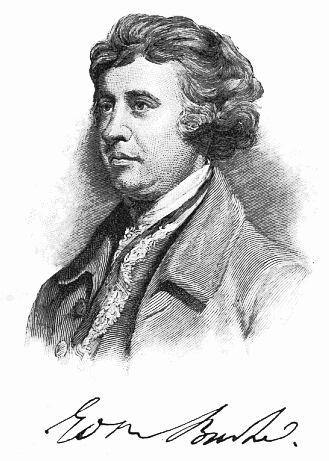
In 1791, in a letter to a Member of the National Assembly, the British philosopher and statesman Edmund Burke wrote:
Men are qualified for civil liberty in exact proportion to their disposition to put moral chains upon their own appetites, — in proportion as their love to justice is above their rapacity, — in proportion as their soundness and sobriety of understanding is above their vanity and presumption, — in proportion as they are more disposed to listen to the counsels of the wise and good, in preference to the flattery of knaves. Society cannot exist, unless a controlling power upon will and appetite be placed somewhere; and the less of it there is within, the more there must be without. It is ordained in the eternal constitution of things, that men of intemperate minds cannot be free. Their passions forge their fetters.
The above quote calls to mind another quote by the Roman historian Tacitus, relating to the character of his late father-in-law Agricola, “He took from philosophy its greatest gift: a sense of proportion.”
Abraham Lincoln’s words have always stuck with me:
The candid citizen must confess that if the policy of the Government upon vital questions affecting the whole people is to be irrevocably fixed by decisions of the Supreme Court…the people will have ceased to be their own rulers.
Some years ago—the early 1990s—part of my job entailed periodically listening to Congressman Charles Taylor give after hour tours of the Old Supreme Court Chamber to small groups of his constituents. The congressman enjoyed talking history and, being a lawyer himself, was especially engaged during his old court tours. The most interesting part, I thought, was when the congressman discussed the supreme court’s Marbury v. Madison (1803) opinion, which established the court’s judicial review authority.
Congressman Taylor would point to the chief justice’s chair and say something to the effect of: “It was here in this room, over there in that chair, that Chief Justice John Marshall said, ‘It is emphatically the province and duty of the judicial department to say what the law is,’ thus establishing the court’s judicial review authority.” It wasn’t my place to get involved, but this was the part in his tour where I wanted to raise my hand. So you understand, the U.S. Constitution didn’t explicitly say the supreme court had the right of judicial review. The last word. No, Chief Justice Marshall, unchallenged by the Congress, basically seized that authority. Bloviate as some lawyers may, and do, the Founders didn’t grant this authority to the high court. And for good reason…I would argue.
The high court’s majority renders its “opinion.” Oftentimes the court’s minority (or dissenting) opinion is just as valid and equally well argued. They just got outvoted, that’s all. And true to form (human nature), many times the opinions of each Justice aligns—oh so conveniently—with his or her perceived political ideology. This is especially true—though admittedly, not always—in big cases, involving hot political topics. On top of that, members of both political parties will openly praise or condemn Justices appointed by their party if that Justice has or hasn’t pulled the party line during a big court decision. No hiding their expectations in other words. It’s not about protecting and promoting the independence of the judiciary it’s about pushing party politics.
Much to the contrary about Justices being “objective” and “just enforcing the constitution,” the members of the Senate like to appoint Justices, naturally, that further their party’s political ideology. For me, the simple truth is the supreme court is mostly just another political body—but, unlike the other two branches, an unaccountable one. For less controversial cases, where there’s little political significance, the Justices will tend to be more judicious….more objective. But in larger cases, with big political stakes involved, the Justices decide mostly inline with their politics. Like everyone else the Justices are human and so their motives are never truly pure. As William James wrote: “Human motives sharpen our questions, human satisfactions lurk in all our answers, all our formulas have a human twist. . . . The trail of the human serpent is thus over everything.”
Since judicial review is based on precedence, and not a provision specifically enumerate in the U.S. Constitution, the Congress could, if they were so inclined, enact a law stripping the high court of this final authority. The court could do nothing about it. The supreme court should function as the last stop in the federal appellant court system. But in certain cases, to use Abraham Lincoln’s words, where “vital questions” are at stake, the U.S. Congress should have the final say. The American people, through their elected representatives, should, in my view, have the final say in such legal cases the U.S Congress deems of vital importance. If both Houses of Congress agree and the President will sign the bill, then Congress and the President should be able to reverse or modify a court decision.
Now, if you disagree with me I welcome your opinion. But just consider some of the horrid opinions rendered by the supreme court. We were forced to live with “opinions” of these unelected and unaccountable judges. All of whom, by the way, have lifetime appointments. Consider that since 1790 we’ve had only 1 of the 115 supreme court justicies appointed face impeachment…and he was acquitted. So no U.S. Supreme Court justice has ever been removed from office. Think about that. That’s a lot of power and security handed to 9 very fallible and opinionated people that will (and have) ultimately forced their values and opinions, whether we like it or not, on the rest of us—a nation of hundreds of millions of people.
I respect the high court’s opinion, but I think the opinion of “the people,” via their elected representatives, will be just as equally and lawyerly argued and just as equally bias as the high court’s; except that those deciding, unlike the justices of the supreme court, will be democratically elected and accountable for their vote. Where “vital questions” are at stake the American people, in my view, should be their own rulers.
As you’ve seen from the quote above, I’m not alone in my concerns about the power and potential abuses of the U.S. Supreme Court. Besides Abraham Lincoln having serious concerns, Thomas Jefferson, in a letter to William Jarvis, also voiced a strong rebuke of the supreme court’s oligarchic power grab:
You seem to consider judges as the ultimate arbiters of all constitutional questions; a very dangerous doctrine indeed, and one which would place us under the despotism of an oligarchy. Our judges are as honest as other men, and not more so. They have, with others, the same passions for party, for power, and the privilege of their corps…. Their power [is] the more dangerous as they are in office for life, and not responsible, as the other functionaries are, to the elective control. The Constitution has erected no such single tribunal, knowing that to whatever hands confided, with the corruptions of time and party, its members would become despots. It has more wisely made all the departments co-equal and co-sovereign within themselves.
This book is a portrait of hours in which the politics of fear were prevalent—a reminder that periods of pubic dispiritedness are not new and a reassurance that they are survivable.
I am writing now not because past American presidents have always risen to the occasion but because the incumbent American president so rarely does.
— Jon Meacham
***
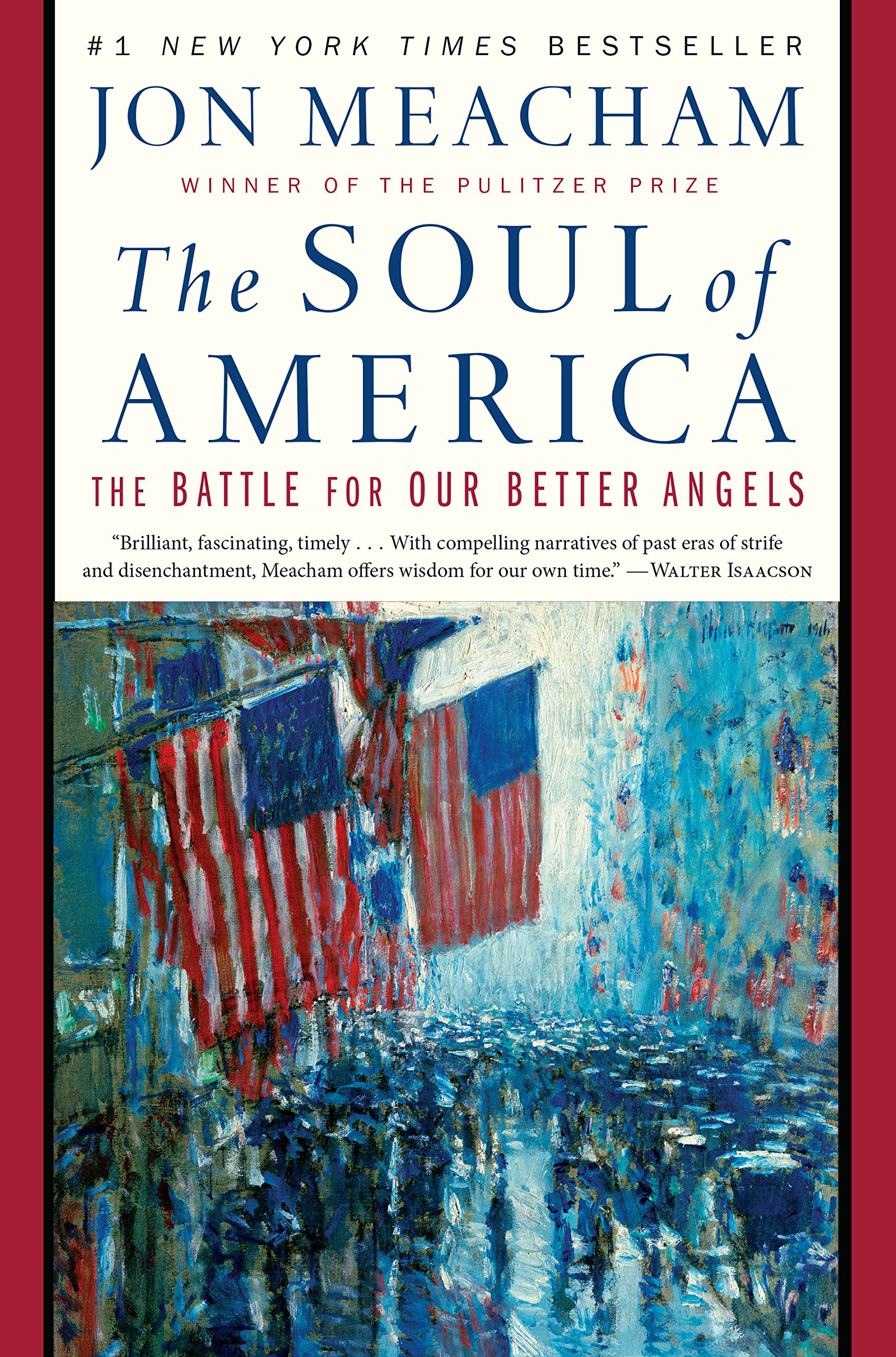
Image: Amazon.com
I recently completed Jon Meacham’s new book, The Soul of America: The Battle for our Better Angels. An instant New York Times bestseller, it is, for various reasons, a very timely book for these very challenging—sometimes soul crushing—and chaotic times. As a historian, Meacham takes a look at the past—from the American Civil War to the Civil Rights era—in order to provide an informed (more hopeful) perspective about the possible trajectory of our turbulent times. In some sense, Meacham’s book is mental therapy; it’s meant to talk you off that ledge.
Meacham looks at some of the great American social struggles—i.e. the civil war, rise of the Klan, women’s movement, the civil rights era, etc, etc,—and some of the prominent people who’ve shaped our nation’s slow march toward a more (though not) perfect union. He focuses mostly on Presidents who, while not perfect, usually (until recently) used their office to lead, to unite and heal, not to divide and humiliate, Americans. With that said, Meacham’s goal is to also remind us that “the struggle is real,” that tumultuous times are more the rule than the exception, and that we must participate in our democracy if we expect hope to prevail over fear. He reminds us that the soul of America is no different than the soul of an individual. It’s a battleground of light and darkness, of hope and fear, of order and chaos. “Our fate is contingent upon which element—that of hope or that of fear—emerges triumphant.” What we pray for, and what our history suggests, is that hope will prevail over fear given enough time, visionary leadership, and activism by the people. Visionary and ethical leaders, as if we need reminding, aren’t guaranteed, but a free people who are hopeful and determined, can prevail over the forces of darkness, fear, and reaction.
Also, for those, like me, who collect quotes, I should note, that besides being a great read, Meacham’s book is worth having just for the quotes alone. The book is littered with great quotes, some I’d never seen before, by prominent people in our history.
Here is a sampling:
“Duty” is the operative word in the following quote. Duty requires one to subordinate one’s personal interests to those of the greater good, the nation, the law. Governing as if these two interests seem to always conveniently sync, is often called “corruption.”
In a government like ours it is the duty of the Chief magistrate, in order to enable himself to do all the good which his station requires, to endeavor, by all honorable means, to unite in himself the confidence of the whole people. — Thomas Jefferson, 1810
I’d never seen follwing one before, but it’s a damn good one, and without a doubt from my experience a rock solid truth:
Now, look, I happen to know a little about leadership. I’ve had to work with a lot of nations, for that matter, at odds with each other. And I tell you this: you do not lead by hitting people over the head. Any damn fool can do that, but it’s usually called ‘assault’ — not ‘leadership.’ . . . I’ll tell you what leadership is. It’s persuasion—and conciliation—and education—and patience. It’s long, slow, tough work. That’s the only kind of leadership I know—or believe in—or will practice. — Dwight D. Eisenhower
And wow, the following presents a honest sense of humility and the awareness of the responsibilities of power that seem almost devoid in our current President.
Well, I have been President for a year and a quarter, and whatever the future many hold I think I may say that during that year and a quarter I have been a s successful as I had any right to hope or expect. Of course political life in a position such as this one long strain on the temper, one long acceptance of the second best, one long experiment of checking one’s impulses with an iron hand and learning to subordinate one’s own desires to what some hundreds of associates can be forced or cajoled or lead into desiring. Every day, almost every hour, I have to decide very big as well as very little questions, and in almost each of them I must determine just how far it is safe to go in forcing others to accept my views and standards and just how far I must subordinate what I deem expedient, and indeed occasionally what I deem morally desirable, to what it is possible under the given conditions to achieve. . . . Often when dealing with some puzzling affair I find myself thinking what Lincoln would have done. It has been very wearing, but I have thoroughly enjoyed it, for it is fine to feel one’s hand guiding great machinery, with at least the purpose, and I hope the effect, of guiding it for the best interests of the nation as a whole. — Theodore Roosevelt
And here the great transcendentalist nails it. This quote says what the bigger, more challenging, issue really is for America right now:
The form of government which prevails is the expression of what cultivation exists in the population which permits it. — Waldo Emerson . . . Amen to that!
The forgoing generations beheld God and nature face to face; we, through their eyes. Why should not we also enjoy an original relation to the universe? — Waldo Emerson
As my last two posts have shown, I’ve been watching, and remembering, some great commencement speeches. Well here is the last one I’ll post about for this season, sent to me by a good friend, and it’s a good one.
Oftentimes the challenge you have when attempting to impart wisdom or insight is to be able do it without necessarily seeming like you’re trying to do it. This is true more so when the topic has a larger, more broader, social meaning—i.e. political meaning—and the speaker is addressing an ideologically diverse group. The master strategist knows, it’s best to avoid the direct approach and resort to oblique order.
Well, in the masterful sense, that’s what Danielle Allen does in her recent commencement address at Pomona College. It’s a short speech, and at first I wasn’t drawn in because of Ms. Allen’s very colloquial delivery, but then the message, the insight, started to hit me right between the eyes. Watch for yourself:

 Jeff Wills