“The most difficult subjects can be explained to the most slow-witted man if he has not formed any idea of them already; but the simplest thing cannot be made clear to the most intelligent man if he is firmly persuaded that he knows already, without a shadow of doubt, what is laid before him.” — Leo Tolstoy
Though I don’t write as often as I’d like, I think a lot about the craft and about its mysteries. This means when I see a good book that sifts the gems of a writer’s wisdom from the mass of their written work I pay attention. When the master speaks, the student listens.
I collect good quotes in general, but I probably have 30 pages of just quotes on writing. Quotes capture the essential wisdom of an author’s thoughts. For some of us, for many of us actually, all we ever read of an author is a quote we run across while reading something else. Well, like in this blog post!
So the other day while browsing the discount table (where you find some great books!) at the bookstore, I came across The Little Book of Writers’s Wisdom. I thought I’d share just a few quotes with you.
So the first one is from George Orwell:
“For the creative writer, possession of the ‘truth’ is less important than emotional sincerity.”
I remember Orwell saying somewhere something to the effect that unless a writer can “feel” they really can’t write persuasively. This connection between feeling and good writing is a common theme in Orwell’s essays.
The second quote is a very rich one by Christopher Hitchens:
“There is some relationship between the hunger for truth and the search for the right words. The struggle may be ultimately indefinable and even undecidable, but one damn well knows is when one sees it.”
Wow, this is a quote that probably deserves an entire blog post by itself. Any volunteers?
Which leads me to my final quote by John Steinbeck, which is a nice follow up to the Hitchens quote:
“The craft or art of writing is the clumsy attempt to find symbols for the wordlessness. In utter loneliness a writer tries to explain the inexplicable. And sometimes if he is very fortunate and if the time is right, a very little of what he is trying to do trickles through — not ever much. And if he is a writer wise enough to know it can’t be done, then he is not a writer at all. A good writer always works at the impossible.”
Yes, another great quote for the topic of a blog post. 🙂
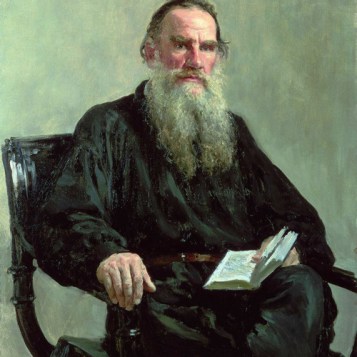
One of the most fascinating figures in the history of literature is Leo Tolstoy. Unlike most people, who discover Tolstoy through his novels and short stories, I was introduced to Tolstoy through his religious writings.
Many years ago I remember reading William James’s book, The Varieties of Religious Experience. As I recall, I was fascinated by James’s analysis and commentary on some of Tolstoy’s religious writings. (James’s book was perspective altering and left a big impression on me. I hope to read it again some day. I highly recommend you give it a go if you enjoy philosophical psychology and religious studies.)
So I picked up a Penguin Classic of Tolstoy’s writings called A Confession and Other Religious Writings. This book, the imagines and ideas, still haunt my memory. After reading this book, I started dipping into the rest of Tolstoy’s works. It was, like Tolstoy’s Russia, a vast and consuming experience. Tolstoy is not just a writer or moralist with something to say, he’s more like the yogi who wants to change your consciousness and reveal a world hidden from your view. This is Tolstoy’s mission in life.
Tolstoy’s deeply philosophical and religious mind get full range in his greatest novel, War and Peace, a large—and seemingly endless—canvas where Tolstoy paints his ideas about determinism and contingency in history, which he brilliantly elaborates on in an essay at the end of the novel.
Tolstoy’s writings and ideas have been highly influential. Mahatma Gandhi and Martin Luther King Jr. were both influenced by Tolstoy’s principle of non-violent resistance. The great 20th century philosophical genius Ludwig Wittgenstein was highly influenced by Tolstoy’s religious book, The Gospel in Brief. The popular historian and biographer, Niall Ferguson, credited Tolstoy, specifically War and Peace, with making him a historian. And who can forget the tragic story of Chris McCandless, the young idealist who appears to have been influenced to go hiking alone in the Alaskan wilderness (see Into the Wild) to commune with nature after reading Tolstoy’s Family Happiness.
Now, when it comes to novels, Tolstoy is not your casual read. If you’re use to reading popular novelists then you’re probably going to find Tolstoy, at times, difficult to follow. Tolstoy is not looking to just entertain, though he does, but to impart wisdom through the medium of art. Tolstoy is using words and story to cast the mind’s eye upon what Rudyard Kipling called “the impenetrable plinth of things.” Immersion in Tolstoy’s work has the real potential to alter your perspective on life.
But most people, other than for work, don’t have time for reading much at all, especially a large book like War and Peace or a book of Tolstoy’s religious writings. And Tolstoy understood this.
So in the mid 1880s Tolstoy came up with the idea for A Calendar of Wisdom: “A wise thought for every day of the year, from the greatest philosophers of all times and all peoples.” He added, “I have to create a circle of reading for myself: Epictetus, Marcus Aurelius, Lao-Tzu, Buddha, Pascal, The New Testament. This is also necessary for all people . . . I would like to create a book . . . in which I could tell a person about his life, and about the Good Way of Life.”
Instead of a big novel or philosophical treatise on the meaning of life, Tolstoy decided one of his last works (he updated and edited the book in the last years of his life) would be a book of daily thoughts to nourish the soul:
The difference between real material poison and intellectual poison is that most material poison is disgusting to the taste, but intellectual poison, which takes the form of cheap newspapers or bad books, can unfortunately sometimes be attractive.
(January 1)
Knowledge is real knowledge only when it is acquired by the efforts of your intellect, not by memory.
Only when we forget what we were taught do we start to have real knowledge.
(Henry David Thoreau, January 9)
A constant flow of thoughts expressed by other people can stop and deaden your own thought and your own initiative…. That is why constant learning softens your brain…. Stopping the creation of your own thoughts to give room for the thoughts from other books reminds me of Shakespeare’s remark about his contemporaries who sold their land in order to see other countries.
(Arthur Schopenhauer, January 9)
Real wisdom is not the knowledge of everything, but the knowledge of which things in life are necessary, which are less necessary, and which are completely unnecessary to know. Among the most necessary knowledge is the knowledge of how to live well, that is, how to produce the least possible evil and the greatest goodness in one’s life. At present, people study useless sciences, but forget to study this, the most important knowledge.
(Jean Jaques Rousseau, March 16)
There is only one real knowledge: that which helps us to be free. Every other type of knowledge is mere amusement.
(Vishnu Purana, Indian Wisdom, June 23)
The way to true knowledge does not go through soft grass covered with flowers. To find it, a person must climb steep mountains.
(Josh Ruskin, September 20)
Intellect is the quality that makes us different from animals.
Buddha said: “In meditation, in speech, in life, in studies, I never forget about the most important thing: the requirements of the intellect.”
The moral and the intellectual are always in harmony.
(June 13)
Each morning, for the past few months, I’ve started my day by opening to the current date in Tolstoy’s Calendar of Wisdom. It has helped put my mind in the right frame, or for lack of a better word, rhythm for the day.
“I cannot understand,” Tolstoy wrote, “how some people can live without communicating with the wisest people who ever lived on earth . . . I feel very happy every day, because I read this book.”
In this busy world we rarely have time to dedicate to our spiritual an intellectual growth. Regardless of where you’re at in life or what’s going on, it’s important to imbibe the nourishing water of wisdom.
Tolstoy has provided a cup. I recommend you take those brief moments and drink daily.
“We are not provided with wisdom, we must discover it for ourselves, after a journey through the wilderness which no one else can take for us, and effort which no one can spare us.” — Marcel Proust



 Jeff Wills