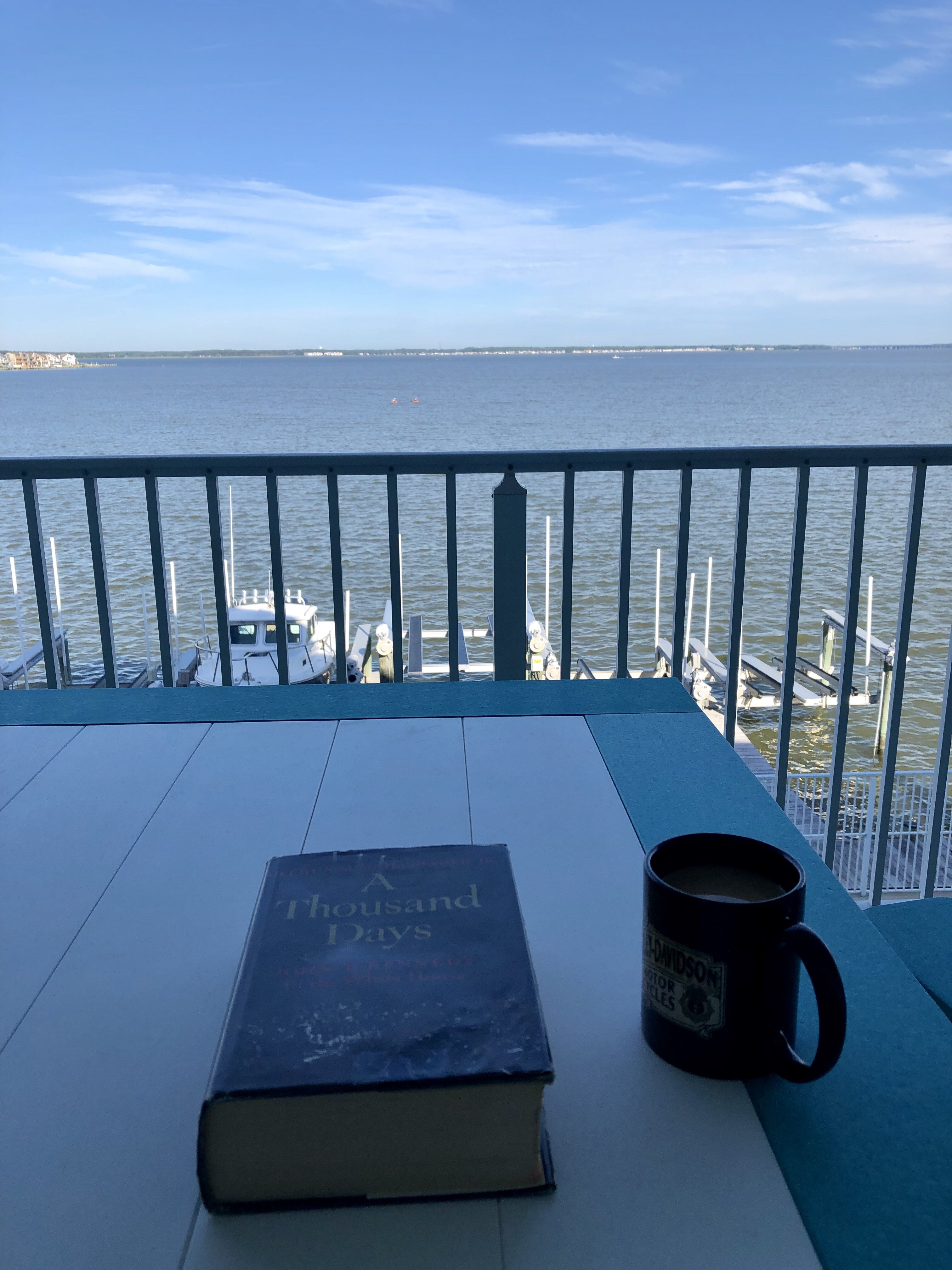
A Thousand Days

(Photo by Jeff Wills)

I visited an acquaintance of mine about two weeks ago. He happens to own a used bookstore. Of course I have far too many books now, but there’s always room for another good find.

We talked for a bit about kids and college and politics and eventually we moved, naturally, into booktalk, which, naturally, led us to his groaning shelves in search of a book.

The search didn’t produce the book we were looking for, but after my acquaintance walked away to take a phone call, my wondering eye spied a thick, black book spine cover with the title of A Thousand Days printed across it.

The full title is A Thousand Days: John F. Kennedy in the White House written by Arthur M. Schlesinger Jr. I had recently read Schlesinger’s Journals, published posthumously by his sons, and was deeply fascinated by them.

A Thousand Days won the 1966 Pulitzer Prize for biography and, from all that I’d read about it, was one of the best books written about President Kennedy the man, the candidate, the leader, and the President. Certainly a book written by an Administration insider and admirer will reflect the writer’s biases, for which, I think it’s fair to say that Schlesinger was well aware of as a professional historian.

But this particular memoir/biography, I think, has become particularly attractive given the times we find ourselves in. I think there’s a need to be reading books about Presidents that, while not perfect, brought high ideals, intelligence, grace, dignity, and visionary leadership to the highest office in the land.

And so, in the quiet of the early morning (0630 when I took picture above), I began a 1000 day journey.

“It was their final, most essential command.”

In the end the Party would announce that two and two made five, and you would have to believe it. It was inevitable that they should make that claim sooner or later: the logic of their position demanded it. . . . The heresy of heresies was common sense. . . . The Party told you to reject the evidence of your eyes and ears. It was their final, most essential command. 

George Orwell, 1984

Ron Chernow as guest speaker at the White House Correspondent’s Dinner

Last night was the White House Correspondent’s Dinner. Now, if you haven’t watched this annual event before then you should know that the the guest speaker is usually a comedian who roasts the President, his administration, the media, and any other opportune target in the audience. In the past, when we had a President with a sense of humor, humility, and the ability to laugh at himself, the President would actually take the podium and make fun of himself, his administration, and, yes, take humorous jabs at the media. It’s all in good fun. The whole idea is to celebrate our nation’s constitutional protections of a free press and its function of ensuring our political leaders are held accountable.

As I said, typically the guest speaker is a comedian, but after last year’s speaker pushed the limit, it was decided to tame it down a bit. Last night’s guest speaker (video below) was the biographer and historian Ron Chernow. If you haven’t read any of Ron’s books, let me recommend his biography on Alexander Hamilton. A superb book that was the inspiration for the awarding winning broadway musical, Hamilton. Ron’s most recent biography is on Ulysses Grant, which is the inspiration for a new movie (in production) about Grant, reportedly being directed by Steven Spielberg.

I must admit when I originally heard Ron Chernow had been chosen as the guest speaker, I thought “Well, that’s a very tall order for a scholar to deliver on. They’re not usually funny people.” I mean a historian taking the slot reserved for a professional comedian? I had heard Ron Chernow discussing his books and answering questions about them, and he is a good speaker for the most part, but as the primary guest speaker at the White House Correspondent’s Dinner? I was struggling even if a side of me thought it was a good turn.

Anyway, Ron was indeed far more tame. But I must say he acquitted himself quite well in my opinion. He did provide some humorous and well delivered and deserved jabs at the current administration. Had he not, to be sure, it would have been far too great a retreat from the spirit of the freedoms being celebrated by the event. Ron found that fine balance between pure joke and the jokingly serious. It was, in the best of ways, an instructive and entertaining speech. Ron showed intelligence, grace, wit, humor, and humility. All qualities that are sorely lacking on Capitol Hill and especially at 1600 Pennsylvania Avenue.

Watch the speech:

“Patriotism means to stand by the country”

Certainly a quote with special resonance at this time in our nation’s history.

Patriotism means to stand by the country. It does not mean to stand by the president or any other public official, save exactly to the degree in which he himself stands by the country. It is patriotic to support him insofar as he efficiently serves the country. It is unpatriotic not to oppose him to the exact extent that by inefficiency or otherwise he fails in his duty to stand by the country. In either event, it is unpatriotic not to tell the truth, whether about the president or anyone else.

― Theodore Roosevelt

DFW on Leadership

Years ago I came across these words about leadership while reading David Foster Wallace’s (DFW) piece on John McCain’s 2000 Presidential campaign bid. They’re part of a superb essay DFW wrote for Rolling Stone called The Weasel, Twelve Monkeys and the Shrub.

Along with some other quotes by various writers, I’ve had DFW’s thoughts on leadership displayed in my office for years now. I don’t recall DFW writing about leadership anywhere else in his work, at least not directly, but as a literary artist he had that natural gift for description. I think this is one of the better, more accurate assessments of how many of us think of real leadership.

For those who’d prefer to hear a reading of this short piece, I’ve included a Soundcloud audio by Debbie Millman.

It is just about impossible to talk about the really important stuff in politics without using terms that have become such awful clichés they make your eyes glaze over and are hard to even hear. One such term is “leader,” which all the big candidates use all the time — as in e.g. “providing leadership,” “a proven leader,” “a new leader for a new century,” etc. — and have reduced to such a platitude that it’s hard to try to think about what “leader” really means and whether indeed what today’s Young Voters want is a leader. The weird thing is that the word “leader” itself is cliché and boring, but when you come across somebody who actually is a real leader, that person isn’t cliché or boring at all; in fact he’s sort of the opposite of cliché and boring.

Obviously, a real leader isn’t just somebody who has ideas you agree with, nor is it just somebody you happen to believe is a good guy. Think about it. A real leader is somebody who, because of his own particular power and charisma and example, is able to inspire people, with “inspire” being used here in a serious and non-cliché way. A real leader can somehow get us to do certain things that deep down we think are good and want to be able to do but usually can’t get ourselves to do on our own. It’s a mysterious quality, hard to define, but we always know it when we see it, even as kids. You can probably remember seeing it in certain really great coaches, or teachers, or some extremely cool older kid you “looked up to” (interesting phrase) and wanted to be just like. Some of us remember seeing the quality as kids in a minister or rabbi, or a scoutmaster, or a parent, or a friend’s parent, or a supervisor in a summer job. And yes, all these are “authority figures,” but it’s a special kind of authority. If you’ve ever spent time in the military, you know how incredibly easy it is to tell which of your superiors are real leaders and which aren’t, and how little rank has to do with it. A leader’s real “authority” is a power you voluntarily give him, and you grant him this authority not with resentment or resignation but happily; it feels right. Deep down, you almost always like how a real leader makes you feel, the way you find yourself working harder and pushing yourself and thinking in ways you couldn’t ever get to on your own.

In other words, a real leader is somebody who can help us overcome the limitations of our own individual laziness and selfishness and weakness and fear and get us to do better things than we can get ourselves to do on our own.