Unsurprisingly, major religions, from Buddhism to Christianity to Islam, place emphasis on humility. And so do countless codes of secular ethics. Indeed, any civilization worth its salt seeks to rein in our propensity for hubris and excessive self-assertion. (Just think of the uncommon length people in Japan, for example, go to embody humility in everyday life.) Yet, for all our efforts, this is, in the end, a losing battle. Civilization is weak and precarious, and life, ever stronger and more savage, always comes out on top. Self-assertion is natural, gratifying, erotically charged, whereas self-denial is anything but. Of all the animals, the human variety may be the most difficult to tame. And this is precisely why humility is so important. Through it we can learn how to tolerate ourselves and others, and make ourselves a touch less abominable. For good or ill, it is the best tool we have to tame the beasts that we are.
There is nothing shocking about this. If anything, it is one of the most banal — or should I say humble? — philosophical ideas. From the Buddha to the Sufi masters to Schopenhauer to Bergson and Weil, mystics and philosophers, East and West, have not in essence said anything else. If hearing it again does shock us, it is only because we have, perhaps like never before, become so blindly, erotically entangled in the race of life that we have even forgotten that we have eyes to see.
All history is the history of longing. The details of policy; the migration of peoples; the abstractions that nations kill and die for, including the abstraction of “the nation” itself—all can be ultimately traced to the viscera of human desire. Human beings have wanted innumerable, often contradictory things—security and dignity, power and domination, sheer excitement and mere survival, unconditional love and eternal salvation—and those desires have animated public life. The political has always been the personal.
Yet circumstances alter cases. At crucial historical moments, personal longings become particularly influential in political life; private emotions and public policy resonate with special force, creating seismic changes. This is what happened in the United States between the Civil War and World War I. During those decades, widespread yearnings for regeneration—for rebirth that was variously spiritual, moral, and physical—penetrated public life, inspiring movements and policies that formed the foundation for American society in the twentieth century.
“America is never wholly herself unless she is engaged in high moral principle. We as a people have such a purpose today. It is to make kinder the face of the nation and gentler the face of the world.” — George H.W. Bush
Former President George H.W. Bush photographed on August 23, 2001 in Houston, TX. (Photo by Pam Francis/Getty Images)
I arrived to work on Capitol Hill in late February of 1991, just as the First Iraq War (Operation Desert Storm) was coming to an end. George H.W. Bush was our President and the leader of the free world.
By any account, President Bush was known as a kind, gracious, and decent man who’d dedicated his life to public service. For me, I’ve always felt, and I think history confirms, that our nation has been best served by those Presidents who’s life has been an extensive history of serving others.
I’ve always asked when sizing up a candidate for high office, What has he or she done with their life up to this point? Has their life been about serving others? Has their life been mostly about advancing their own personal interests or has it been about their community’s and their nation’s interests? George H.W. Bush spend most of his life in faithful and dedicated service to our nation.
The only personal (and brief) memory I have of President Bush involved a visit he made to the U.S. Capitol Building in the summer (I believe) of 1992. I was standing near the House Door of the U.S. Capitol and President Bush and his entourage were about to leave the building and head back to the White House. The President was slowly making his way, talking and shaking hands, when he suddenly broke from his group and headed straight for me. I hadn’t been paying close attention to him, but to the group in general as it was moving toward the exit. I noticed the crowd all starting to look at me and I turned to see President Bush walking toward me with his right hand extended to shake my hand. I can still distinctly remember the genuine look in his eyes and the sincerity in his voice as he strongly shook my hand and thanked me for my service “to our great nation.”
At this particular time in our nation’s history, I’m sure, many Americans miss that genuine decency, dignity, graciousness, intelligence, and nobility that President George H.W. Bush brought to the Office of the Presidency and to the reputation and leadership status of this great nation.
Farewell Mr. President. You leave behind a grateful nation. Thank you for your service.
(President George H.W. Bush passed away yesterday, November 30, 2018, in Houston, Texas. He was 94.)
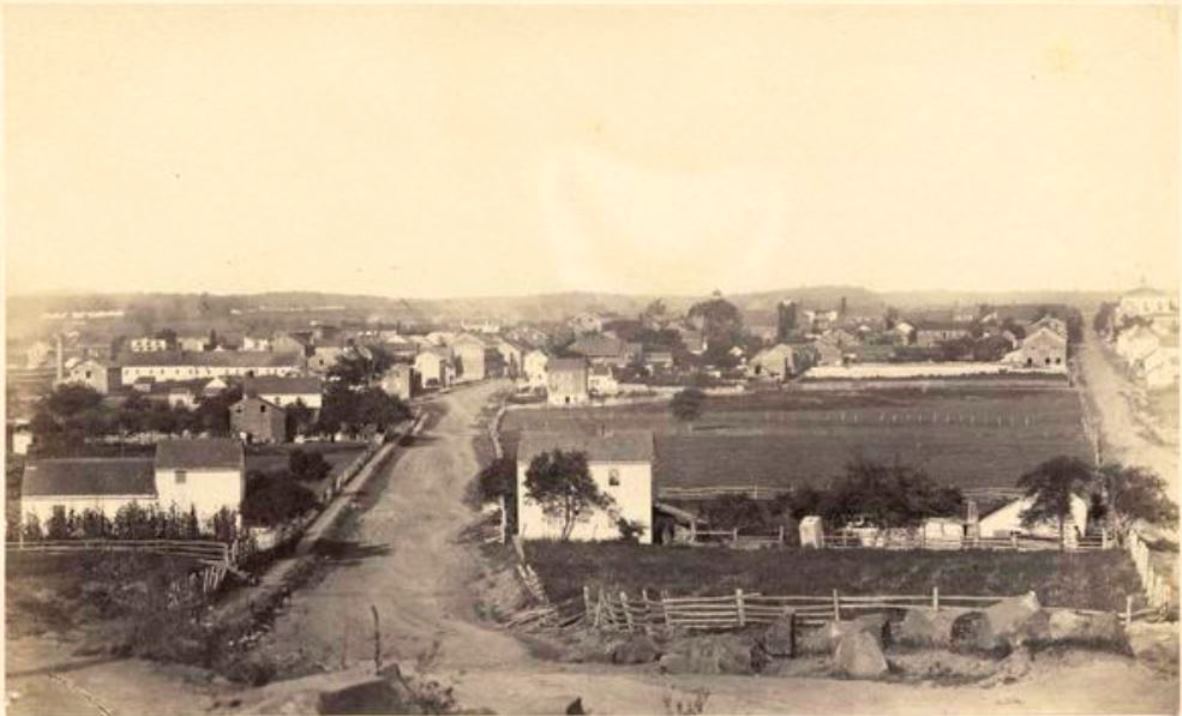
For 3 days (July 1-3, 1863) the 2,400 residents of Gettysburg, Pennsylvania, hunkered down in their homes and cellars, waiting for the violent storm to pass. Outside the air was filled with bullets, exploding artillery shells, the pounding of horse hooves, and “rebel shrieks” that “permeated their homes, their cellars, their souls” with the “unearthly yells of the exultant and defiant enemy.”
And then finally, it was over. The morning of July 4th was quiet. The guns were silent. During the night the confederate army had pulled out. In his book, The Gettysburg Gospel, the historian Gabor Boritt describes what the residents of Gettysburg found as they emerged from their homes and cellars.
Stench fills the air. Excrement from perhaps 180,000 men and more than 70,000 horses has been left behind in the area. There are thousands of flies, millions. Dead men barely covered in shallow graves. Seven thousand dead men? More likely close to 10,000. How many dead horses and mules? Three thousand, five? None buried. A nurse writes of carcasses “steaming in the sun.” The smell of putrid animal flesh mingles with the odor of human decay. It extends into the spirit of the people. War had come to them. Then it had gone and left the horror behind.
But this initial scene portended another horrific scene that would quickly follow. Amongst all the death and destruction around Gettysburg, the fields and hills and woods were filled with the moans and wails of wounded and dying men. There were 21,000 of them between the Union and Confederate armies. That July 4th morning, Gettysburg woke to find the greatest man-made catastrophe in American history.
Eliza Farnham, a volunteer nurse from Philadelphia, tell much the same story. “The whole town . . . is one vast hospital. . . . The road, for long distances, is in many places strewn with dead horses . . . the earth in the roads and fields is ploughed to a mire by the army wheels and horses . . . avenues of white tents. . . . But, good God! What those quiet-looking tents contained! What spectacles awaited us on the rolling hills around us! It is absolutely inconceivable. . . . Dead and dying, and wounded . . . torn to pieces in every way.” Moans, shrieks, weeping, and prayer fill the houses, the barns, the tents, the fields and woods, the whole area. The land itself seems to wail. Nothing but suffering. Sights, sounds, smells unbearable. Horror. The piles of limbs dripping blood, the dying, the dead. Hell on earth.
You can’t read Boritt’s narrative of the horrific scene in Gettysburg after the great battle and not be thankful beyond words for the care and compassion and sacrifices made by so many women who came from all over to volunteer as nurses. “Angels” is the only word to describe them. For many of the dying soldiers, the last face or voice they saw or heard would have been one of these nurses providing them with as much comfort—and oftentimes prayers—as possible as they slipped from this world.
At the time of the battle, it was generally felt the outcome of it would decide the fate of the nation. A lot was hanging on what happened during Lee’s invasion of the North. Lee’s invasion plan was to draw the Union army out into the open and destroy it. He came close at Gettysburg. But it just wasn’t meant to be. The significance of the Union army’s victory, the fact that the rebel army was repulsed, badly mauled, and had to retreat, saved the nation, and brought about the planning for the November 19, 1863, ceremony to dedicate a portion of the battlefield as a cemetery for Union army soldiers killed in the battle. Today is the 155th anniversary of Lincoln’s Gettysburg Address.
President Lincoln arrived in Gettysburg by train on the evening of November 18th. He stayed at the home of David Wills (no relation that I know of), a local Gettysburg attorney and the man selected by the governor of Pennsylvania to plan the event. There’s been much debate, and Boritt covers much of it in his book, over when Lincoln wrote his Gettysburg Address. But we have strong evidence to believe Lincoln wrote the first part of it at the White House in ink on White House stationary, before he left Washington, and then finished his speech, in pencil on lined paper, at the Wills home the night of the 18th, possibly during the morning of the 19th.
Lincoln’s original handwritten copy of the Gettysburg Address (Photo by Jeff Wills, November 19, 2018)
Lincoln’s primary goal for his short speech was to justify the continuance of the war and to give meaning to the tremendous suffering and sacrifices—“that these dead shall not have died in vain”—being made by Union soldiers and their families so that “the nation might live.” For Lincoln, the war was a test of whether “a government conceived in liberty and dedicated to the proposition that all men are created equal” could “long endure.” The war would be the trial-by-fire of this test, from which “a new birth of freedom” would emerge and set America on a new path. Lincoln called upon his listeners to take from this battlefield an increased determination to preserve the national government, to continue the fight for democracy, because in doing so Lincoln believed the American people, in winning this struggle, would affirm to the world that democratically elected governments—here and wherever they may take root—-can and will survive. “That government of the people, by the people, and for the people, shall not perish from the earth.”
I must admit that I can rarely hear Lincoln’s address all the way through and not get a little emotional. Those 265 words, written using the rhythms and phrases of the King James Bible and the Book of Common Prayer, are beautiful and so meaningful. I’ve searched the internet for a good reading and the best one I’ve found was one done by former President Barack Obama. So take a few moments on this 155th anniversary of the Gettysburg Address and reflect on Lincoln’s words, their meaning, and how incredibly timeless they really are. To hear these words and feel the force of their meaning is to understand that “the proposition” is still being tested and that it is for us, “the living,” to demonstrate its truth.
Fourscore and seven years ago our fathers brought forth, on this continent, a new nation, conceived in liberty, and dedicated to the proposition that all men are created equal.
Now we are engaged in a great civil war, testing whether that nation, or any nation so conceived, and so dedicated, can long endure. We are met on a great battle-field of that war. We have come to dedicate a portion of that field, as a final resting-place for those who here gave their lives, that that nation might live. It is altogether fitting and proper that we should do this. But, in a larger sense, we cannot dedicate, we cannot consecrate—we cannot hallow—this ground. The brave men, living and dead, who struggled here, have consecrated it far above our poor power to add or detract.
The world will little note, nor long remember what we say here, but it can never forget what they did here. It is for us the living, rather, to be dedicated here to the unfinished work which they who fought here have thus far so nobly advanced. It is rather for us to be here dedicated to the great task remaining before us—that from these honored dead we take increased devotion to that cause for which they here gave the last full measure of devotion—that we here highly resolve that these dead shall not have died in vain—that this nation, under God, shall have a new birth of freedom, and that government of the people, by the people, for the people, shall not perish from the earth.
Americanism means many things. It means equality of rights and, therefore, equality of duty and of obligation. It means service to our common country. It means loyalty to one flag, to our flag, the flag of all of us. It means on the part of each of us respect for the rights of the rest of us. It means that all of us guarantee the rights of each of us. It means free education, genuinely representative government, freedom of speech and thought, equality before the law for all men, genuine political and religious freedom and the democratizing of industry so as to give at least a measurable equality of opportunity for all, and so as to place before us as our ideal in all industries where this ideal is possible of attainment, the system of cooperative ownership and management, in order that the tool users may, so far as possible, become the tool owners. Everything is un-American that tends either to government by a plutocracy or government by a mob. To divide along the lines of section or caste or creed is un-American. All privileges based on wealth, and all enmity to honest men merely because they are wealthy, are un-American—both of them equally so. Americanism means the virtues of courage, honor, justice, truth, sincerity, and hardihood—the virtues that made America. The things that will destroy America are prosperity-at-any-price, peace-at-any-price, safety-first instead of duty-first, the love of soft living and the get-rich-quick theory of life.
Preparedness must be of the soul no less than of the body. We must keep lofty ideals steadily before us, and must train ourselves in practical fashion so that we may realize these ideals. Throughout our whole land we must have fundamental common purposes, to be achieved through education, through intelligent organization and through the recognition of the great vital standards of life and living. We must make Americanism and Americanization mean the same thing to the native-born and to the foreign-born; to the man and to the woman; to the rich and to the poor; to the employer and to the wage-worker. If we believe in American standards, we shall insist that all privileges springing from them be extended to immigrants, and that they in return accept these standards with whole-hearted and entire loyalty. Either we must stand absolutely by our ideals and conceptions of duty, or else we are against them. There is no middle course, and if we attempt to find one, we insure for ourselves defeat and disaster.
— Theodore Roosevelt, Letter to Solomon Stanwood Menken, the head of the National Security League and the chairman of its Congress of Constructive Patriotism, January 10, 1917


 Jeff Wills