School and the Development of Moral Identities

I ran across an interesting piece in the Atlantic. Paul Barnwell, an English teacher in Kentucky, argues that too much time in school (primary and secondary) is spent on pure academics and not much is given to allowing students to develop a moral identity.

Barnwell’s concern was peaked after he initiated a discussion involving a moral dilemma:

A few months ago, I presented the following scenario to my junior English students: Your boyfriend or girlfriend has committed a felony, during which other people were badly harmed. Should you or should you not turn him or her into the police?

The class immediately erupted with commentary. It was obvious, they said, that loyalty was paramount—not a single student said they’d “snitch.” They were unequivocally unconcerned about who was harmed in this hypothetical scenario. This troubled me.

Hmmm. If we assume that “other people were badly harmed” means others were physically harmed, I’m shocked Barnwell’s entire class was “unequivocally unconcerned” and wouldn’t say anything to the police. Yeah, that might have been hypothetical but sheesh. I mean where is Barnwell teaching? Tough crowd! That’s definitely a moment of clarity for a teacher.

Anyway, the bigger point that Barnwell took from this was how the students seemed more drawn to these moral discussions:

We continued discussing other dilemmas, and the kids were more engaged that they’d been in weeks, grappling with big questions about values, character, and right versus wrong as I attempted to expand their thinking about who and what is affected—and why it matters…

(Italics added)

Well first I’d say I don’t think it’s just high school kids who’re “more engaged” by moral questions, just watch a group of adults at election time! Let’s just say you don’t know people as well as you think you do.

Anyway, our moral identities are a large part of who we are. And of course ethics is politics writ large. So a challenge to our moral world view (or our politics) is a challenge to our personal identity, and that can be very personal to some people. And that’s largely why schools tend to avoid ethical discussions, because it can offend some students which can lead to parents showing up at the school complaining “My kid doesn’t go to school for that!”

However, while these moral discussions may offend some parents, they’re usually very interesting to the students. Whether you’re a student or an adult you get passionate about what we believe, and being passionate is good. It reminds us we’re alive. It stirs our sense of connection to something larger than ourselves. I think most people crave that. Educators should capitalize on that and guide their students to explore their value systems and the connections they have with others. It’s not about imposing a view, it’s about exposing the student to the views of others. Empathy is how we expand our moral imagination.

One of the central reasons for an education is to free the mind. By doing so we free the individual from the tyranny of manipulation. The motto for the Enlightenment, coined by Immanuel Kant, was Sapere Aude! [dare to know] “Have courage to use your own understanding!” That, at least, is how I see the goal of education. Provide students with the tools and then let them decide how to use that knowledge in their own life.

There is nothing wrong with teaching moral courage, honesty, and the acceptance of others. The vast majority of parents agree with this. The trick is how you go about it. Barnewell’s thoughts are you “expose students to tough (moral) issues in the context of academic work—not imposing values, but simply exploring them.”

The idea is to draw students into various perspectives and let them explore them. This can be done with various disciplines. For example, Barnwell uses his HS biology teacher who challenged his class to think about their consumer choices and how these affect the ecosystem and the environment. The question doesn’t impose a value or ask students to adopt one, but challenges students to think through the various connections and consequences of their individual decisions. The student can decide what this means to them. As they think, as they see, so they feel.

Of course HS English and History teachers have the advantage in this task. There’s nothing like literature and the stories of human beings to frame moral questions and stir our moral imagination. Those of us who love the humanities have always known this was why a liberal arts education is so important for the maintenance of a just and free society.
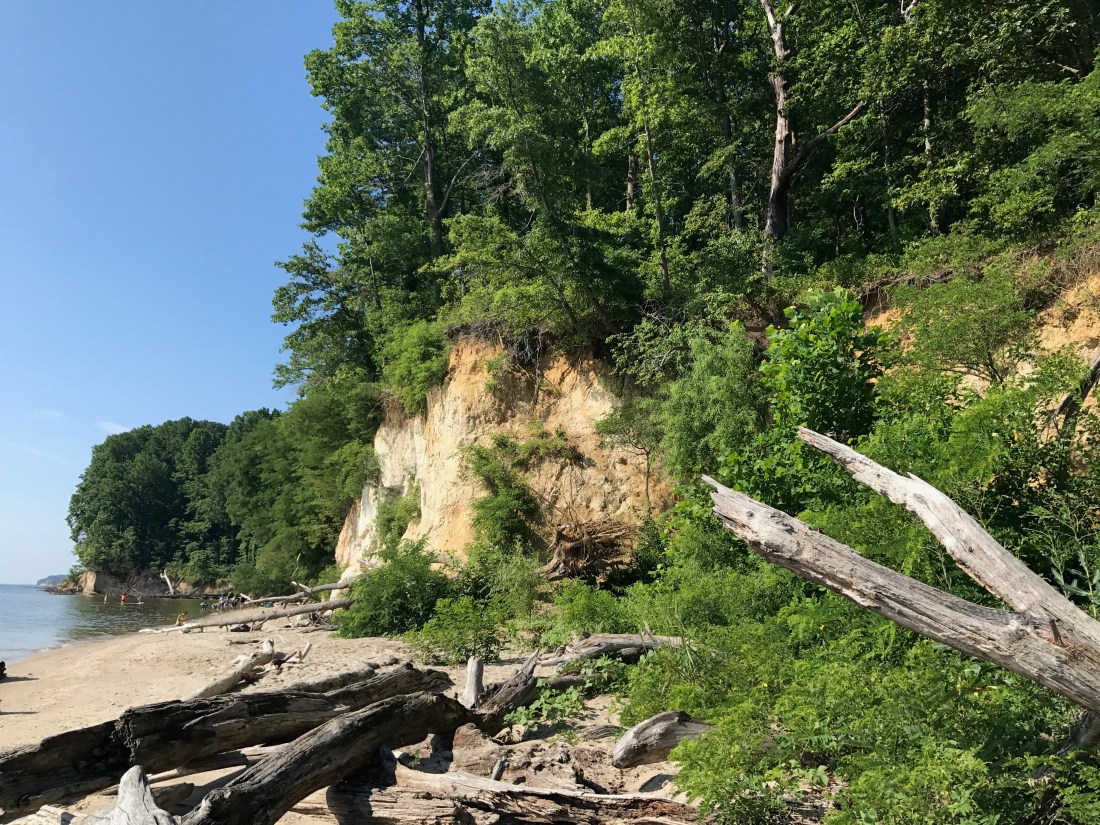
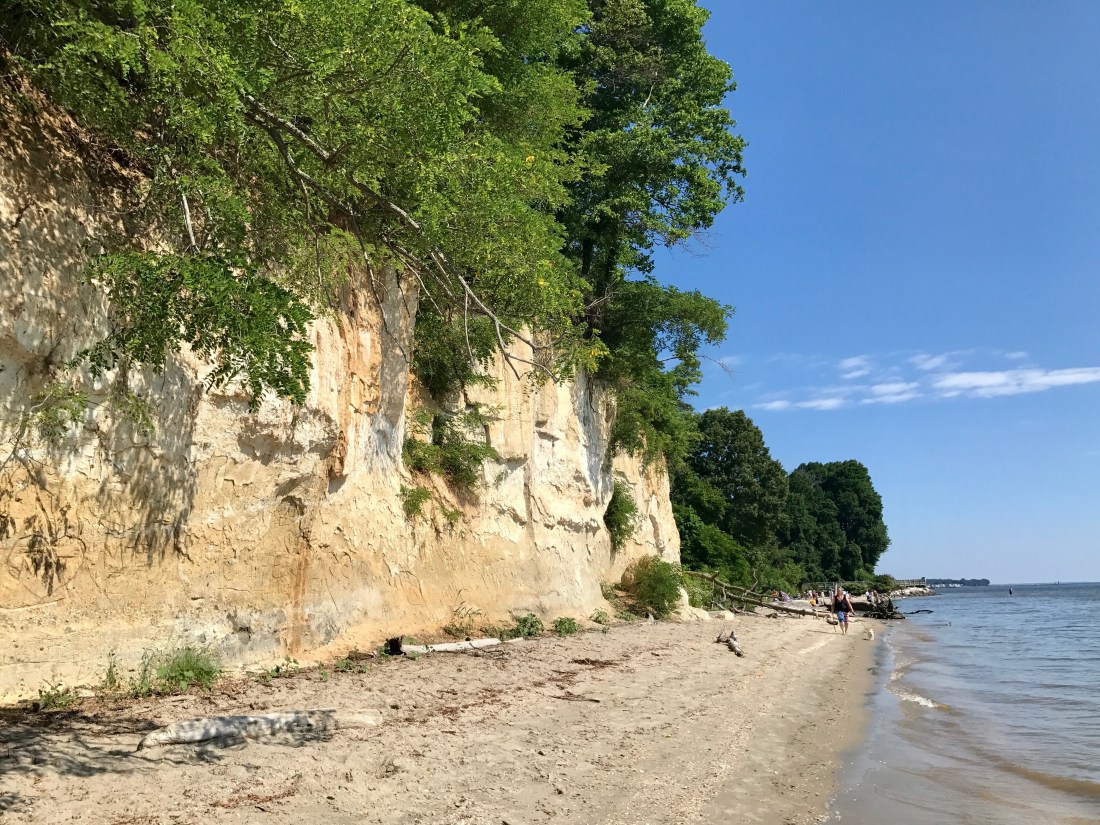
The Calvert Cliffs at Brownie’s Beach

After paying a modest fee we headed up the path, loaded up with beach bags, cooler, towels, chairs, and water float. Brownie’s Beach is a small beach (part of Bay Front Park) on the southern end of the town of Chesapeake Beach, Maryland. We live down the road from the town.

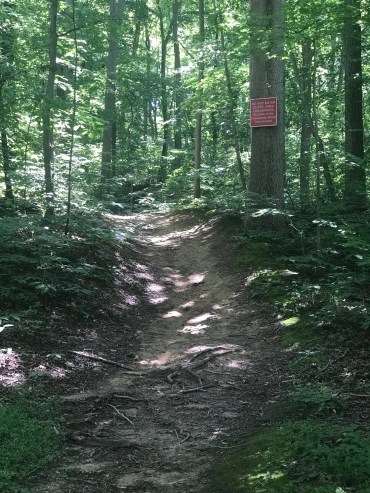
The walk from the small parking lot is not over sand or through dunes but along a blacktop path through a thick of woods. All along the path are educational plaques naming particular flora. The only other sign which attracts notice (I paused briefly) is a warning sign nailed to a tree. There are cliffs near by so “by order of the town council” you’re told not to enter the “cliff area.” Directly under the warning sign is a well worn path leading toward the cliff area revealing just what people think about the town council’s order.

IMG_2604
Warning Sign

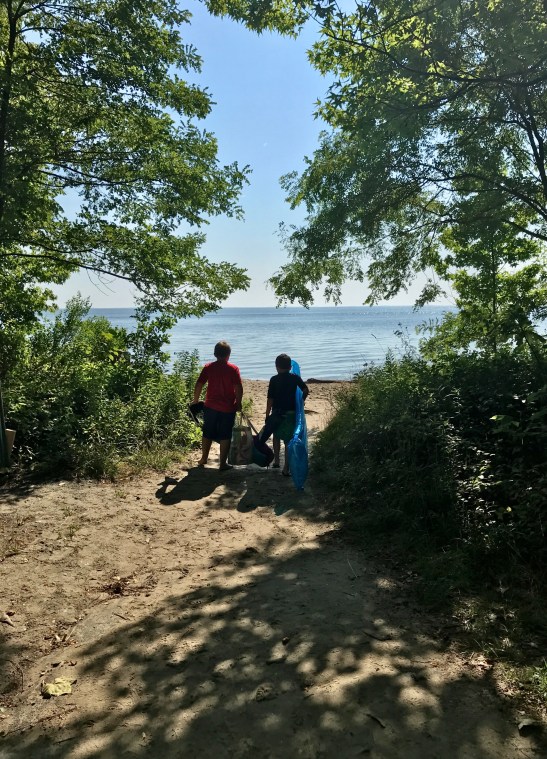
As we approached the beach area we could hear the faint sound of boat motors off in the distance and the muted voices of fellow beach goers. The thick canopy of trees had dimmed the sun light, and along with the surrounding thick woods, marsh and brush, it had made the path feel almost like an entry point between two worlds. Walking behind my youngest son and his friend, I snapped the following picture of them about to emerge from the entry path.

IMG_2574

The beach area is a slim strip of sea sand and the various accretions from the eroding cliffs—shale, sandstone, clay, and fallen trees. Dropping our bags and looking south we see parts of the rock face of Calvert Cliffs. The Cliffs start at Brownie’s Beach and extend about 25 miles south, ending in the Drum Point area of Calvert County. The cliffs at Brownie’s Beach are at the lower end in height. They get much higher (130 feet in some places) as you head south. (See this search stack of photos.)

IMG_2578

The mind is definitely a mysterious thing…it’s also an associative thing. So, to be candid, my immediate thoughts weren’t of the beauties of nature (those were a close second) but were actually, oddly enough, of Julius Caesar and his Roman invasion fleet as it approached the Dover Cliffs off the coast of southern England in 55 BC. Though the White Cliffs of Dover are far more imposing, I couldn’t help but wonder what the sight of the Calvert bluffs might have meant to the various minds observing them from sea for the first time over the centuries.

IMG_2582

The nature lover sees bleached rock, a sandy beach, green trees and the natural beauty of it all. The scientist sees geological formations, tectonics, and flora. The historical mind sees the beauty and the science but with the added dimension of how geography has played a big part in the course of human history. I’m not a scientist or historian, but having read a small library of history, especially classical history, has obviously stamped my associative mind. So my imagination tends to randomly dart across time, historical events, and the scenes of famous characters.

The boys and I started walking down the beach toward the cliffs. This beach, and all up and down the Calvert Cliffs, is well known for its fossils. It’s a paleontological heaven. One of the first people I talked to was a young lady, who appeared to be a college student, hunting for fossils in the surf. In particular, there are a lot of fossilized shark teeth along these beaches that in some cases belong to sharks from hundreds. My wife and I have friends who’s home fireplace was inlaid with hundreds of shark teeth collected from the Calvert Cliff’s beaches. My friend’s house was located (they’ve since sold it) in a community along these cliffs, called, appropriately enough, Scientist Cliffs. It’s a beautiful community where all the homes have a log cabin exterior.

The water along Brownie’s Beach is surprisingly clear for Chesapeake Bay water. You can see the rippled sandy bottom and schools of fish swimming by. The water is not deep in this area either, making it good for younger kids and for those just wanting to enjoy wading in the water. I can also report that Brownie’s Beach is rarely ever crowded. A big plus.

Typically, here in the east, the summer ritual of beach going involves trips to the large beaches along the Atlantic coast line, with large expansive beach areas, dunes, and the touristy beach town near by. Well you won’t get that here. Here you get a slim beach, calm shallow waters, the soothing sounds of a sea shore, no crowds, and the beautiful view of the Calvert Cliffs.

This trip to the Brownie’s Beach took place on Sunday, July 2, 2017.

Being Bigger on the Inside

The sad state of American politics, especially the degraded state of the Presidency, has made this quaint little story about personal character, as told by John Maxwell in his book The 21 indispensable Qualities of a Leader, very pertinent to our times:

A man took his young daughter to a carnival, and she immediately ran over to a booth and asked for cotton candy. As the attendant handed her a huge ball of it, the father asked, “Sweetheart, are you sure you can eat all that?”

“Don’t worry, Dad,” she answered, “I’m a lot bigger on the inside than on the outside.”

That’s what real character is—being bigger on the inside.

A short little story that says so much.

Looking Past the Petty to What Matters

Gem in hand
What Truly Matters

I cannot recall ever having an inferiority complex. By that I mean I don’t recall ever experiencing a sustained feeling that someone else’s greater natural or acquired status, intellect, talent, or abilities, in any way diminished me—that because I was not so endowed, I must be made of lesser clay. That’s not to say I haven’t felt envy from time to time, or that I haven’t felt inadequate for some task. I certainly have. Knowing my limitations, and accepting them, seems to me the better part of maturity and happiness.

On the flip side, I have experienced people who have a finely tuned superiority complex. I’m sure you know the type; they have the air of someone who wants you to think they’re naturally superior. Candidly speaking, I’m usually not bothered by these people. I’m actually rather amused…and curious.

The snobbery of wealth is typically hollow and fake, there’s usually not much depth there. You find out quickly in conversation. There are no spiritual or mental qualities worth admiring in money snobs. And typically speaking, they’re terrible bores, because they’ve got big pockets but not usually big minds or souls. The snobbery of beauty is, well, skin deep. We may find the snobbery unattractive and off-putting, even if we can’t help but admire the beauty.

A truly cultured and refined intellect or artistic sense…now that’s something different. The snobbery is bad and, yes, off-putting. But unlike the rich or the beauty snob, the intellectual or artistic snob may have something to truly offer beyond mere show. Their snobbery, in part, may actually be justified. Not in the class sense or “I’m superior than you” sense, but in the “I’m unique” sense. I have no problem recognizing and admiring superior minds. I’d like to think engaging these minds is good for my own. If you’re an avid reader, especially of the Great Books, you’re use to getting past the ephemeral and detritus of human folly and admiring the enduring gems of wisdom and art. If we seek a life of depth and meaning we cannot get “caught up in the thick of thin things.”* We must move past it to what truly matters.

I should note that I’m not saying that being a snob, in any way, is a good thing, because it’s not. I’m just saying that some self-regard may be deserved, even if most of the time, I find, it’s not. I’m saying that sometimes truly gifted people may be a snobs, but I don’t let that distract me from enjoying and learning from engagement with their mind—which is the only part of them you can truly learn anything of lasting value. I can look past the petty, even inwardly laugh at it sometimes, to recognize something unique and take from it those gems that edify my own mind and soul.

Early Morning at the Lincoln Memorial

Doing the best I can to stay fit, I jog the National Mall a few days a week. I start out early in the morning, typically before the sun has peaked over the horizon. Running, which I’ve found is the best way to keep my weight in check, has also become therapeutic for me. I usually run alone and without any music. I like to take in the sights and sounds of the majestic scenery; of a capital city waking up.

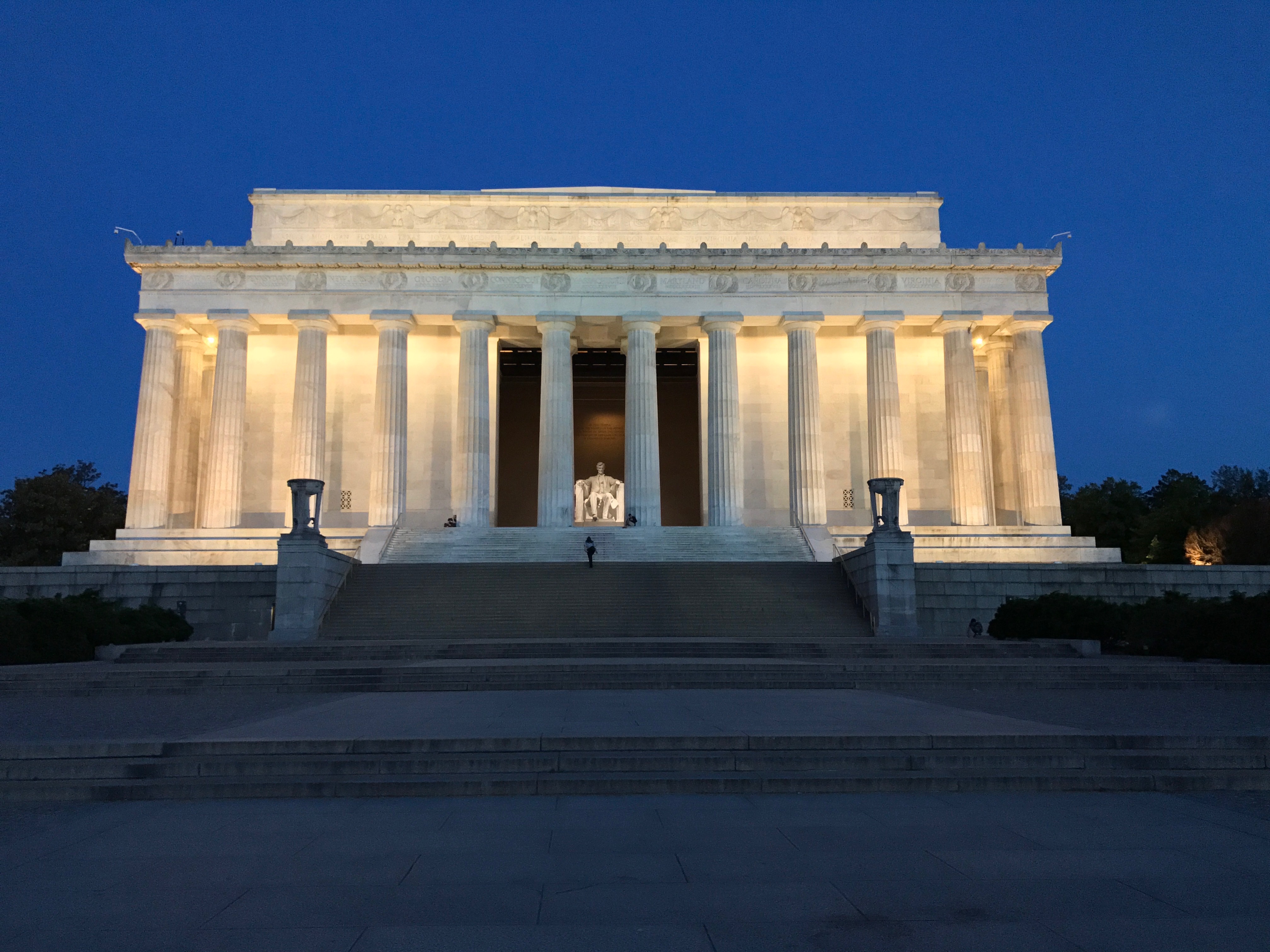
One of my favorite monuments is the Lincoln Memorial. Jogging west from the Capitol Building, it’s about 2 miles to the Lincoln Memorial at the far end of the Mall. The classical Greek Temple structure sits near the banks of the Potomac river. The Lincoln Memorial, being one of the most recognized structures in the world probably, attracts a lot of visitors. Even in the early morning pre-dawn light you’ll almost always see a few people, sometimes even a group, sitting on its steps or wandering among its Greek Columns. I usually climb the temple steps and stand in reverential silence before the grand statue of Lincoln. I always tell people it’s a spiritual experience.

At about 5:30 a.m. yesterday morning as I approached the Lincoln Memorial I stopped and took this picture with my iPhone:

IMG_2358
Image Credit: Jeff Wills