While slowly reading and sipping coffee this morning, I read these lines on page 58:
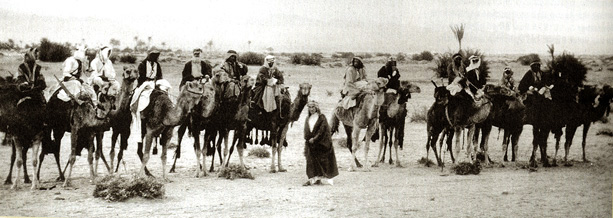
…The Juheina tribe, on Feisal’s left, lost heart quickly and fled the battlefield. The Juheina would later claim that they had merely been tired and thirsty and had needed a coffee break…their flight led to the rapid collapse of the rest of Feisal’s line and a disorderly rout…
One hopes they were going for expresso, because the regular coffee wasn’t doing it!
Anyway, in a Western army—this was 1916, the middle of WWI—a commander would have most likely faced a firing squad for this.
Later on, when Lawrence met up with Feisal, the Emir wasn’t upset at all about his army’s collapse in the face of a Turkish force half the size of his, in fact Feisal was in a rather “jolly mood.” He was trading good natured taunts and insults with another Arab commander over “the speed” in which his forces had also “run away” in the face of a Turkish force.
One of the early lessons Lawrence took from Emir Fiesal, the man Lawrence felt had the heroic qualities to lead the Arab revolt, was a sense of humor, “that invariable magnet of Arab good will” Lawrence wrote, that was one of the key qualities that allowed Fiesal to maintain the cohesion and loyalty of the various tribal leaders. “The tribesmen,” Korda wrote, “responded poorly to criticism or reproof but enjoyed a good story even when it was at their own expense.”
Fiesal’s army wasn’t a disciplined professional army but a collection of Bedouin tribes, any of which, if they’d had enough, could walk away at any time. To keep this army together would take a leader adept in emotional intelligence, which Fiesal seemed naturally endowed with.
Plato, and before him poets like Hesiod, complained that society was going to hell. And think about it, western civilization was just getting started! Throughout the Platonic Dialogues (399 to 347 BC) there’s a sense of a longing for the past, the sense that something is being lost, that the youth (of Athens) were being corrupted by “the new ways.” The source of this corruption was the spread of immoral art (too much Homer), scientific explanations of nature (which angered the deniers), irreligiousness, and a disrespect for the old ways, i.e. tradition. So…really not much has changed.
It’s interesting because Plato isn’t really viewed as a conservative, thanks in part to Karl Marx, and yet Plato’s overall philosophy is about conserving the inherited forms of the moral and political order. Plato (through Socrates) is ultimately saying, in some form or another, that whatever you may believe it shouldn’t usurp the established moral and political order — because God knows what we’ll end up with! And for Zeus’s sake, Plato irritatingly prodded, if you’re going to challenge the traditional order, try to at least understand what you really believe and be able to explain it. Define your terms! Ask questions. Tell us how you know what you know and why it’s better than the way things are now. Because relativism — the bane of social cohesion — isn’t very solid footing!
Okay, so this brings me to David Brooks’s NYTs column lamenting the Crisis of Western Civ. Brooks starts his column by plugging one of the best set of books you can read if, and this is the big issue, you have the time. The Story of Civilization is an 11 volume set running almost 10,000 pages. Definitely not a “I’ll knock this out in a weekend” read. This is a reading project for, say, a year or two or more. Even though Will and Ariel Durant finished the series in 1975, the Story of Civilization is still one of the best liberal arts educations you can get on your own. The education is broad, the writing is excellent, and you’ll gather a whole stock of great quotes.
So back to Brook’s column. There is a Western set of values, a grand narrative — though you’d be hard-pressed to find many Western citizens who could explain it to you — that has animated the rise of Western Civilization. (Note to some of my fellow Americans reading this: You’re actually part of Western Civilization, just incase you missed that class). If ideas rule the world, as Lord Keynes assured us they do, then this set of ideas, known collectively as Western Civilization, have guided the rise of the most prosperous and free, most powerful, civilization in history. So probably not a bad idea to hold on to some of these values and ideas. But then who’s judging, that’s just so Western. Anyway, Brooks provides a brief explanation of what these Western values entail:
This Western civ narrative came with certain values — about the importance of reasoned discourse, the importance of property rights, the need for a public square that was religiously informed but not theocratically dominated. It set a standard for what great statesmanship looked like. It gave diverse people a sense of shared mission and a common vocabulary, set a framework within which political argument could happen and most important provided a set of common goals.
Now there’s a lot more to what makes up Western Civ or culture, but you get the gist. But regardless of how we define it, Brooks wants to remind us the whole project is in trouble, and has been for a while.
Starting decades ago, many people, especially in the universities, lost faith in the Western civilization narrative. They stopped teaching it, and the great cultural transmission belt broke. Now many students, if they encounter it, are taught that Western civilization is a history of oppression.
It’s amazing what far-reaching effects this has had. It is as if a prevailing wind, which powered all the ships at sea, had suddenly ceased to blow. Now various scattered enemies of those Western values have emerged, and there is apparently nobody to defend them.
Hmmm, grim. For the most part I agree with Brooks. There does appear to be some cracking in the Western Civ narrative, and generally speaking this is a bad thing for the long term health of Western Civ — if, and this is important, these cracks in the narrative are the beginnings of a break. Cracks are typical with wear and tear and require constant repair, some social and cultural chalking. But breaks are very hard to fix and mean things are definitely going to hell.
Brooks contends that the decline of Western Civ started “decades ago,” which I reasonably sure he means the 1960s. But the evidence seems to suggest, like Plato and Hesiod long ago, that the idea of cultural decline is an observation going back even further than the 1960s. The American poet and essayist T.S. Eliot, an astute observer of society, wrote these words in 1948, during the rise, please note, of the Greatest Generation: “We can assert with some confidence that our own period is one of decline. The standards of culture are lower than they were fifty years ago; and the evidences of this decline are visible in every department of human activity.” So Eliot sees decline all around him. It’s all going to hell! A Google search will reveal quotes from across Western history about the decline of society. So we can say with historical authority that the Idea of Decline is something built right into the Western narrative itself.
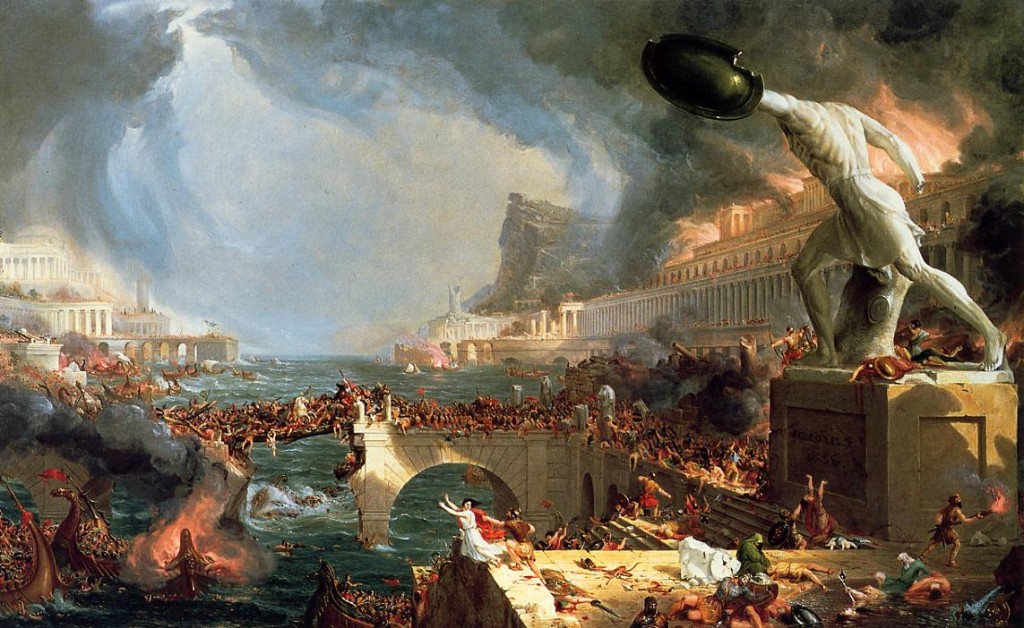
So Western Civilization is falling apart, but it seems to be taking so damn long and somehow it keeps recovering and then continues falling apart, recovering again, and then back to falling apart again. Might the current fracturing simply be symptoms of Western society going through a stage of development within Western Civilization? I might be wrong (yes, I’m hedging), but this seems very probable. Stages in the growth of a society or civilization, like with individuals, are typically disruptive events — they’re times of change, reflection, discovery, a sense of falling away from old ways, and the altering of perspective. Think of the Enlightenment. The old order, typically, isn’t going to be happy with the change. Now, of course, like Rome ultimately, the whole project could eventually fall into ruin. The course of empire and human nature has a strong tendency to assert itself. Let’s not forget, for those who paid attention in Sunday school growing up, this is a fallen world. One just doesn’t know if we’re experiencing a fall or a stumble…or a stumble leading to the fall; a crack or the beginnings of a break. Even so, remember Rome’s fall didn’t ultimately destroy Western Civilization. It turned out to be a set back, but Western Civilization ultimately recovered and marched on.
I think the real question, since the idea of decline has always been with us, is whether we’re actually facing a Germanic invasion (the cause of Rome’s immediate collapse, the beginnings of a break) or are some people simply reacting negatively, as many older generations do, to change, to the defeat of old politics and old ways, to a new generation not like them in many ways, with different ideas, and on the verge of taking power in the society. With new perspectives comes change in the moral and political order. It’s unavoidable. But does that mean the new generation is giving up on Western values? Does this mean we’re seeing the end of Western Civilization? Or is the new generation simply reinterpreting these Western values in light of their experience? Hasn’t every generation in Western history, to some degree, done this?
These are my thoughts as I sit here drinking coffee this morning. I’m trying to remain positive as you can see. But hey, tomorrow, after scanning my Facebook feed, I might think it’s all definitely going to hell!
This post is about civil war history, but it’s also written as a memento for my youngest son to remember our trip by.
In great deeds, something abides. On great fields, something stays. Forms change and pass; bodies disappear; but spirits linger, to consecrate ground for the vision-place of souls. And reverent men and women from afar, and generations that know us not and that we know not of, heart-drawn to see where and by whom great things were suffered and done for them, shall come to this deathless field, to ponder and dream.
— Joshua Chamberlain at the Dedication of Maine Monuments, Gettysburg, PA, October 3, 1888
***
At cemetery ridge looking out toward the confederate position on seminary ridge
Last October 29, 2016, I visited the Gettysburg battlefield with my friend Rich and my youngest son. It was a beautiful autumn day. The temperature was perfect. The skies clear. The colors were at their peak. It was a lovely day to reflect and daydream.
Like with any meaningful place, there’s a unique spirit-of-place to Gettysburg that stills the soul and leaves a lingering presence, haunting the corners of your mind long after you’re gone.
The impetus for this particular trip had three things behind it:
First, my love for history and biography. I’ve read and learned a lot about the Civil War and the leading characters of this epic historical drama. The battle of Gettysburg was the biggest, mostly costliest battle ever fought in this hemisphere. At the end of 3 days of savagely intense fighting, there were upwards of 51,000 casualties between the two armies. Consider that just for a moment. Over an approximately 72 hour period, there were almost as many casualties incurred at the Battle of Gettysburg as there were U.S. troops killed (59,000) in the entire 10 years of the Vietnam War. For any student of American history, you can’t learn enough about the Civil War or what happened at Gettysburg and how it changed the direction of American history and the shape and trajectory of our nation leading up to the present. There are many great books out there, but I suggest you begin with the best. The Civil War historians Bruce Catton, Shelby Foote, and James M. McPherson have produced some of the finest literary histories ever written. Stephen Sears wrote one of the best, most comprehensive histories of the Gettysburg campaign. And who can forget the absolutely absorbing, pulitzer prize winning, historical novel by Michael Shaara, The Killer Angels, and the movie based on it. There’s a lot of great literature about the Civil War. Any aspiring writer can learn his or her craft just by reading Catton, Foote, and McPherson alone.
The study of war is so much more than a study of strategy, maneuvering, and the calculated application of violence. The history of warfare (as does all history) teaches us many things, but it’s an especially good tool for teaching leadership, whether it’s for the personal or professional domains of our lives. Violence, to be sure, is the shroud of war. But within this covering fabric is the vast interweaving of human qualities, both base and noble. To study and learn from this collision of circumstance and character is one of the best educations in human nature, human excellence, and human folly you’ll ever get. “History is,” Lord Bolingbroke once said, “philosophy teaching by example.” Hopefully this type of liberal education, as it was intended, inspires each of us to emulate the virtuous and the noble—to be guardians of civilization and civilized values. An education in any of the Liberal Arts is ultimately about improving the heart and mind, but historical study in particular provides the best laboratory for examining what human beings have actually done, said, and suffered. Literature, historical or otherwise, has the potential to greatly expand our empathetic and intellectual horizons. It’s a never ending journey of discovery. It has the potential to positively transform your life.
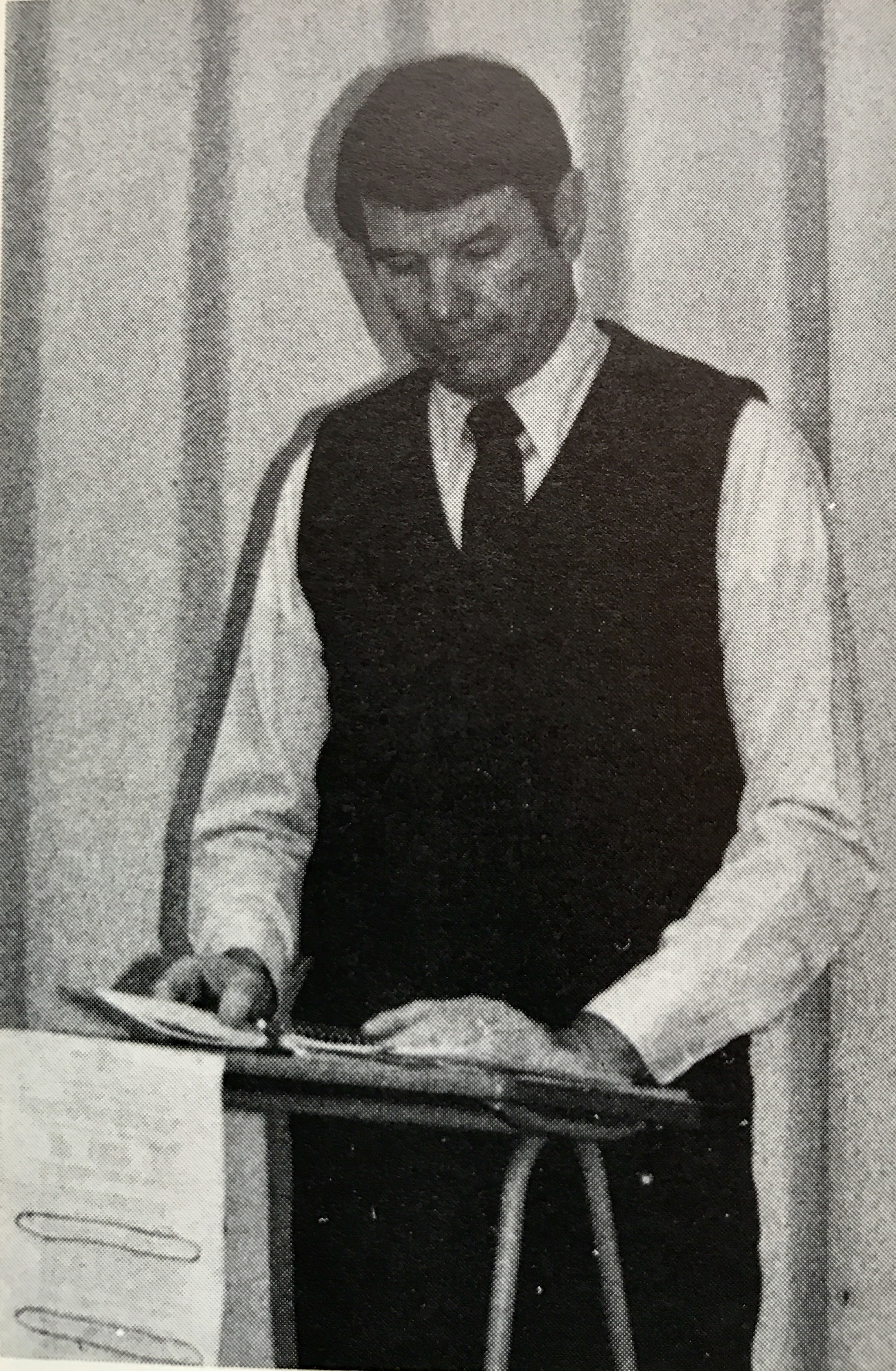
Donald S. Fuller, 1981, KJHS
This brings me to a brief aside. I think it’s important to remember the great teachers of our life, those who helped form who we are today. I date the beginning of my lifelong fascination and love for history to my time in Donald Fuller’s history class at Kempsville Junior High School (now Kempsville Middle School) in Virginia Beach, Virginia. Don Fuller was a retired Naval Officer and teaching was his second career. He had a real passion for teaching and he really knew how to make history interesting and relevant to my understanding of the world. I can still remember how I’d approach him after class to get more details about a famous person, battle, or event that he’d discussed during class. He would take his time with me and often draw on the chalkboard to illustrate his point. I can still remember him drawing the details of Hannibal’s “bending bow” strategy at Cannae. He knew so many interesting things about the battle and the characters involved. I remember being fascinated by the depth and breath of his knowledge, and thinking to myself how I’d like to be that knowledgeable about history one day. I can still recall the sound of his unique voice. About a decade or so after attending his class, I visited him at Kempsville Junior HS, where he was still teaching. He remembered me at first sight and was glad to see me. We had a good long talk standing in the hallway. He was still the teacher, and I was still the admiring student. He was a big influence in my early life and certainly a big reason History has been one of the passions of my life. In its original Latin derivation, the word inspire means “to breath into,” and that is what Don Fuller did for me. He inspired me. I really admired him, and I will never forget him.
At the Penn Memorial
Secondly, I also wanted to visit Gettysburg because my good friend Rich had never been there, and he wanted to take some pictures (I didn’t know at the time, that another motive for Rich wanting to go was his secret mission to help get me out of the house so my lovely wife could prepare for my surprise birthday party, that afternoon, when we got home!). And lastly, but most importantly, I wanted to go to Gettysburg so I could spend some quality time with my youngest son, Seth. This would be his first trip to Gettysburg and hopefully one among many to historically significant places over his life.
Our first stop that morning, after touring the visitor center (where I bought my son a toy musket and canteen), was the federal army’s position along Cemetery Ridge. Union or federal army troops had retreated to this position (the high ground) and formed defensive lines during the 1st day of battle (It was a 3 day battle, July 1-3, 1863).
The battlefield, especially the federal army side, is replete with monuments and memorials. The largest and most impressive is the Pennsylvania memorial. All around the outer edge of this massive stone structure are large bronze tablets with the memorialized names of approximately 34,000 officers and soldiers from the Pennsylvania regiments that fought in the battle.
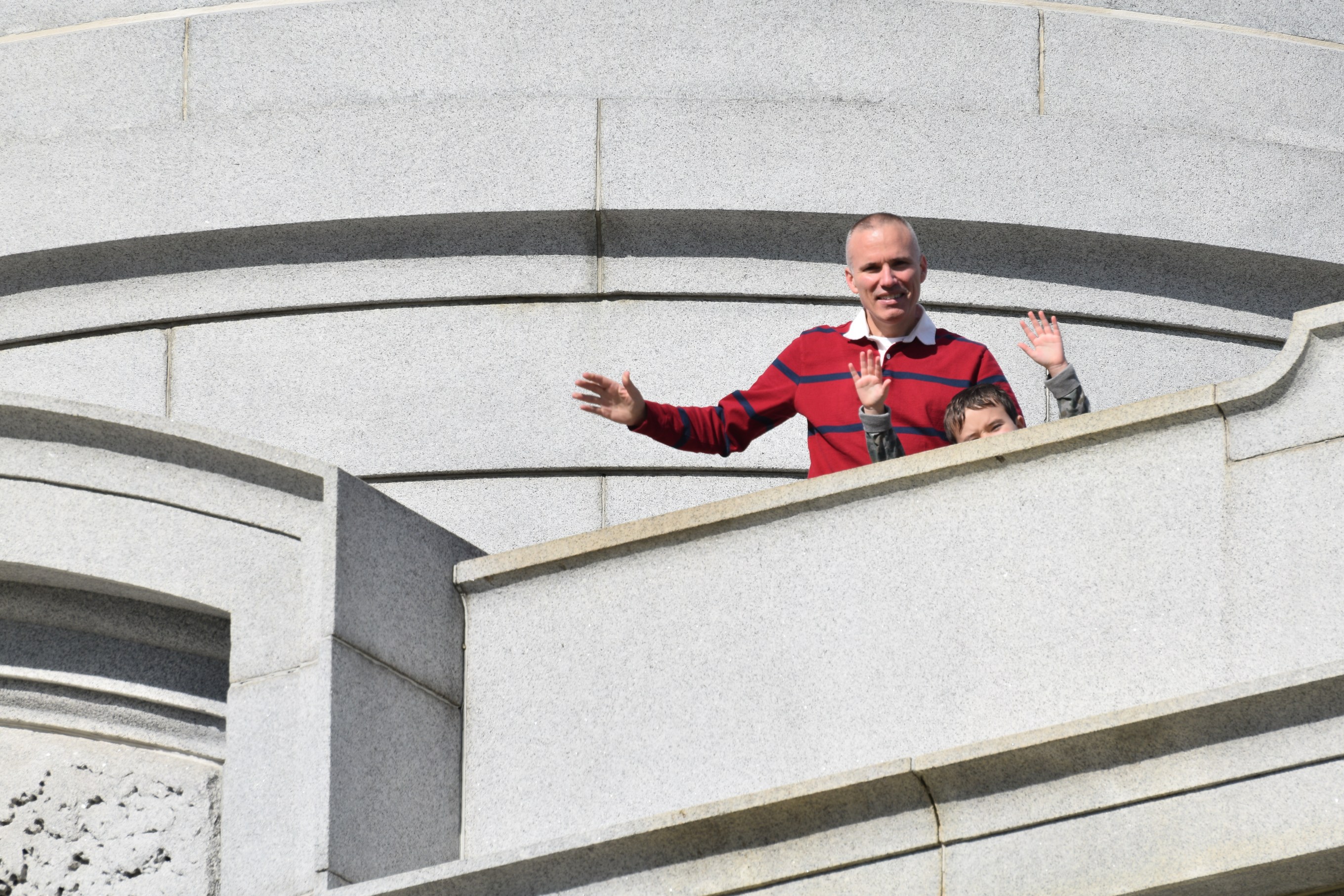
While walking around the Penn memorial, Seth and I discovered that it had an upper level for viewing the battlefield, so we headed up. My son was nervous about being up so high. He leaned against me protectively and held my hand tightly, as we climbed the narrow spiraling stairwell. As we continued up I heard his shaky voice, slightly strained with fear, say “I’m afraid of heights dad.” I’d never heard him say this before, so I pulled him closer and we continue up. We emerged onto a circular viewing platform and a magnificent view. From this position we were near the center of the federal army line. To our south the line runs to Little Round Top—the far left end of the federal army line— and then turning our gaze northeasterly, we saw Culp’s Hill, which is the far right end of the federal army line. Directly to our West was the confederate army position in a tree line along Seminary Ridge.
Atop the Pennsylvania Memorial
We lingered a little while and I took some pictures. We waved to Rich who was still in the parking lot below getting his camera equipment together. He took a picture of us waving from the top of the memorial. My son didn’t want to linger, so we walked around the memorial dome, taking in the view from all sides, and then headed back down.
We moved from the Penn memorial to another part of Cemetery Ridge known as the “bloody” Angle. This is the point confederate General Robert E. Lee focused his main attack on the afternoon of July 3rd at about 3 p.m. Known as Pickett’s Charge, it was comprised of between 13,000 and 15,000 men, mostly Virginians, and was ultimately repulsed (with over 50% casualties), but not before a brigade of Virginians led by Brigadier General Lewis Armistead breached the federal line at the Angle. Armstead’s men fought bravely, but there simply wasn’t enough of them to exploit the breakthrough. There’s a plain stone marker at the spot where Armistead was hit and fell during the close quarter fighting. That spot is known as the High Watermark of the Confederacy.
This past Sunday, the Washington Post had an interesting piece by Bill Bishop. If you don’t know Bishop, and you have an interest in understanding American’s current social and political problems, then I suggest you pick up his book The Big Sort. It really is one of the best books I’ve read in the past 10 years. It’s was a fascinating read.
In this past Sunday’s piece, Bishop looks at why our trust in institutions is at such a low level. In 1964 roughly 75% of the American public trusted their government to do the right thing. By 1976 that trust level was down to 33%. A big swing in 12 years. Now, during that period we had the assassination of 2 major national figures, civil rights unrest, a major political realignment, an unpopular war, and the resignation of Richard Nixon over the Watergate scandal. But while all of these things may have added to a decline in trusting government, they aren’t, Bishop argues, the real story here.
Bishop points to two big trends in recent history. First, the decline in people trusting their government parallels a “falling trust in nearly ever institution,” both public and private. So it’s not just the government we’re talking about here, we need to be clear on that. Second, this trust deficit, though maybe not as bad as it is in the U.S., is a trend across most industrial democracies. So it’s not just America either.
Americans may have less trust in their government, but they’re also walking away (no longer trusting or wanting to be involved with) from organized religion and many other civic associations that use to serve in helping unify us. Bishop sees expanding diversity, the welfare state, and rising wealth as social engines that have brought about an “Enlightenment Individuality” in our society, which in many ways is inimical to the maintenance of community and trust. More than ever people are “artists of their own lives,” shedding traditions and cultural norms. While this is liberating in many ways, it’s also, when taken in the large, socially disrupting because it weakens social cohesion.
The interesting point, from a historical perspective, is that this trend is something much older than we think. Where ever there is an intersection of commerce, wealth, culture and diversity, you will have this pull toward “negation.”
As far back as the 1600s, travelers confronted by new cultures and novel deities began to question their own societies’ rules and institutions. “Not a tradition which escapes challenge, not an idea, however familiar, which is not assailed; not an authority that is allowed to stand,” historian Paul Hazard wrote. “Institutions of every kind are demolished, and negation is the order of the day.” This was the Enlightenment, a turning away from tradition and an anointing of reason, scientific inquiry and individualism.
And so while some people may point to Donald Trump as the personification of a movement against the so called “establishment,” it’s far more accurate to say he’s simply riding a wave, a historical trend that has little to do with him at all.
Bishop finishes his piece by saying there really isn’t anything we can do about this. Personally I think he’s wrong on that point. It will take, as William Hazlitt said, “a lot of fine writing,” strong leadership, good will and good government, all things in very short supply right now, to push this long term trend in another direction. But it can be done.
I picked up my youngest son at school the other day. After getting in the car, instead of immediately buckling up, he started searching his book bag for something. I sat patiently and waited util he was ready to go. He found what he was looking for and got buckled up. I started driving toward his favorite restaurant (Applebee’s), where I’d promised to take him the day before. As we were driving, I noticed in the rear view mirror he was reading through a book. Great, I thought. We stopped at a traffic light and he asked me to turn and look at a map and a sign language chart in the book. He had the air of a kid who knew his dad liked books and so he wanted to show this one off. I was happy to oblige.
After parking the car, my son quickly unbuckled and started showing me sections of the book. At first I thought the book might have been some type of encyclopedia but I still wasn’t sure yet. After about my third question, my son finally handed me the book. The cover of the book had me immediately.
There in vivid color were the starry heavens, mother earth, an a profound quote by one of the 20th century’s greatest philosophers. I have to say, the quote of Ludwig Wittgenstein really sealed the deal. It’s one of my favorite quotes, and for a dictionary meant for 3rd graders having this quote on the cover was just the type intellectual presumptiveness I find very encouraging. A quote like that ignites reflection before you even open the book.
This Dictionary was given to my son as part of The Dictionary Project (DP). The DP’s goal is to “assist all students in becoming good writers, active readers, creative thinkers, and resourceful learners by providing them with their own personal dictionary.” There are many great causes in life to dedicate yourself to, but this has to rank as one of the most important. So much of the personal and professional success that young people ultimately have in life stems directly from the quality of their education at the primary school level.
In the opening pages of this dictionary there’s a short, concise essay that cuts to the central reason why students (at school and throughout life) need to use and refer to a dictionary regularly:
To succeed in school and in life, you must be able to use the English language effectively. You simply cannot learn all that you need to know without being able to understand the words you hear and read, and without knowing how to use the right words to convey your thoughts and ideas clearly.
For someone who admires intelligence, creativity, and the artful use of language and the power that words can carry, it was a nice reminder that there are so many people and groups—teachers, parents, and private Foundations—constantly striving, in big and little ways, to improve the lives of our most precious resource, our children.




 Jeff Wills