Making George Orwell Great Again

george-orwell
George Orwell

The new Trump Administration has been a boon for sales of George Orwell’s book 1984. The novel is a literary masterpiece. Originally published in 1949, it’s a dystopian novel about authoritarianism. The most famous quote, which you’ve probably heard at one time or another, is “Big brother is watching you.” The novel introduces us to concepts like Newspeakdoublethink, and thoughtcrime. The decades old novel is suddenly back on the bestseller list (an Amazon #1 recently) because some of the book’s ideas are speaking to us at this unique time in American history. What this book does, or I should say what all good literature does, is provide us with a vocabulary for articulating our feelings and thoughts. Being able to speak about something allows us to better understand it. Freedom of thought, as the novel tells us, is partly brought about by an expansion of expression via language. Thought and language are tied together.

This brings me to a general theme in Orwell’s work. Like every good writer Orwell was concerned with the truth. For example, Orwell had fought in the Spanish civil war on the side of the Republic against the fascist. He had personally witnessed some of the key events in the war. After the war, he’d read a lot of reports about the war and found a lot of what he’d read contained blatant falsehoods. He knew what was happening. The fascist had ultimately won the Spanish civil war and they were now attempting to shape its history through propaganda…or as Orwell might say, they were purposely trying to create its fascist history. Authoritarian leaders, i.e. Franco, Hitler, and Stalin, where not just trying to control the present and the future, but also the past. Propaganda and lies were replacing history and fact and what actually happened. This terrified Orwell:

This kind of thing is frightening to me, because it often gives me the feeling that the very concept of objective truth is fading out of the world. . . . Nazi theory indeed specifically denies that such a thing as ‘the truth’ exists. There is, for instance, no such thing as ‘Science’. There is only ‘German Science’, ‘Jewish Science’, etc. The implied objective of this line of thought is a nightmare world in which the Leader, or some ruling clique, controls not only the future but the past. If the Leader says of such and such an event, ‘It never happened’ — well, it never happened. If he says that two and two are five — well, two and two are five. This prospect frightens me much more than bombs — and after our experiences of the last few years that is not a frivolous statement. (Underlining added)

I’ve read the entire 3 inch thick volume of the Everyman’s Library edition of George Orwell’s essays. It’s one of my top 5 all time favorite books. While Orwell’s novels are excellent, it’s in Orwell’s essays that I believe we get the best of Orwell as a writer and social critic. His essays are a first class education in the humanities and writing. Take my word on that. We could have a college level course just on Orwell’s essays and it would be a fascinating intellectual and moral adventure.

Being Orwellian, I think, should also mean having a scrupulous concern for precision, integrity, and facts in the way you think, write, and speak. The truth is usually complex and sometimes very difficult to get at, but it can only be genuinely approached through a moral courage and intellectual integrity we see on constant display in writer’s like George Orwell.
Good finds!


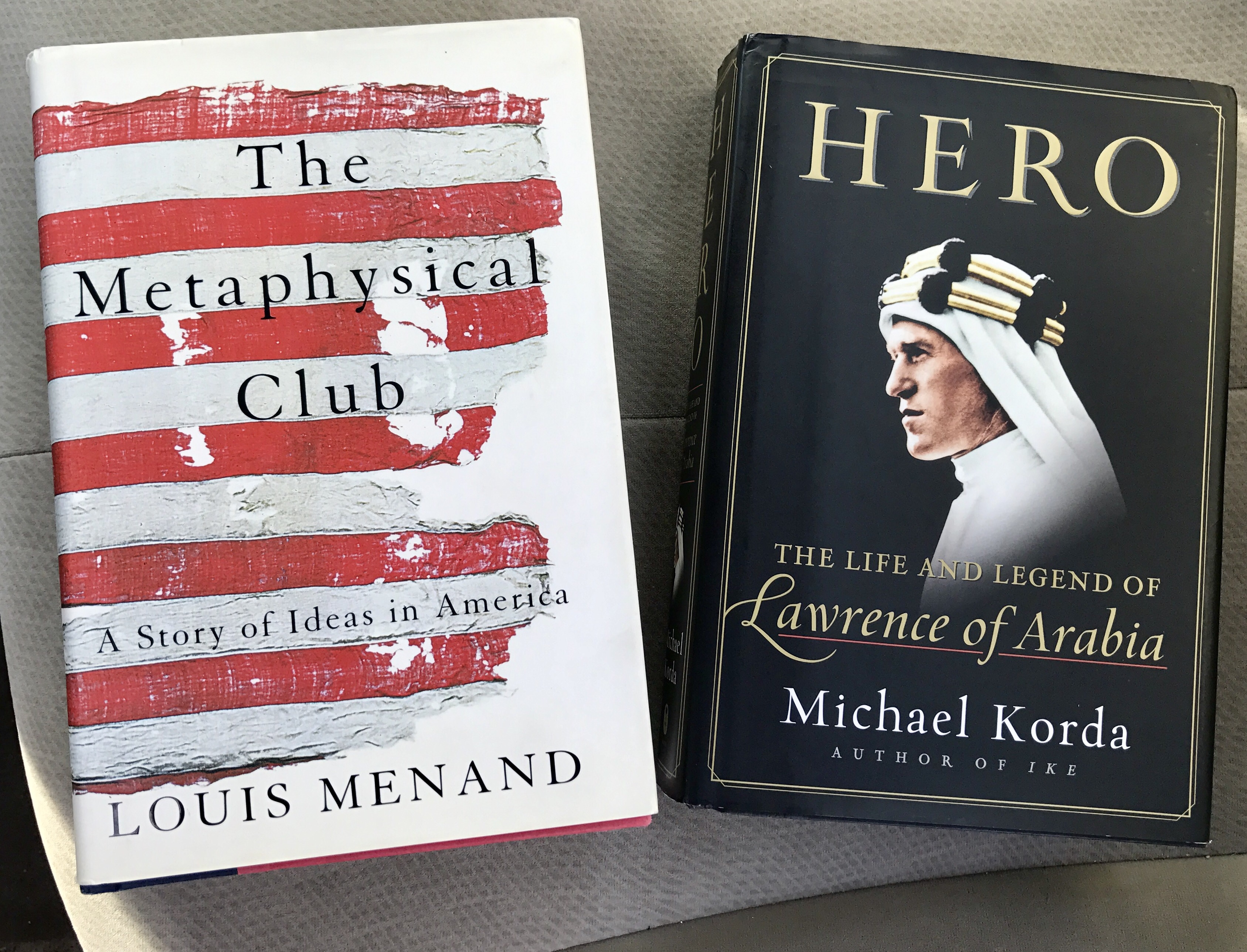
Found these two at a local used bookstore today. The Metaphysical Club won the Pulitzer Prize the year it was released. Menand is also an accomplished essayist. I’ve always been fascinated by pragmatism since reading William James’s work. Metaphysical Club elaborates elegantly on the origins of this American philosophy.

I studied management and leadership at undergraduate (and graduate) school and one of the books I reviewed as part of a course was T. E. Lawrence’s 7 Pillars of Wisdom. That was a very interesting book. I remember thinking I needed to find a good biography on Lawrence. So finally, many years later, I’ve finally picked one up for cheap. Great finds!

What Our Book Collections Can Tell Us About Ourselves

In a good bookroom you feel in some mysterious way that you are absorbing the wisdom contained in all the books through your skin, without even opening them. — Mark Twain


img_1605
From my Collection

I have a small study in my house. Well, it would be better to say I have a room in my house with books on shelves, books in boxes, and books stacked on a French Avignon desk that I don’t use. We moved into this house over a decade ago and I told my wife then, patient and tolerant woman that she is, that “You go ahead and decorate and finish all the other rooms first and then we’ll do my study last.” Well, as with various other projects around the house, I never followed through. I had grandiose ideas about my new study and what it would mean when we moved into our new house. “I would,” as Michael Dirda quipped “of course, wear a velvet jacket at my desk, take breakfast in the conservatory, and in the late afternoon go for long walks on graveled paths.” I know, that’s pathetic.

Anyway, the truth is I’m either sitting at the kitchen table or in a chair in our bedroom when I write (or read) at home. Oh, and I don’t have any graveled paths to walk on either. My study, or “bookroom” really, is just storage space for me to wander through (or trip), while searching for a book or just casually picking up books and dipping into them to get a taste of the author’s prose or find some inspiration. My bookroom ramblings remind me of a fine quote by Churchill, that nicely captures my state of mind:

“If you cannot read all your books…fondle them—peer into them, let them fall open where they will, read from the first sentence that arrests the eye, set them back on the shelves with your own hands, arrange them on your own plan so that you at least know where they are. Let them be your friends; let them, at any rate, be your acquaintances.” — Winston Churchill

IMG_0321
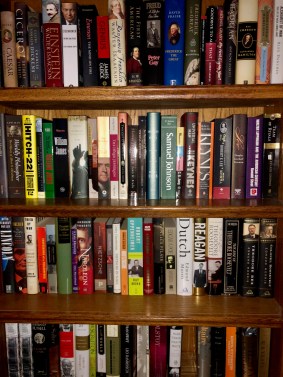
Part of my Biography Collection

Recently I decided to organize my books a little better. Instead of strictly by author, I organized them into large categories like history, philosophy, economics, etc, etc. A novel idea, I know. Of course this process, as I sifted through the boxes and shelves, forced me to see (by stack size, and word count) exactly what category had won my interests and taxed our budget over the years. In my case the winner, by sheer numbers and thickness of books, is biography. I’ve definitely read a lot of them over the decades.

Maybe it’s partially in the blood. My mother loves biographies and has a small collection herself. For me, I don’t know exactly when biography became my favorite genre, but I can remember two books that probably had the biggest influence on me early on in my reading life. Many years ago I read James Boswell’s biography of Samuel Johnson. Yes, I read the entire unabridged 1402 pages of the Oxford World Classic edition. I’m a slow reader, so believe me that took a while! But it was a great reading experience. Boswell’s biography was full of wit—which Johnson excelled at—and wisdom and fascinating details about 18th century English culture and art. It’s definitely a classic. I came away totally fascinated by Johnson’s unique life and powerfully quick, creative, and intelligent mind.

Boswell’s biography led me to Walter Jackson Bate’s biography of Samuel Johnson. This was an absolutely absorbing book and a captivating literary experience. I had no idea, at that point in my reading life, that biography could be so compelling, instructive, and psychologically insightful. I completed Bate’s biography of Johnson feeling my perspective on life and the dynamics of human potential had changed. It was, properly speaking, literature that inspired a reverence for the power of literature to alter how we see the world. The book, by the way, won all 3 of the major American literary prizes, something that rarely happens.

The next biggest book category in my study appeared to be classical history, followed by literature (mostly essay collections), general history, leadership, psychology, civil war, and economics. And of course I have a large collection of what can be called general non-fiction. Books by, say, Malcolm Gladwell would fall into the category. My collection of novels is not what it use to be. I actually don’t read that many novels anymore I’m sad to admit. My time is limited, as you can tell by the rather spare postings on this blog (hoping to change that), and so I need to prioritize my reading to make room for writing.

If there is anything I’m reminded of from reorganizing my bookroom, it’s that the books we collect don’t just represent what we like to read, but also through what discipline (or category) we enjoy discovery. For me, I’m attracted to biography, the story of people’s lives. It’s this form of literature that’s had the biggest influence in shaping how I’ve learned about the world. “I esteem biography,” Samuel Johnson said, “as giving us what comes near to ourselves, what we can turn to use.” I for one have always loved this quote and, as my bookshelves can attest, taken it to heart.

Remembering John Glenn (1921 – 2016)

Senator John Glenn

The morning mists at Arlington National Cemetery were still visible as I stood watching the slow precision of the officers folding the U.S. flag. Everyone stood completely still as the ceremonial team of the United States Capitol Police (USCP) carried out this final symbolic act of a grateful nation. This funeral took place in the early 1990s. I don’t recall who it was for. But I do know the deceased had served in the armed forces and then completed a second career with the USCP, protecting and serving the U.S. Congress.

When the two officers completed folding the flag, the officer holding the flag turned and ceremoniously stepped toward a man in a gray suit who was standing at attention waiting to receive the flag. The officer handed Senator John Glenn the flag and saluted him. Senator Glenn saluted the officer back. Senator Glenn then turned, walked around the casket to a woman seated in front of the casket, bent down toward her, and with both hands gently handed her the folded American flag. As she grasped the flag Senator Glenn spoke. Although I could not hear him, the Senator would have said something to the effect of “On behalf of the President of the United States, the President Pro Tempore of the U.S. State Senate and the Speaker of the U.S. House of Representatives, please accept this flag as a symbol of our appreciation for your loved one’s service to this Country and the United States Congress.”

I had watched this entire event from my position about 25 yards away, standing quietly by myself near a parked police van. When Senator Glenn was done he walked over and stood next to me. I hadn’t expected it. It was just him and I standing there in silence as the ceremony continued and the burial team’s bugler began playing taps. As the sad and final note of taps began to fade, the Senator broke the silence: “You know,” he said in a quiet and solemn tone, as he stared out across the sea of gravestones, “I’ve heard that many times and yet every time always seems like the first emotionally.” The Senator had come here to Arlington that morning because he had known the deceased U.S. Capitol Police officer and volunteered to present the flag.

As the ceremony ended, the Senator asked me where I was from and we began talking. I’d seen the Senator around Capitol Hill a number of times since I’d arrived in 1991, but I’d never really had the chance to talk one-on-one with him, so I took this opportunity. I knew what most people knew about John Glenn: that he’d been an astronaut and, of course, a Senator. But I didn’t know much more. I remember at one point asking him about his military career:

“So you were a Navy pilot?”

“Oh no, I was an Marine Corp Aviator.”

“Oh, so the Marine Corp has Aviators too?”

Turning toward me and speaking through a playful smile, “I didn’t know there was any other type.”

I chuckled at this good humored shot at the Navy. The rivalry was still alive with this retired Marine Corp Colonel. We stood there talking for about another 5 minutes, and during that brief time I remember feeling a deep sense of admiration and inspiration.

Until he left Congress in 1999, I would see Senator Glenn around the Hill on a number of occasions. He was always friendly and always seemed to remember me and our brief conversation that morning in Arlington. He would typically stop for a moment to shake my hand and exchange a few words. It was always a real pleasure.

John Glenn was a true American hero and a powerful inspiration for any aspiring leader. In this uniquely uncertain time in American history, we need to look to the lives of people like John Glenn as the example of what truly made America a great nation.

He will be missed.

(John Glenn passed away on December 8, 2016. He was 95)

My Thoughts on the Presidential Election

IMG_2500
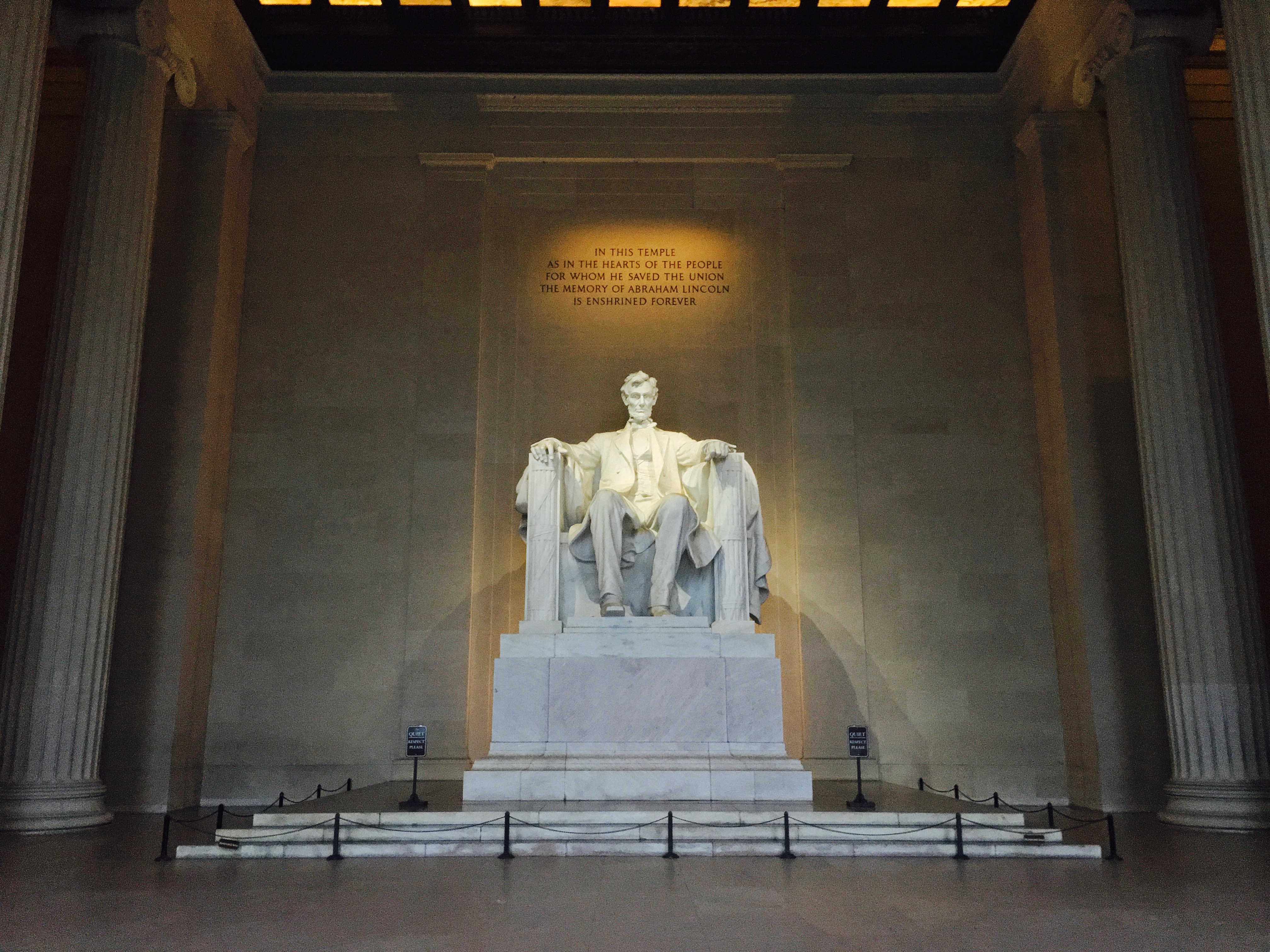
Lincoln Memorial, Washington D.C. (Photo by Jeff Wills)

The morning after the November 8th presidential election, I jogged to the Lincoln Memorial on the Mall of Washington DC. I entered the memorial, where the statue of Abraham Lincoln, the first Republican president is located, and stood there in meditative thought. Out of the profound silence I thought I heard the whisper of Lincoln’s ghostly voice: “Holy shit, you’re kidding me.” I turned and stared out across the National Mall toward Capitol Hill and wondered the same myself.

I’ll admit I have a bias against people like Donald Trump. I prefer leaders who act magnanimously toward their rivals and those they disagree with. I prefer leaders who can speak intelligently, responsibly, and realize that words really do matter—because, believe me, they do. I prefer leaders who’ve done their homework, actually understand the issues, taken the time to study them in-depth, and can talk intelligently about those issues. I prefer people who don’t abuse their status or celebrity and instead act with graciousness and kindness toward those less fortunate than them. And I definitely prefer leaders without an elaborate and well attested history of immoral behavior. I guess, in brief, I prefer leaders who’ve consistently demonstrated a spirit of nobility and excellence instead of the very opposite qualities. So naturally I find people like Donald Trump an anathema in positions of public leadership. To me—an a very large swath of America—Donald Trump may be the most unfit man to ascend to the Presidency in our nation’s history.

But now the deed is done and we’ll have to suffer through it. I’m doubtful that Donald Trump or those around him will ultimately be able to help most Americans—especially the working class—improve their lives much. The same trickle-down economic policies the Trump team (and the GOP Congress) are currently batting around are the very policies that caused the stagnation of the middle-class and decline of the working class over the past few decades. Another big consideration is that a number of the social problems in many working class communities are self-inflicted and not amenable to being improved by government policy. In short, while government policy can help, and should be implemented, there are some cultural problems within those communities that need to be resolved by those communities.

I suspect from this president and republicans in congress we’ll see mostly policies that favor the Donald Trump’s of the world (his family’s wealth and prosperity), while many of the programs and investments in the middle-class and working class will be targeted for cuts in order to allow for more corporate largesse and tax breaks for the rich—who don’t need them and we can’t afford to give them. It’s really about math, and many of us will likely be on the losing side of the equation with this administration and this congress. And so the march toward a bigger, even stronger, more powerful oligarchy resumes.

But prove me wrong! Believe me, that would be fine by me.