What Type of Bourbon Drinker Are You?

A good friend of mine started a blog that’s about Bourbon and the art and craft of making it and enjoying it. Take a look and follow his blog. Thanks!

So when I set out to create The Bourboneer (see About page), my plan was to define the constitution of a true bourbon enthusiast. Specifically, that desire which drives the bourbon drinker to love …

Source: What Type of Bourbon Drinker Are You?

Bad Thinkers

Is the way people think, to use the computer metaphor, always amenable through a software update? Or, are there people whose hardware just can’t be updated?

I suspect we all know of people (hopefully not too many) who believe in wild conspiracy theories. They tend to reject contrary evidence, solid science, or sound arguments. So a fair question arises: Are these people misinform or just badly educated? Or is their bad thinking something innate? Is this way of thinking just part of their character?

Well Quassim Cassam, a professor of philosophy at the University of Warwick at Coventry, discusses this idea in an Aeon piece. Cassam illustrates his argument through the fictitious story of Oliver, a guy who believes 911 was a massive conspiracy. Regardless of the overwhelming evidence against his conspiracy theory, Oliver dismisses that evidence and believes 911 was a big conspiracy. Oliver cannot be reasoned out of this belief. You cannot, and will not, get through the thicket of nonsense that’s taken hold of him.

The typical argument is that people like Oliver have an information problem: they either lack enough or cannot process it correctly. But Cassam sees the problem as even more fundamental. Oliver’s wild conspiracy beliefs aren’t the result of a lack of relevant information, they have more to do with Oliver’s intellectual character:

I want to argue for something which is controversial, although I believe that it is also intuitive and commonsensical. My claim is this: Oliver believes what he does because that is the kind of thinker he is or, to put it more bluntly, because there is something wrong with how he thinks. The problem with conspiracy theorists is not, as the US legal scholar Cass Sunstein argues, that they have little relevant information. The key to what they end up believing is how they interpret and respond to the vast quantities of relevant information at their disposal. I want to suggest that this is fundamentally a question of the way they are. Oliver isn’t mad (or at least, he needn’t be). Nevertheless, his beliefs about 9/11 are the result of the peculiarities of his intellectual constitution – in a word, of his intellectual character.

This is a controversial idea, but my own experience leads me to believe Cassam may be right. It does make sense intuitively, but it would take experimental research to confirm it. The difficulty I see in conducting this research is trying to separate structural, innate, mental deficiencies in thinking from information processing problems and willful ignorance.

I suspect some bad thinkers, I realize I’m being optimistic, can be improved if they have the right attitude and receive the right kind of education. But “attitude” is critical. I say this because without some admission or realization that you’re wrong or maybe not applying good thinking skills it’s not likely any amount of education will work. As the saying goes, “There are none so blind as those who will not see.” So I’ll admit attitude may be the very thing you can’t turn with a bad thinker. Cassam is not as optimistic:

It is in the nature of many intellectual character traits that you don’t realize you have them, and so aren’t aware of the true extent to which your thinking is influenced by them. The gullible rarely believe they are gullible and the closed-minded don’t believe they are closed-minded. The only hope of overcoming self-ignorance in such cases is to accept that other people – your co-workers, your spouse, your friends – probably know your intellectual character better than you do. But even that won’t necessarily help. After all, it might be that refusing to listen to what other people say about you is one of your intellectual character traits. Some defects are incurable.

For the most part a good education should lead to a high degree of epistemological humility. The more we learn the more we realize just how much we don’t know. Barring strong evidence or sound logic we should approach ideas cautiously. Our path to knowledge should be inferentially, moving in a linear path from one valid point to the next, stepping stone to stone across the river. But it may be that the ability to do this or not do this, at least in some of us, is more about something that resides in our personal constitution than in our cognitive tool kit.

Reading Biography

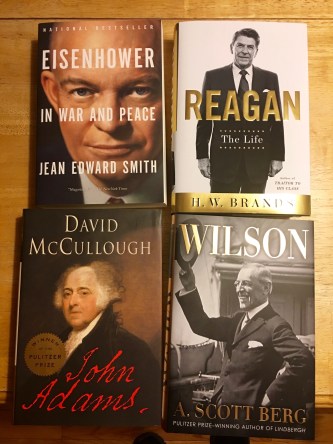
A colleague at work gave me these 4 autographed biographies of American presidents.

IMG_3588

These books arrived at my office after a meeting where business and the pleasure of reading seem to go naturally together. My colleague had obviously discovered my love of books and thought she’d indulge it. We didn’t talk about any particular genre so I was pleasantly surprised to be given 4 biographies, my favorite kind of reading.

The great English lexicographer and essayist, Samuel Johnson, once said: “I esteem biography, as giving us what comes near to ourselves, what we can turn to use.” By studying the lives of other people, specifically those who’ve risen to great renown, we can learn a lot about the workings of human excellence and human vice. We can put to use what we learn from these biographies in our own lives.

Humanities departments have long argued that one of the best ways to improve yourself, both morally and culturally, is to study the arts and literature; more specifically novels and other works of the imagination. By experiencing the world imaginatively through the lives of others we’re able to sympathize, to “move with” them, as our protagonists experience the world, its triumphs, trials, and tribulations. It’s through this sympathetic process that we expand our own moral and cultural horizons. We understand them and ourselves better. This has the potential to create new intellectual and moral connections we did not have before. We grow.

In the modern age biography has replaced the novel in this respect. Just notice how the fiction section of the Barnes and Noble Book Shop is shrinking and the biography section is expanding. Most modern biographers write their story with the skill of a good novelists, and with biography you’re dealing with facts, with characters from history, not fiction. I think there’s a greater demand these days for the literature of fact, because it touches our need for what P.G. Wodehouse once said about good conversation being “a feast of reason and a flow of soul.”

A Ghost Writer’s Regret

Donald Trump’s best selling book, The Art of the Deal, opens with this paragraph:

I don’t do it for the money. I’ve got enough, much more than I’ll ever need. I do it to do it. Deals are my art form. Other people paint beautifully on canvas or write wonderful poetry. I like making deals, preferably big deals. That’s how I get my kicks.

It’s a good opening. I can imagine a film about Trump opening with a sweeping view of New York City’s skyline and a voice-over of Donald Trump speaking these words as a sort of epigraph to the story that’s about to unfold.

The Art of the Deal was a big best seller and helped launch Donald Trump’s persona as a talented businessman who rose to wealth and fame by his skilled art of deal making. When Donald Trump launched his Presidential campaign, he referenced his book as one of his main credentials: “We need a leader that wrote The Art of the Deal,” Trump said. The book is one of Trump’s main legitimacy cards.

There is one big problem with Trump’s above statement. He didn’t write the Art of the Deal. Not one word of it. And Trump didn’t say the words quoted above. The entire book was a creation of Tony Schwartz, Trump’s ghost writer. Now if you’re thinking, “Well, that’s what ghost writers do, they gather information and write the book,” you won’t be wrong but you won’t be entirely right either. The ghost writer’s job is to paint the main author in the best possible light. That’s true. But there is something unique about this case.

Typically a ghost writer collaborates in writing the book. Meaning, the ghost writer collects materials and does a large number of lengthy interviews with the central author and then begins drafting a book for review by the main author, in this case Trump. Yes, the ghost writer does a lot of the writing. The interviews allow the main author to work out what they believe and tell the story for the ghost writer to capture and use to create the narrative, the book. But in this case that didn’t happen. Trump never told his story.

Tony Schwartz said he was unable to conduct those essential interviews. He was reduced to listening in on phone calls to grasp how Trump dealt with people and traveling with Trump to observe how Trump operated. A lot of what he saw and heard, we now know, was not positive according to Schwartz. Ultimately Schwartz had to put the book together on his own from the riot of materials he could gather. He had to be very creative.

Getting to know who Trump really was and then seeing Trump run for President—and possibly win the White House—has really caused some angst for Schwartz recently. He has a case of ghost writer’s regret. He’s kept quite all these years (the book was published in 1987) because Trump remained in the private sector. But not anymore. Knowing what Trump is really like, compared to how Schwartz falsely portrayed Trump in the book, has caused Schwartz to come forward to tell the world what he knows.

On NPR Schwartz tells us why he couldn’t conduct those book interviews with Trump and what he learned from that:

“One of the chief things I’m concerned about is the limits of his attention span, which are as severe as any person I think I’ve ever met,” Schwartz says. “No matter what question I asked, he would become impatient with it pretty quickly, and literally, from the very first time I sat down to start interviewing him, after about 10 or 15 minutes, he said, ‘You know, I don’t really wanna talk about this stuff, I’m not interested in it, I mean it’s over, it’s the past, I’m done with it, what else have you got?”

There you have it. Trump was incapable of telling his story. He couldn’t sit still long enough and he wasn’t really interested talking about “this stuff.” So Schwartz wrote the entire book from notes and handed it to Trump for review. Trump made no changes, no edits, no revisions, and handed the book back to Schwartz. So the voice you hear on the page, like the opening paragraph quoted above and the ideas you get from the text, are primarily the creation of Tony Schwartz not Donald Trump.

So that’s why when Schwartz saw Trump announce his candidacy and state: “We need a leader that wrote The Art of the Deal, Schwartz immediately tweeted: “Many thanks Donald Trump for suggesting I run for President, based on the fact that I wrote ‘The Art of the Deal.'” Schwartz felt that “If he could lie about that on Day One–when it was so easily refuted–he is likely to lie about anything.”

Schwartz tells us that what he learned about Donald Trump was not flattering at all. Trump was not some great mind or leader or some great dealmaker. He was “pathologically impulsive and self-centered,” “Had no attention span,” and “Lied strategically…[with] a complete lack of conscience about it.” In writing the book, Schwartz felt he’d “Put lipstick on a pig.”

Now, beyond what Schwartz thinks about Trump, my main reason for posting has to do with my thoughts about writing and personality. It confirms a hunch I’ve had about Trump and the craft of writing. Listening to Trump talk and observing his public behavior made me suspect that Trump wasn’t capable of writing a book like The Art of the Deal. He probably hasn’t written any of his own books. Writers, at least the one’s who dedicate themselves to the craft, are typically careful and precise with words in both writing and speaking. Trump, if you’ve listened to him talk for any length of time, is typically imprecise and sloppy with words. I don’t detect any profound respect for the power and effect of words, which comes natural from a craftsman. And the truth is Trump doesn’t come across as very intelligent. He doesn’t sound like a man who reads much or has seriously wrestled with ideas. 

Secondly, from a moral perspective, I find it interesting that Trump’s behavior has stayed pretty consistent since The Art of the Deal was published in 1987. I don’t detect a lot of growth unfortunately. He still seems like the same guy he was almost 3 decades ago: loose with the truth, struggling with attention deficit, and lacking good impulse control. Not that any of this disqualifies him to be President of the United States or so it seems in this bizarro election season. Maybe Trump will win, I really don’t know. But it won’t be because of Trump’s character or abilities, but more likely because of a populist anger and the failure of Hillary Clinton to inspire confidence as the alternative.

Of course Tony Schwartz has been threaten by Donald Trump with litigation over his revelations. That’s to be expected Schwartz admits. I’ll note that Trump’s lawyer in his letter to Schwartz was careful not to say Trump wrote the The Art of the Deal. Trump’s lawyer knows that would be a lie. Schwartz, whom by the way kept a journal (great piece of evidence to substantiate his claims) while writing The Art of the Deal, refused to retract anything. He knows what he’s saying is the truth will not back down.  

I think there is some connection between how one thinks and speaks and the quality of their writing. I think, though I may be totally wrong, that you can listen to some people talk, which is a reflection of how they think and organize information, and estimate just what the quality of their writing would be. I’ve experimented with this idea for years and so far I’ve be proven correct in the vast majority of cases. And so listening to Trump all these years, I have a hard time believing he’s a good writer and even capable of creating a book or a good essay, for that matter, on his own.
Britain’s Decision to Leave the EU

uk-eu-brexit

Yesterday most of Europe, and the financial markets, were unnerved by the British people’s decision to leave the European Union (EU). The Brexit referendum was close, but those wanting to leave the EU ultimately triumphed over those wanting to “Remain.” And so the divorce notice has been served. Like all divorces, there’s a chance this will be messy and expensive—especially in the near term for the Brits.

What I found rather amusing, and yet totally unsurprising, was that after the polls had closed in Britain, Google Trends reported a high volume of searches related to questions about the Brexit referendum, containing phrases like “What is Brexit? or “Why should we stay in the EU?” These searches were being, as The Washington Post described it, “frantically” queried by the Brits.

This is humorous in a Saturday Night Live sort of way. It’s also just pathetic. I suspect that a lot of Brits didn’t really grasp the complex implications of their vote. Like many Americans, they probably listened to media pundits, rabid partisans, and rank propagandists, and didn’t take to time to read widely what the experts had to say and then try to determine how the outcome might serve or not serve their true interests.

This was a complex matter. The decision to leave or remain, in my view, shouldn’t have been decided by popular referendum. It should have been a decision of the ruling government. We elect representatives, called MPs or Members of Parliament in Britain, to examine these complex matters, confer with the experts and their constituents and then take a vote. That’s their job.

If an MP’s constituents don’t like the vote their MP has taken, they can remove the MP (or party) in the next election and install someone who supports their views. That’s the way representative governments work. The average voter, in complex matters like this, simply doesn’t have enough time (or background knowledge) in their busy lives to properly calibrate.

Personally I can respect and understand both positions, whether one voted to leave or remain. There are valid—though not equally persuasive—arguments to be made on both sides of the decision. Either way, the stakes were high. The opposing arguments both came with various consequences and implications for the political, social, and economic viability of Great Britain going forward.

In the short term this is likely to have negative impacts on the British economy. If Brexit leads to a break up of the EU entirely, we could see tremendous economic shock waves across the world that may cripple most of the European economies, especially Britain’s, for years. And we all know what long term economic problems cause politically: the rise of radicals high on rhetoric and emotions and short on real and lasting solutions.