Morals excite passions, and produce or prevent actions. Reason of itself is utterly impotent in this particular. The rules of morality, therefore, are not conclusions of our reason. — David Hume
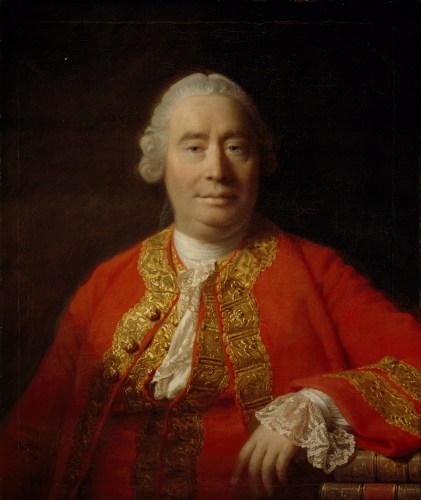
Today in history is David Hume’s birthday. Hume was a 18th century Scottish philosopher who’s writings have gotten more attention lately because modern psychologists, notably Jonathan Haidt, have been praising parts of Hume’s moral philosophy. Haidt sees the core of Hume’s moral philosophy as anticipating Haidt’s researchconclusions about how people reach moral judgements.
In short, Hume & Haidt both argue that moral judgements aren’t something we reach through a process of reflective reasoning. That’s a rationalist delusion. Our moral judgements are primarily the product of our intuitions, or in the Humian sense, our passions. Reason is simply the ex post facto lawyer who’s primary job is to defend your moral intuitions. Haidt’s social intuitionism model says, “Moral intuitions come first, strategic reasoning comes second.”
As David Hume wrote: “Reason is, and ought only to be the slave of the passions, and can never pretend to any other office than to serve and obey them.” Reason serves our passions, our emotions, our non-rational intuitions.
Of course the down side of Hume’s & Haidt’s idea is that logic and good arguments are not likely to persuade anybody of anything when people’s beliefs or moral convictions are set. Haidt would argue, and I think rightly, that it’s not that reason can’t persuade at all, it’s just that until emotional barriers are soften or lowered Reason cannot make much headway in influencing our morals, politics, religion or football.
As Jonathan Swift wrote: “Reasoning will never make a man correct an ill opinion, which by reasoning he never acquired…”
I think an honest observer of people and human nature would think Hume’s & Haidt’s idea a confirmation of the obvious. I mean watch people at election time…like now in the US.
Politics, which is very moral, is a good example. Facts, evidence, and sound argument are not what typically guides most people’s decisions about issues and who to vote for. Now, I don’t think that’s true with everyone. Certainly there are people who can be persuaded by logic, evidence, and good arguments. There are people who are aware of their emotional barriers and who do want to get at the truth or what’s best for themselves or the society. But that persuadable group is relatively small, unfortunately.
The saving grace for our society is that this group of Independent voters and thinkers have a big impact in the outcome of close elections. They’re willing to go either way and are weighing the reasons and arguments for each candidate—or so I’d like to believe.
All the world’s a stage, And all the men and women merely players; They have their exits and their entrances, And one man in his time plays many parts. — William Shakespeare
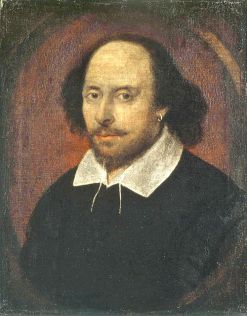
William Shakespeare (photo: Wiki)
Today is the 400th anniversary of William Shakespeare’s death. I was reminded by a New Yorker piece I read over morning coffee. It got me to thinking about my first “encounter” with Shakespeare.
Most of us educated in the Western world, especially in the English speaking nations, probably remember an English class where you had to read and discuss a Shakespearian tragedy, history, or comedy. I suspect the tragic plays, if any at all, are probably more remembered than any of the other plays: works like Julius Caesar, MacBeth, Othello, and King Lear. There’s a greater weight and imprint to the tragic sense of life. It’s always there, just below the surface, working sadly.
I first experienced Shakespeare’s plays in a high school English class. The most cogent memory is of Mr. Snodgrass’s class at F.W. Cox High School in Virginia Beach, Virginia. The course instruction was memorable only in the sense that I was so bored. It was hard to stay awake. I seem to recall Mr Roper calling on me just to make sure I was awake. I was not as good as many of the other guys in class at hiding it. Shakespeare’s idioms and word play required too much thought and had no relevance to my life or my future. Just like those complicated math classes…it was a waste of my time!
Or so my teenage mind thought at the time.
College was a little better. A little more maturity, mixed with the exposure to other interrelated liberal arts courses and, more importantly, excellent teachers, stirred my interest in the subtleties, meaning, and value of the arts. Reading Shakespeare in college was, well, an eye opening experience for me. I don’t recall the instructors name, though I can still see and hear him in my mind. With him Shakespeare came alive and spoke to me. I began to see, and more importantly in art, to feel and appreciate the artistry and creativeness of Shakespeare’s genius.
“For there is nothing either good or bad, but thinking makes it so.”
“What’s in a name? That which we call a rose
By any other name would smell as sweet.”
Sure, a psychologists, using different words, would tell you these very basic things: your perceptions construct your world. Most of us understand that. But the scientist couldn’t say it with the poetic depth of a Shakespeare! And believe me when I say delivery absolutely influences receptivity.
Art is the mirror of life as the saying goes. The artist is simply holding up that mirror—words, imagines, and provoked emotions—to stir your soul. Because the active soul engages. And that’s what art, ultimately, is about. Art is about engaging your intellect and emotions so you can see and feel the world differently.
There are great multitudes of good and decent people out there in the world who belong to the category of creators rather than destroyers. But they are not the ones who are most visible or most audible, not the ones who talk mindlessly and endlessly on television, not the ones who have a judgmental reaction to everything that differs from their way of seeing. They make up a beautiful though silent community. But they are there.
While my wife, Lori, and I were lunching in a restaurant one day, she said to me, “How can you not feel alive if you are creating?” And Bergson once wrote, “Where joy is, creation has been.” This may be, for many of us, as near the answer to the meaning of life as we will find in this life. You’re alive as long as you’re creating. Ray Bradbury insists that it matters not what happens in the world; your moral obligation is keep on creating. It is the greatest of privileges to strive to belong to the community of creators.
Ask yourself, Do you strive to be a member of the Community of Creators? I would like to think I do, even if my membership is in need of constant renewal.
There is no shortage of people calling for more “deregulation” or for the dismantling (“the doing away with”) of entire government agencies. There is always a natural agitation to clear away rules and governing oversight, any “fence” that stands in our way.
But most laws, rules & regulations, and institutions of government come into existence after years, sometimes decades, of experience and debate. There is usually a good reason. There is a history that outlines why we have them. We need to know the exact history of why we have these institutions, laws or regulations, and the implications of not having them, before we tear them down. It may be that doing away with the fence doesn’t free the lambs so much as it fattens the wolves.
And so anytime we hear calls for reforming or removing any law, rule, regulation, or government institution we’d be wise to consider the principle of [G.K.] Chesterton’s Fence:
“In the matter of reforming things, as distinct from deforming them, there is one plain and simple principle; a principle which will probably be called a paradox. There exists in such a case a certain institution or law; let us say, for the sake of simplicity, a fence or gate erected across a road. The more modern type of reformer goes gaily up to it and says, ‘I don’t see the use of this; let us clear it away.’ To which the more intelligent type of reformer will do well to answer: ‘If you don’t see the use of it, I certainly won’t let you clear it away. Go away and think. Then, when you can come back and tell me that you do see the use of it, I may allow you to destroy it.'”
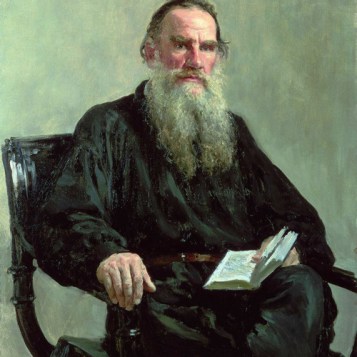
One of the most fascinating figures in the history of literature is Leo Tolstoy. Unlike most people, who discover Tolstoy through his novels and short stories, I was introduced to Tolstoy through his religious writings.
Many years ago I remember reading William James’s book, The Varieties of Religious Experience. As I recall, I was fascinated by James’s analysis and commentary on some of Tolstoy’s religious writings. (James’s book was perspective altering and left a big impression on me. I hope to read it again some day. I highly recommend you give it a go if you enjoy philosophical psychology and religious studies.)
So I picked up a Penguin Classic of Tolstoy’s writings called A Confession and Other Religious Writings. This book, the imagines and ideas, still haunt my memory. After reading this book, I started dipping into the rest of Tolstoy’s works. It was, like Tolstoy’s Russia, a vast and consuming experience. Tolstoy is not just a writer or moralist with something to say, he’s more like the yogi who wants to change your consciousness and reveal a world hidden from your view. This is Tolstoy’s mission in life.
Tolstoy’s deeply philosophical and religious mind get full range in his greatest novel, War and Peace, a large—and seemingly endless—canvas where Tolstoy paints his ideas about determinism and contingency in history, which he brilliantly elaborates on in an essay at the end of the novel.
Tolstoy’s writings and ideas have been highly influential. Mahatma Gandhi and Martin Luther King Jr. were both influenced by Tolstoy’s principle of non-violent resistance. The great 20th century philosophical genius Ludwig Wittgenstein was highly influenced by Tolstoy’s religious book, The Gospel in Brief. The popular historian and biographer, Niall Ferguson, credited Tolstoy, specifically War and Peace, with making him a historian. And who can forget the tragic story of Chris McCandless, the young idealist who appears to have been influenced to go hiking alone in the Alaskan wilderness (see Into the Wild) to commune with nature after reading Tolstoy’s Family Happiness.
Now, when it comes to novels, Tolstoy is not your casual read. If you’re use to reading popular novelists then you’re probably going to find Tolstoy, at times, difficult to follow. Tolstoy is not looking to just entertain, though he does, but to impart wisdom through the medium of art. Tolstoy is using words and story to cast the mind’s eye upon what Rudyard Kipling called “the impenetrable plinth of things.” Immersion in Tolstoy’s work has the real potential to alter your perspective on life.
But most people, other than for work, don’t have time for reading much at all, especially a large book like War and Peace or a book of Tolstoy’s religious writings. And Tolstoy understood this.
So in the mid 1880s Tolstoy came up with the idea for A Calendar of Wisdom: “A wise thought for every day of the year, from the greatest philosophers of all times and all peoples.” He added, “I have to create a circle of reading for myself: Epictetus, Marcus Aurelius, Lao-Tzu, Buddha, Pascal, The New Testament. This is also necessary for all people . . . I would like to create a book . . . in which I could tell a person about his life, and about the Good Way of Life.”
Instead of a big novel or philosophical treatise on the meaning of life, Tolstoy decided one of his last works (he updated and edited the book in the last years of his life) would be a book of daily thoughts to nourish the soul:
The difference between real material poison and intellectual poison is that most material poison is disgusting to the taste, but intellectual poison, which takes the form of cheap newspapers or bad books, can unfortunately sometimes be attractive.
(January 1)
Knowledge is real knowledge only when it is acquired by the efforts of your intellect, not by memory.
Only when we forget what we were taught do we start to have real knowledge.
(Henry David Thoreau, January 9)
A constant flow of thoughts expressed by other people can stop and deaden your own thought and your own initiative…. That is why constant learning softens your brain…. Stopping the creation of your own thoughts to give room for the thoughts from other books reminds me of Shakespeare’s remark about his contemporaries who sold their land in order to see other countries.
(Arthur Schopenhauer, January 9)
Real wisdom is not the knowledge of everything, but the knowledge of which things in life are necessary, which are less necessary, and which are completely unnecessary to know. Among the most necessary knowledge is the knowledge of how to live well, that is, how to produce the least possible evil and the greatest goodness in one’s life. At present, people study useless sciences, but forget to study this, the most important knowledge.
(Jean Jaques Rousseau, March 16)
There is only one real knowledge: that which helps us to be free. Every other type of knowledge is mere amusement.
(Vishnu Purana, Indian Wisdom, June 23)
The way to true knowledge does not go through soft grass covered with flowers. To find it, a person must climb steep mountains.
(Josh Ruskin, September 20)
Intellect is the quality that makes us different from animals.
Buddha said: “In meditation, in speech, in life, in studies, I never forget about the most important thing: the requirements of the intellect.”
The moral and the intellectual are always in harmony.
(June 13)
Each morning, for the past few months, I’ve started my day by opening to the current date in Tolstoy’s Calendar of Wisdom. It has helped put my mind in the right frame, or for lack of a better word, rhythm for the day.
“I cannot understand,” Tolstoy wrote, “how some people can live without communicating with the wisest people who ever lived on earth . . . I feel very happy every day, because I read this book.”
In this busy world we rarely have time to dedicate to our spiritual an intellectual growth. Regardless of where you’re at in life or what’s going on, it’s important to imbibe the nourishing water of wisdom.
Tolstoy has provided a cup. I recommend you take those brief moments and drink daily.

 Jeff Wills