Character Matters

Photo by DS stories on Pexels.com

For certain individuals, setting a positive example may be interpreted as a sign of weakness. It seems that some people in this world prefer to embrace a different approach, one that involves using crude language, constantly lying, and refusing to take responsibility for their actions. They proudly display an intellectual prowess that is limited to expressing themselves in grievance filled rants on social media.

But why do they choose this path? Their actions seem to suggest that they believe appealing to people’s baser instincts is more effective than promoting noble ideals. They argue that this is what it means to be real, to be genuine.

I believe that the majority of us know better.

In fact, it’s crucial to recognize the importance of setting a good example. While modeling negative behavior may be tempting, it rarely leads to positive outcomes or inspires others to be their best selves. On the other hand, demonstrating honesty, integrity, and responsibility can have a profound impact on those around us.

By choosing to be authentic in a positive way, we encourage others to do the same. We inspire them to strive for excellence, to prioritize kindness and empathy, and to take ownership of their actions. In a world where negativity and cynicism can often dominate, being a source of inspiration and embodying noble values is more important than ever.

So, while some may believe that behaving in a less-than-exemplary manner is the path to success, I remain firm in my belief that setting a good example is a far more powerful and meaningful way to make a positive impact in the world.

We should aspire to be the ones who uplift and inspire others, rather than succumbing to the allure of base behavior. Let us be the people who choose nobility over negativity, and in doing so, create a better, more harmonious world for all.
The Education Nudge

Yesterday I had the distinct honor of being my youngest son’s guest for VIP Day at his elementary school. Okay…so Mom had to work and I filled in. Anyway, my son’s elementary school reminds me a lot of the one I attended. I have some fond memories of my elementary school years: the field days, the book fairs, the Halloween parties at school, the lunch room gatherings, the learning experiences (of course!), and the teachers who made a difference. I still remember Mrs. Gillett teaching my 1st grade class the alphabet. I still remember Mrs. Chalmers, a 3rd grade teacher, teaching us math, and Mrs. Wilson, a 4th grade teacher, teaching us science. There’s no doubt those early years had an influence on me and my classmates, as our minds were nudged in certain directions. How far and to what extent we can never know for sure. But the clay was soft and impressions made easily.

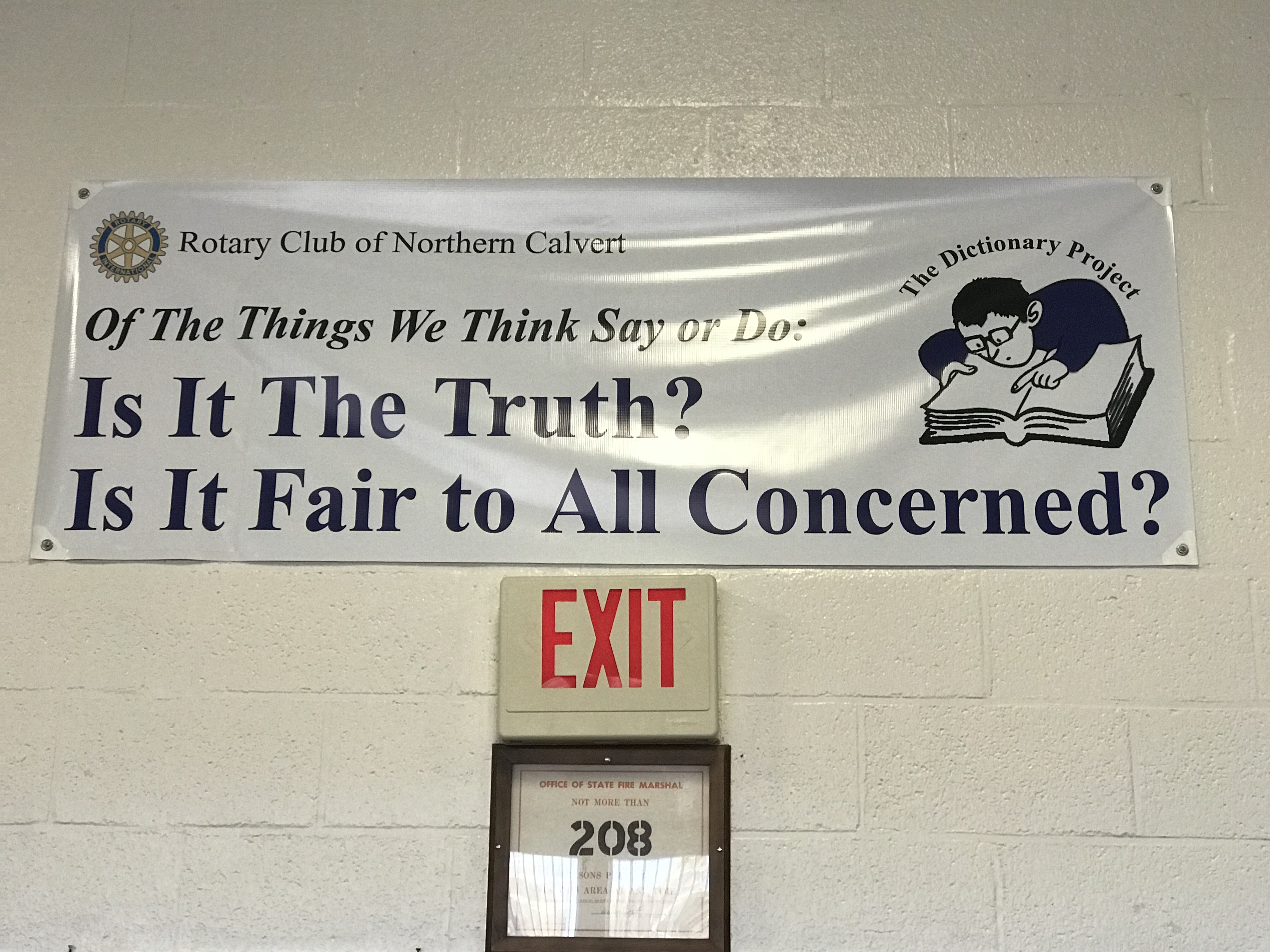
Of course elementary schools teach the basics in reading, writing, math, etc, etc. But what’s forgotten, or not noticed until you walk around an elementary school like I did yesterday, is that elementary schools also impart or encourage other forms of education that aim to develop character. There are no classes that aim specifically at character education, at least not that I’m aware of, but character education is instilled many other ways. For example, inside my son’s school lunch room, above the entrance, is the following banner:

IMG_3783

The Dictionary Project is an educational charity that hands out free dictionaries to elementary school students. My son got his dictionary last February. Now you might be thinking there are little signs and banners all around the lunch room, but that’s not the case. This particular banner stood out. I don’t recall any others actually. While the teachers may not be asking the two questions on this banner, the environment, combined with repeated exposure, combined with curiosity, do their work. The students sit in this large room for lunch and various other gatherings and events all the time. The students read this banner every day and to some degree absorb its questions about truth and fairness in everything they Think, Say, or Do. (Of course the Dictionary Project also enforced bad grammar by forgetting the needed comas in the first line! But hey, that’s why we have teachers…to correct bad grammar!)

After getting home yesterday, I asked my son about the banner and he repeated the words on the banner verbatim. Whether he pursues the answers to those two questions is a different story, but at least the questions are imprinted in his little mind. And that’s a good start.