Hitler’s Circle of Evil

294fbfdf3cf4f1c851de9474dcc0cc5dad1788c8
Source: Netflix

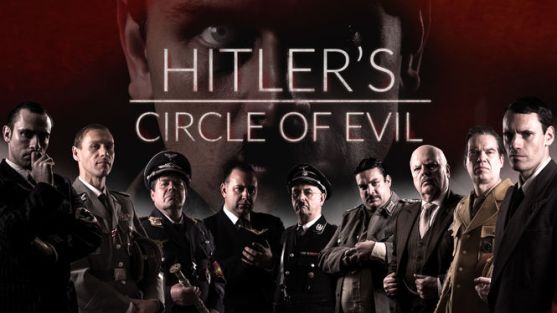
I just finished watching a well done docudrama on Netflix called Hitler’s Circle of Evil. I highly recommend it. It’s definitely a good binge watch (10 episodes) for a weekend rainy day—if you like history. (If you don’t have Netflix, you’re in luck. Someone has uploaded the whole series to Youtube.)

I’ve read a lot about Hitler, the Nazis in general, the Holocaust, and, of course, the 2nd World War, but my knowledge of Hitler’s inner circle of power and how they interacted and related to der Führer (German for “The Leader”) was rather thin and incomplete as I enjoyably discovered.

These are just a few, among the many, interesting takeaways I got from the series:

  1. Joseph Goebbels was true believer to the bitter end. I’d read this about him to some degree, but this Netflix series really showed just how critical Goebbels was in building the Nazi party and, more nefariously, in pushing the hatred of the Jews as one of the core beliefs of the Nazis. It was Goebbels who was behind the infamous Kristallnacht (Crystal Night) in 1938, named “from the shards of broken glass that littered the streets after the windows of Jewish-owned stores, buildings, and synagogues were smashed.” Kristallnacht marked the first steps toward the Final Solution. Over two nights hundreds of Jews were killed and 30,000 were sent to concentration camps as a result of Kristallnacht. The day following the pogrom Hermann Göring said, “The Jewish problem will reach its solution if, in anytime soon, we will be drawn into war beyond our border—then it is obvious that we will have to manage a final account with the Jews.” While Göring and Himmler would ultimately abandon Hitler at the end, Goebbels remained loyal to the very end. Sadly, I had forgotten, Goebbels had brought his family to Hitler’s bunker and after Hitler committed suicide Goebbels had his wife poison all three of their young children and then he and her took poison pills.
  2. Hermann Göring seem less fanatical and more pragmatic. He didn’t think invading Russia, for example, while the British were still not pacified, a good strategy. Likely thinking of WWI, he didn’t think a two front war was a winnable situation for Germany. But he couldn’t get Hitler to listen. He was angry and confronted Goebbels about Kristallnacht, complaining the violence and destruction bad for the German economy. And “who was going to pay for all the damage” Göring demanded to know from Goebbels. Of course the answer, from Goebbels and agreed to by Hitler, was that the Jews would pay for it.
  3. Albert Speer, who’s memoirs I read many years ago, is one of those characters who doesn’t seem so much a committed Nazis as much as a committed German. He is the young architect who Hitler took under his wing and was ultimately made Minister of Armaments and War Production. It’s really in following Speer’s path that you see one of the most fatal flaws (that surely Speer mentioned in his book but I’d forgotten) in Hitler’s approach to war. Even as the Russian front and Operation Barbarossa began to look grim for Germany, the German Economy was still not in full war mode. Hitler wanted the home-front affected as little as possible by the war. As late as 1942, with German soldiers occupying most of Europe, Britain still in the war and America now a member of the allied forces, and a raging war in Russia, a number of German factories were still producing common household goods instead of war materials for troops in the field. It was Speer and Goebbels who pushed Hitler to approve a plan of “total war.” This plan called for ALL Germans to be directly involved in supporting the war. All factories had to be retooled to produce war materials and even German women (which Hitler resisted at first) needed to be working in those factories in support of the war effort. Of course in Britain and America this was the situation pretty much from the beginning. Germany had been at war since 1939, and here they were three years later just getting around to a total war economy. My theory is success blinded Hitler to the need to transform his economy. His victories had been swift against the allies in the beginning. The tempo of his economy was sufficient for the task up to that point, so he didn’t see a need to transform all his industries and bring the war home. It was Speer who realized this fatal flaw, but by then it was really too late.

We Need True Visions of Greatness

franklin d roosevelt motorcade_001_0
President Franklin Delano Roosevelt (FDR)

Thumbing through a book of essays by Alfred North Whitehead, I came across these words I’d underlined years ago while reading the book:

Moral education is impossible apart from the habitual vision of greatness. If we are not great, it does not matter what we do or what is the issue.

Whitehead was defending, or praising really, the superior nature of classical education (reading classics) in shaping a strong moral character. It’s a model based, in large part, on the study of great people in history. Thomas Carlyle once said “The history of the world is but the biography of great men.” The idea is that people primarily shape events and history by their actions. By studying the lives of renowned people we learn about “the evil that men do,*” or the nobility they can rise to, or the compromises they’ve made between these two extremes. We witness the subtleties of human personality. We see that life really isn’t, in large part, black or white but black and white. We learn just how human these great people actually were while also learning how they overcame many of the same difficulties we all face in spite of life’s head winds and the internal struggles of their own character. Through it all we can get a vision, even if not in perfect focus, of greatness in the human realm.

Whether people have an innate moral goodness or not is still debatable, but there is overwhelming scientific evidence that supports the idea that “the environment” has a big impact on the moral development of people. The ancient Greeks and Romans didn’t have the research, but they knew this to be true by experience. So ancient students not only learned poetry, history, music, math and about the lives of great Greeks and Romans, but their masters (parents, teachers, or tutors) were responsible for modeling the moral ideal and enforcing the civic/moral behavior expected from a man or woman of a civilized society. And then as the students moved into society and began families and became active citizens, they were expected to uphold these civilized values and model them to the next generation and to their fellow citizens. At least that was the ideal. It’s a conceptual idea captured in the ancient Greek word paideia.

The classical ideal stayed with Western civilization for a long time and finally started breaking up in the early part of the 20th century. World wars and the need for advanced educations in science, math, and technology pushed aside (understandably) the studying of the lives of ancient Greeks and Romans. Of course classical education didn’t die all together but evolved over the past century from strictly a study of the ancients to the study of the Great Books.

In this competitive world, students naturally seek educations that advance their job prospects, not necessarily their personal enrichment, civic awareness, or moral world view—of course, without a good degree of the latter, the former is likely to shrink as wealth and power pools around the few at the top…hmmm, kind of like it is now. No ideal is perfect and certainly western civilization has not been all good in practice or implication, but it’s an ideal or set of beliefs (moral and political) that have made the West the most advanced, most prosperous, freest collection of societies the world has ever known. This is worth remembering as we witness the growing attacks, and disillusionment with, its foundations from those on the far left and far right politically.

For Whitehead and the ancients, greatness, in the moral sphere, was mostly a product of social osmosis. If we are exposed to a “habitual vision of greatness,” via our readings (education) and life examples, there’s a good chance that vision will take hold and become a part of us. Regardless of whether anyone cares to read ancient texts or biographies in general, it’s a model with strong merit and, in my view, the best way to shape and lead a truly great society.

Our nation could really use some visions of greatness in both the realms of political and business leadership right now. It’s sorely lacking. We need leaders, especially in government, willing to sacrifice—like, say, an FDR—their own personal or class interests for the sake of others and the greater good of our society. But we’re seeing so much of the opposite right now. On the private sector side corporate statesmanship seems mostly gone and the tide of big business executive “greed,” the Gordon Gekkos of business (who now also run our government), have seized the moment, like an oligarchic plague over democratic Athens.

We don’t have the help of classical education as a shaper of our society anymore, and, of course, even if we had there’s no guarantee things would be any different. But we can still hope there’s a return to the ideal that modeling greatness matters at all levels of leadership in our society. We can still hope some people actually have and believe in a noble and dignified vision of society and are determined to live by it. We can still hope—and demand via our civic duty to vote!—that we have government leaders who model nobility in actions and words. We need leaders, in both business and government, with a noble vision that’s inclusive and dignified and not just one that’s all about their personal wealth, influence, or tribal loyalties. There are so many reasons Americans need a vision of greatness in Washington D.C. right now. But instead of a Cicero or a Marcus Aurelius we have a Nero…that tweets while the nation yearns.

The change starts with each of us. We need true visions of greatness. Let’s expect and demand a selfless and dignified vision of greatness from our government and business leaders. Our future, and that of our children, is at stake.

The Retreat of Western Liberalism

41dqZWxy60L._SX330_BO1,204,203,200_

Like many of you, I’m sure, I’m trying to better understand the various problems and agitations facing America and Western societies in general at this time. Of course there has always been struggles to overcome, but I think it’s fair to say we face some unique challenges at this time in our history. The better we can get our heart and mind around them the better chance we have of overcoming them.

With that in mind, I recently completed Edward Luce’s new book, The Retreat of Western Liberalism. A very interesting read. It’s not a book meant to make you feel good. Titles like that shouldn’t. But it will cause you to do something we all need to do in moments (as a nation and as individual) like these and that’s pause to reflect on what truly matters. For those who don’t know, the word Liberalism in this context (the book’s title) is referring to a set of fundamental principles that constitute the basis of all Western democratic societies. We’re talking about things like free and fair elections, freedom of speech, a free press, religious freedom, equality before the law, representative government, etc, etc. Western governments are in-fact liberal democracies.

Edward Luce thinks the Western liberal democratic model of governance, while not dead, is in serious trouble:

Western liberal democracy is not yet dead, but it is far closer than we may wish to believe. It is facing its gravest challenge since the Second World War. This time, however, we have conjured up the enemy from within. At home and abroad, America’s best liberal traditions are under assault from its own president. We have put arsonists in charge of the fire brigade.

Donald Trump, Luce argues, is a symptom of the disease not the cause. So naturally the question becomes: What brought on this disease? Well what holds liberal democracies together, Luce says, isn’t culture but economic growth. And when that economic growth stalls, leading to massive inequality and a loss of social mobility (U.S has the largest gap of both in the West), we begin to see this threat to the political order and ultimately the survival of liberal democracy.

By any numerical measure, humanity is becoming rapidly less poor. But between half and two-thirds of the people in the West have been treading water — at best — for a generation. Tens of millions of Westerners will struggle to keep their heads above the surface over the coming decades. The spread of automation, including artificial intelligence and remote intelligence, which some call the fourth industrial revolution, is still in its early states. So too is what the American journalist Fareed Zakaria has labelled the rise of the rest. The emergence of China is the most dramatic event in economic history. We are living in an age of convergence no less dramatic than the age of divergence brought about by European colonialism and the Industrial Revolution. The downward pressure on the incomes of the West’s middle classes in the coming years will be relentless.

So the lack of economic growth and social mobility has fueled this threat to liberal democracies. The future doesn’t look good unless we return to government policies that help grow and stabilize a prosperous middle class while avoiding policies that continue to build a strong oligarchy—which is largely what we’re doing right now. That’s right, as one writer put, “No bourgeoisie, no democracy.” Being able to aspire upwards, the dream of upward social and economic mobility, is at the heart of the American (Western) dream. When middle-class growth stalls, when wage growth stagnates (as it has for decades now in America), when large segments of the population are either unemployed or underemployed, or working multiple jobs just to stay above water, then personal investment in the current political system starts to weaken and you start to have a rich soil for rebellion and the rise of unprincipled, self-serving, demagogues (i.e. the Donald Trumps of the world).

Many Americans, as we witnessed in the 2016 presidential election, are fully willing to risk disaster, and we need to be mindful that we’ve reached the point where a grossly unfit, unprincipled man like Donald Trump could carry 60 plus million votes in the United States of America. A Trump victory would’ve been impossible, say, 10 years ago. The idea that Americans posses some exceptional quality that exempts us from the forces of chaos and ruin should be dismissed as nursery story. (It was never the case anyway.)

The economy had been improving steadily since 2009, but the massive inequality and lack of social mobility will stall again under the set of government policies being pushed by the current White House, and hence the problem will only continue to grow until we have yet another large economic shock or downturn (which will come eventually) and those millions of Americans, still treading water (for so long), will simply sink below the surface. We don’t have to imagine what they will try to drag with them under the waves.

Brands’s Laws of History

The study of history is an edifying pursuit, but it’s also time-consuming. We all…okay, well most of us I should say, like to be edified, but most of us don’t have the time…or the attention span. And so it’s always nice when some great scribe lays down the lessons he or she has learned from a lifetime of personal study.

Such is the case with professor H.W. Brands. He has written a number of history books, but he’s mostly known for his superb biographies. Biography, in my view, is the highest of art forms under the category of History. As I’ve said before, I think you get more wisdom and inspiration from the study of people’s lives than almost any other literature.

I pulled Brand’s bio of FDR from my bookshelf the other day (I haven’t read it yet), and that led me to his internet homepage where I found these aphoristic observations from Brands’s life of studying “humanity’s crooked path.”

Brands’s Laws Patterns of History

Idiosyncratic observations on humanity’s crooked path

1. There are no laws of history.

(History is not physics; people are not atoms. But there are patterns.)

2. Beliefs die when the believers do.

(People don’t change their minds, but neither do they live forever.)

3. The Sabbath comes once a week; people eat every day.

(Material desires are the locomotive of history; ideals are the whistle.)

4. Every country gets the foreign policy it can afford.

(Poor countries bend to fate; rich countries try to change it.)

5. Happy stays home.

(Immigrant nations like the U.S. are inherently restless.)

6. Sex makes babies; war makes heroes.

(Which is why humans are so attached to both.)

7. Even monsters sleep well.

(The capacity for self-justification is boundless.)

8. Great leaders have limited vision.

(People who look too far ahead trip over the present.)

9. History is complicated.

(For simple, see myth.)

Dunkirk

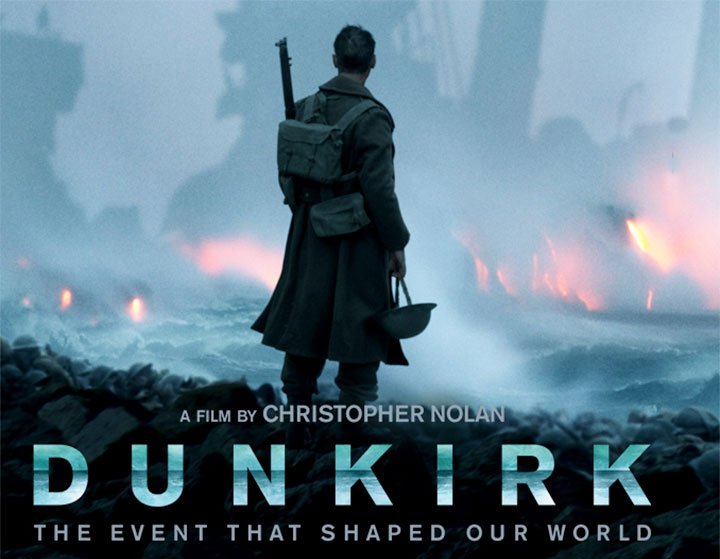
930At the last minute I decided to go see the movie Dunkirk. The movie is based on the mass evacuation (26 May to 4 June 1940) of British and French troops from the beaches of Dunkirk, France, during the opening stages of WWII.

Before the Russians and the yanks got involved, the German army was pretty much taking whatever they wanted and crushing all resistance. They were steam rolling the continent. The French and British armies, woefully unprepared to face Hitler’s military juggernaut, had been pummeled and forced to retreat to the beaches of Dunkirk and wait to be evacuated to England before the encircling German army killed or captured them.

This is a war story, so one should expect the typical motifs of war and warriors: sacrifice, endurance, honor, courage, fear. They’re all here in abundance and they give to the film, as such emotions do, a raw energy, mostly dark, but with the occasional piercings of light.

The tempo of the movie is fast—rightfully so when soldiers are cornered, beaten, tired, afraid and being constantly strafed by German airplanes. The movie is told through 4 perspectives.

There’s a British army private and his attempts to get off the beach anyway he can, even if it means using deceptiveness to cut in line to board a transport ship—from which he barely escapes after the ship is sunk by a German bomb just after departing. There’s the British Navy admiral, played perfectly by Kenneth Branagh, standing stoically at the end of a long pier, directing the orderly loading of troops onto transport ships, and refusing to leave until all the troops, British and French, are evacuated. There’s the British father and son, who join the thousands of other British civilians, using their personal boats and braving the bombs and machine guns of German planes, in order to help evacuate the British army stranded on the French beach just across the English Channel.

And then, lastly, there’s the British Spitfire pilot. He was my favorite character. Alone and running out of fuel, after having his two wing men shot down, instead of turning around and returning to base, he continues to engage the enemy, fighting until the last drop of fuel is gone. Leading up to this, there’s a defining scene in the movie where this British Spitfire pilot is staring at his gas gauge. He knows if he doesn’t turn around now, he can’t make it back to England. His face is covered by a flight helmet and mask so all you see is his eyes. And that’s all you need. In those eyes you see the brief moment of struggle, the thousand yard stare as his mind hovers between two loves and two duties, and then the decision, his eyes relax, and we see a man embracing his fate. He pushes the throttle forward to chase a German bomber in the distance. He’s not turning back. No. His countrymen are on that beach getting shot at and every man must do his duty.

If you’re looking for complex character development this isn’t your movie. At the opening of the movie you’re dropped into a quickly evolving situation and you’re carried along on a fast ride. The movie is more about action and scene than dialogue and personal connection. The emotional connection you get is from the pathetic spectacle of watching men fight for their lives against the odds. To survive is to win! A terrible sense of doom lingers over those beaches, and the only thing those soldiers have is their fighting spirit and the faith in their fellow countrymen to rescue them.

About 338 thousand allied troops were evacuated from Dunkirk. Over a hundred thousand by citizens coming to the rescue with their own boats. The battle was a big defeat for the allies, and yet, for the British nation it was a defeat that served the needs of the moment. The French, beaten and battered, would ultimately surrender. But the British, led by Winston Churchill, would take from this defeat the spirited determination, the fearless resolve, to fight on regardless of the odds. (Ahhh, and unlike the French, it helped—a lot—that Britain is an island nation with a channel holding back the German invasion force.)

On a scale of 1 to 5, five being the best, I’d give Dunkirk a 3.5. It lacked in a few areas in my view but overall it was a good movie and I recommend it.

If you go see it, please come back and let me know what you think.