The Other Side of the Hill

caspar_david_friedrich_-_wanderer_above_the_sea_of_fog
Wanderer above the Sea of Fog by Caspar David French

Very recently I celebrated my half century mark. Yes, the kid finally turned 50. Being a guy who loves books means memorable events naturally remind me of memorable phrases in literature. This occasion reminded me of a passage in John Buchan’s memoir:

Sir Walter Scott had a pleasant phrase for middle life; he called it reaching the other side of the hill. It is a stage which no doubt has its drawbacks. The wind is not so good, the limbs are not so tireless as in the ascent; the stride is shortened, and since we are descending we must be careful in placing the feet. But on the upward road the view was blocked by the slopes and there was no far prospect to be had except by looking backwards. Now the course is mercifully adapted to failing legs, we can rest and reflect since the summit has been passed, and there is a wide country before us, though the horizon is mist and shadow.

At this point in my life, I no longer feel I have anything to prove or anyone to impress for that matter. It’s a nice feeling. I still have goals and dreams to be sure, but there’s less worldly ambition to them and more a feeling of what contribution can I make or legacy can I leave. My hope now is that I can offer something valuable to those on the ascent. I’m hoping I can offer that most important, but sometimes difficult lesson in life: a sense of perspective.

The Lincoln Bible

For over 25 years I’ve been fortunate to have worked in one of the most unique and impressive, if sometimes notorious, places on the planet: The U.S. Capitol or “Capitol Hill.” I realize there are many negative things we could say about the U.S. Congress, I suspect that’s always been the case, but if we’re honest with our mostly hypocritical and righteous selves we’d admit the problems are just a reflection of us, the mostly fickle, many times ill informed voter. But enough of that. I’ll save a elaboration on those thoughts for another time. 

For now, I’d like to note my thoughts on an experience I had at the Library of Congress recently. But before I go on about that let me provide some background.

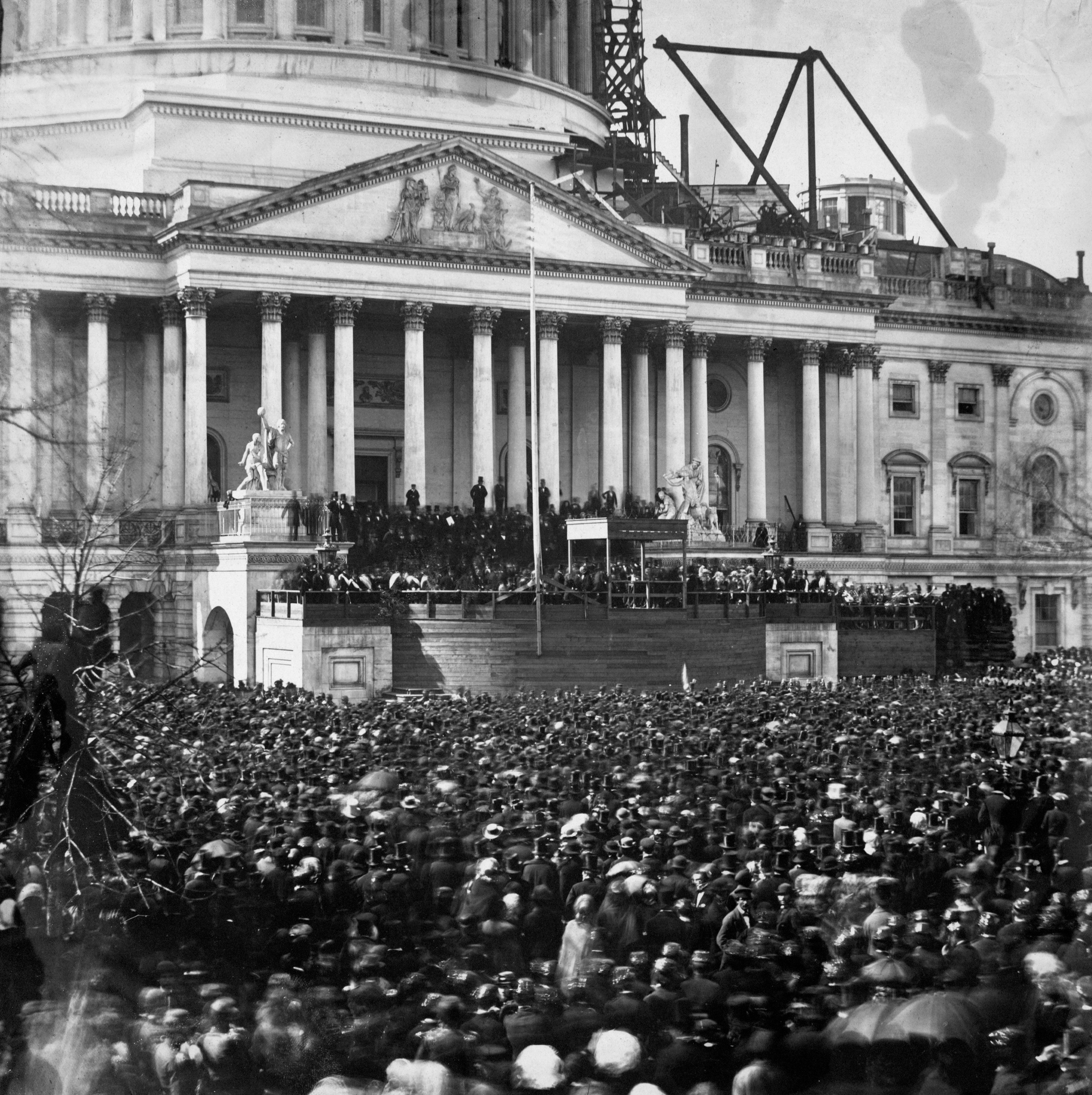
Let’s go back a little in history for a moment. In the lead up to Abraham Lincoln’s first inauguration (March 4, 1861), the federal government believed there was an assassination plot against President-elect Lincoln. Because of this, the President-elect arrived in Washington DC, via train, under the cover of darkness. In the rush to get Lincoln into Washington during the night, Lincoln’s baggage was misplaced and along with it the Lincoln family Bible. The bags and the Bible would not make it to Washington in time for the inauguration and swearing-in ceremony at the U.S. Capitol Building.

abraham_lincoln_inauguration_1861
(Image credit: Wikipedia) U.S Capitol Building: Lincoln’s First Inauguration, March 4, 1861

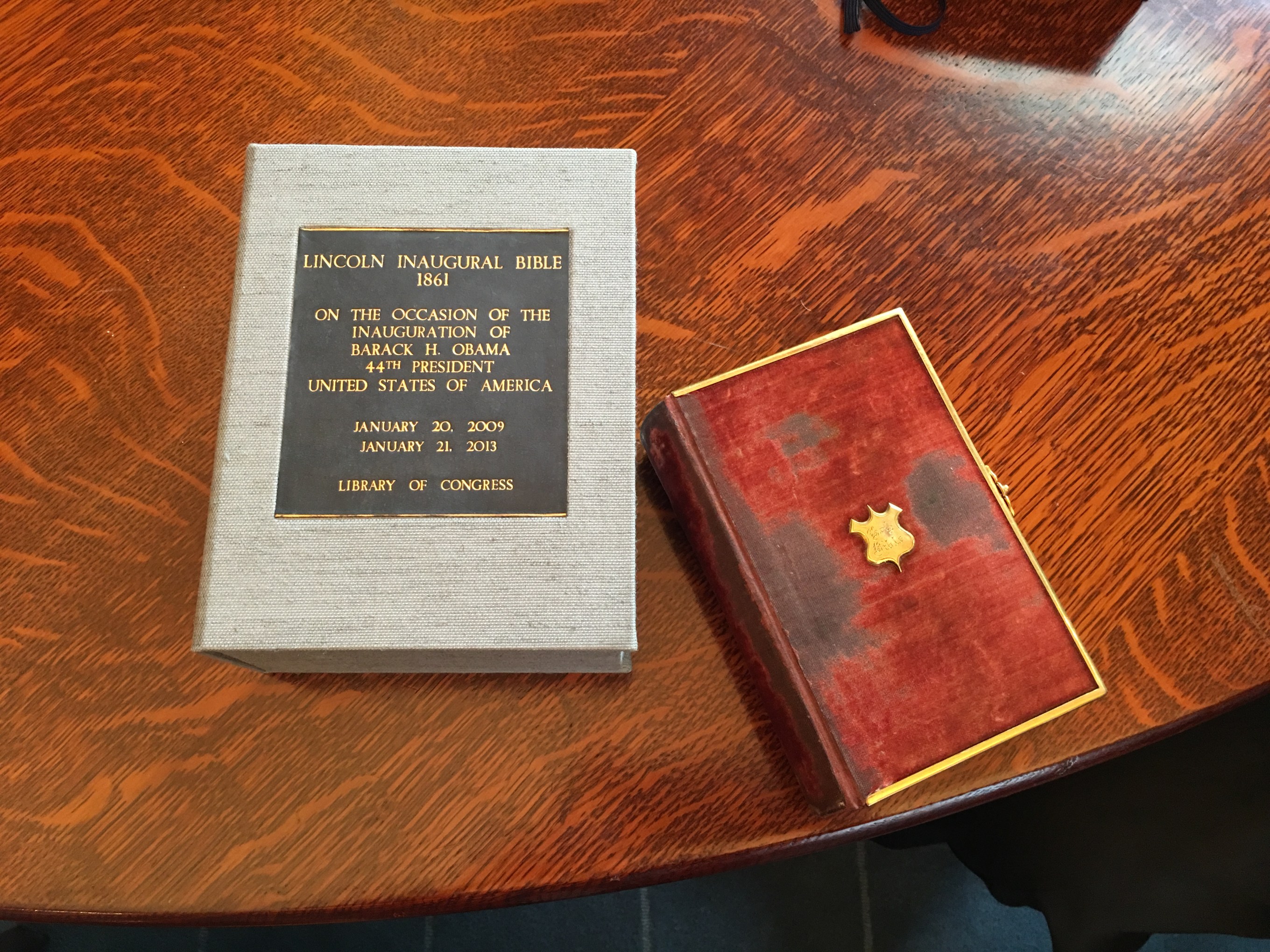
Saving the day was the Clerk of the Supreme Court, William Thomas Carroll, who provided a Bible he’d kept for official occasions. And it was this Bible, which Abraham Lincoln would place his left hand on and take the official oath of office, that became known as The Lincoln Bible. The only other U.S President to use the Lincoln Bible for the oath of office was President Barack Obama for both of his swearing-in ceremonies in 2009 and 2013. And then recently, September 14, 2016, the newly appointed Librarian of Congress, Carla Hayden, used the Lincoln Bible for her swearing-in ceremony. It was just prior, literally maybe 20 minutes, to Carla Hayden’s swearing-in that I got my chance for a personal viewing of the Lincoln Bible.

Reverence. In some sense, I think, reverence for events, people, or things that serve as important connections to the past is a waning virtue right now in our history. The “mystic chords of memory,” to quote Lincoln, connect us to a shared fate and a shared destiny.

I believe, have always felt, that some things should invoke a feeling of respect for great things and people and the sacrifices made in forming this great, if not perfect, nation. There’s a good reason the constitution begins with the words “to form a more perfect union.” A perfect union wasn’t possible. From the very beginning the founding of this nation was a compromise deal. The nation’s birth was only the beginning of a task, a continual building and improvement upon an experiment in democracy. The task of improving, of making a more perfect union, would always be the task of those who’d inherited this Democratic Republic. Abraham Lincoln’s presidency, and the civil war brought on by it, were the first great test to determine whether this experiment in democracy, this union, this “nation so conceived,” could be saved and preserved through the growing pains of forming a more perfect union. Lincoln and his vision, his leadership, thank God, prevailed. 

And so there I was, standing there listening to Mark (a Library curator and guardian of the Bible) give me a brief history of the Lincoln Bible. I actually stepped up to the table and stood for a moment almost as if I were viewing a deceased friend or loved one at a wake. I looked down on the Bible and thought of the so many events and people that have come and gone since Lincoln laid his left hand on this Bible and took the oath of office and then, after his destiny complete, passed into “the ages.” 

img_3922
Image Credit: Jeff Wills

What immediately grabs you about the Lincoln Bible is how small it is. The Bible is an 1853 Oxford Press KJV edition. It’s 6 inches long by 4 inches wide and about 1.75 inches thick. The Bible is bounded in a burgundy red velvet with gilt edges. The front cover is stained, worn, and faded with blackened stains along the spines edge. I thought of Lincoln’s left hand resting on the Bible as he began to recite the oath, the emotions he must have felt, and how his mind must have been occupied with the gathering storm of rebellion. And I thought of all the subsequent people who’ve held this Bible and reflected on Lincoln, his times, and what his presidency and leadership meant to the nation.

For those brief but solemn moments I felt privileged for this opportunity to be touched by those mystic chords of memory.

Remembering Shakespeare and the Arts

All the world’s a stage, And all the men and women merely players; They have their exits and their entrances, And one man in his time plays many parts. — William Shakespeare

William Shakespeare
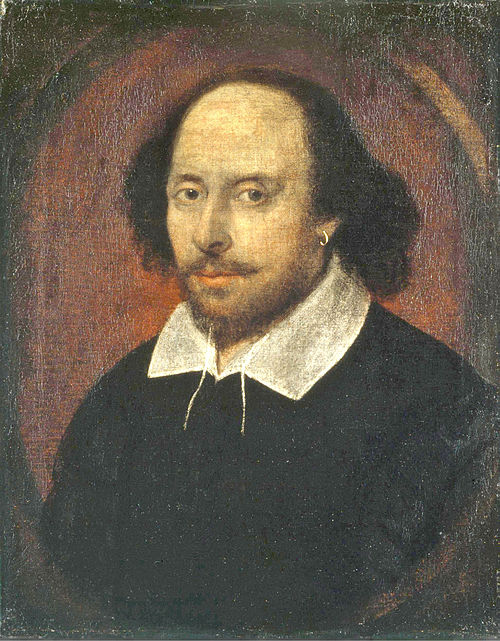
William Shakespeare (photo: Wiki)

Today is the 400th anniversary of William Shakespeare’s death. I was reminded by a New Yorker piece I read over morning coffee. It got me to thinking about my first “encounter” with Shakespeare.

Most of us educated in the Western world, especially in the English speaking nations, probably remember an English class where you had to read and discuss a Shakespearian tragedy, history, or comedy. I suspect the tragic plays, if any at all, are probably more remembered than any of the other plays: works like Julius Caesar, MacBeth, Othello, and King Lear. There’s a greater weight and imprint to the tragic sense of life. It’s always there, just below the surface, working sadly.

I first experienced Shakespeare’s plays in a high school English class. The most cogent memory is of Mr. Snodgrass’s class at F.W. Cox High School in Virginia Beach, Virginia. The course instruction was memorable only in the sense that I was so bored. It was hard to stay awake. I seem to recall Mr Roper calling on me just to make sure I was awake. I was not as good as many of the other guys in class at hiding it. Shakespeare’s idioms and word play required too much thought and had no relevance to my life or my future. Just like those complicated math classes…it was a waste of my time!

Or so my teenage mind thought at the time.

College was a little better. A little more maturity, mixed with the exposure to other interrelated liberal arts courses and, more importantly, excellent teachers, stirred my interest in the subtleties, meaning, and value of the arts. Reading Shakespeare in college was, well, an eye opening experience for me. I don’t recall the instructors name, though I can still see and hear him in my mind. With him Shakespeare came alive and spoke to me. I began to see, and more importantly in art, to feel and appreciate the artistry and creativeness of Shakespeare’s genius.

“For there is nothing either good or bad, but thinking makes it so.”

“What’s in a name? That which we call a rose
By any other name would smell as sweet.”

Sure, a psychologists, using different words, would tell you these very basic things: your perceptions construct your world. Most of us understand that. But the scientist couldn’t say it with the poetic depth of a Shakespeare! And believe me when I say delivery absolutely influences receptivity.

Art is the mirror of life as the saying goes. The artist is simply holding up that mirror—words, imagines, and provoked emotions—to stir your soul. Because the active soul engages. And that’s what art, ultimately, is about. Art is about engaging your intellect and emotions so you can see and feel the world differently.  

Debts and Lessons

college classroom

We all have debts, and most of them aren’t financial either. I realized one recently while I was reading Gregory Hays’s translation of Marcus Aurelius’s ancient philosophical journal, the Meditations. Book one of the Meditations begins with a section entitled “Debts and Lessons.” In this section Marcus briefly summarizes the positive things he learned from various people in his life while growing up, and this got me to thinking about a debt I have from an earlier time in my life.

I went to college like so many high school graduates because I wanted to “get an education” and then get a job. At the time, of course, I really wasn’t sure what I wanted to do in life; most of us aren’t at that age. And I wasn’t sure exactly what getting educated really meant. So I began college by signing up for a number of general education courses at the local community college. One of the courses was Philosophy 101. At the time, I didn’t know much about philosophy and didn’t know exactly what to expect, but I did know that “Phil 101” was available and it fulfilled my general education requirements. The course description also made taking philosophy seem like a no brainer. The course catalog described the study of philosophy something like this:

The study of philosophy serves to develop intellectual abilities important for life as a whole, beyond the knowledge and skills required for any particular profession. Properly pursued, it enhances analytical, critical, and interpretive capacities that are applicable to any subject-matter, and in any human context. It cultivates the capacities and appetite for self-expression and reflection, for exchange and debate of ideas, for life-long learning, and for dealing with problems for which there are no easy answers. It also helps to prepare one for the tasks of citizenship. Participation in political and community affairs today is all too often insufficiently informed, manipulable and vulnerable to demagoguery. A good philosophical education enhances the capacity to participate responsibly and intelligently in public life. — The American Philosophical Association (APA)

After reading a course description like this I was sold. It sounded like what getting educated was all about. (To this day I would say the description above is the best and most accurate way of describing the benefits of a philosophical education.) Philosophy 101 was an introductory course, but I suspect it might have been the only philosophy course some of my unsuspecting classmates completed. Philosophy isn’t easy, even at the introductory level. You have to do something a lot of people at that young age aren’t always ready to do, and that involves thinking deeply and critically. It’s mental work of the highest order. You don’t take Philosophy “for fun” or an “easy three credits.” Those who did were quickly disabused of the notion. You stayed in the class either out of genuine intellectual interest, necessity, or sheer determination. Ultimately, if you stayed and pushed yourself it was very rewarding.

The instructor was Tom Hilton. As I recall, he was relatively new to the college (As of this writing he is still teaching there.). He was a soft spoken man with an easy manner and a gentle approach to teaching. He had a genuine love for philosophy and was a natural teacher. He made the class interesting and engaged us intellectually. He made us think in ways many of us hadn’t even vaguely reckoned at that age. Using the Socratic Method, he forced us to stretch our minds—to examine, to question, to think, to learn, and most of all, to grow. The English word “education” is a derivation of the Latin verb educes, which means “to draw forth from within.” Mr. Hilton was indeed educating us, he was prodding us to engage and exercise our critical abilities. At least that’s how I felt in his class. The very best teachers are those who can get you to engage the subject and think deeply about ideas. That’s how you grow intellectually. It has the potential to change your life. It certainly had an affect on mine.

I took two more philosophy classes from Mr. Hilton. I took Philosophy 102 and a class called Practical Reasoning. Philosophy 102 covered the existentialists. It was a very interesting and very challenging intellectually. I actually still have the text book. Existentialism is very deep, it took some real effort to understand the thoughts of Kierkegaard, Nietzsche, Sartre, Buber, and Heidegger. As with all theoretical philosophy, you had to follow extended lines of reasoning and conceptual complexity. You had to sweat, mentally.  I remember being particularly fascinated by Kierkegaard and Nietzsche. At first I struggled to see through the words to the ideas, but slowly the mental fog evaporated and I began to recognize (I believe) the deep meaning and genius of their work.

Practical Reasoning class was another awakening experience. Mr. Hilton taught us the structure of a good argument and how to detect a bad one. We learned basic logic and how to recognize the vast array of logical fallacies most people bring into everyday discussions and arguments. Mr. Hilton usually began the class with having individual students read articles from The Virginian Pilot newspaper. He would then lead the class in anatomizing the statements and arguments made by the author to determine if they were logically sound and, well, reasonable. The course made me realize just how illogical, and at times totally unreasonable, most of us can be in our everyday thinking; a realization that has been sadly confirmed—tragically and humorously—over and over throughout the years since. The theoretical philosophy I’d learned so far was interesting, but it was this course that really brought philosophy down to earth. All of us, every day, must navigate arguments. These arguments come in many forms, from TV commercial, to newspapers, the political discussion at lunch, to an employee’s explanation (or spin) of an event or problem. All of them are laced with arguments. By “argument” I mean attempts to persuade you. TV commercials about buying a product are, rhetorically, an argument for you to buy something. Our daily life is filled with arguments of some type, situations that require us (if we’re conscious) to reason effectively and decide.

Philosophy is a hard subject to define. In ancient Greek philosophia simply meant “a love of wisdom.” The ancient Greek philosophers Plato and Aristotle philosophized on just about everything. No set of ideas or inquiry was off limits, all domains of knowledge were open to inquiry. I still see the task of philosophy as Aristotle did: a synoptic vision of reality. There’s no exact, settled modern definition of philosophy. Over the centuries philosophy bracketed into various sub disciplines and schools of thought. Look at this Wiki page and you’ll see just why philosophy was once called the “Queen of all Sciences.” Philosophy is really about everything.

After Mr. Hilton’s class I began reading philosophy on my own. I spent years reading through various works of Philosophy. I didn’t end up with a degree in philosophy, if you’re wondering. My graduate and undergraduate degrees are both in management. Both of my degree programs, however, were Liberal Arts based and did contain courses in ethics. Of course I really enjoyed those courses because the discussions centered on philosophical theories and the philosophers who constructed them. I was also fortunate in graduate school to have some very fine professors for those courses. (My hat’s off to Professors Stephen Vicchio and Christopher “Aristotle is the man” Dreisbach of Johns Hopkins University, two exceptional human beings, teachers, and mentors.)

I don’t read very much pure (or theoretical) philosophy now. The truth is, as Moses Mendelssohn once said about one of Immanuel Kant’s books, it “consumes the fluid of the nerves.” You have to be in a certain mindset for that type of reading and thinking. I’m talking primarily about epistemology and logic. I still read and enjoy the practical philosophers like Aristotle, Epictetus, Marcus Aurelius & Cicero, along with the many modern philosophers. Practical philosophers are generally interested in politics, ethics, society, personal development, and many other practical affairs. It’s reading that has a direct impact on my thinking. And of course my interest in philosophy naturally led me into many other areas of the humanities, especially history.

So it was Mr. Hilton, in that community college class room (circa 1987), who first sparked my interest in philosophy, ideas, and great thinkers. It hasn’t provided me with any professional status or fame, but it has shaped my perspective in many positive ways and enriched my life. It was, as Mark Twain said, a “conspicuous link” in the chain of my being and for that I’m very thankful to Tom Hilton.