A Visit to Charleston

Charleston
(Photo by Jeff Wills)

Like so many of you, I suspect, my bucket list is getting pretty long. I think I added Charleston, South Carolina, many years ago after listening to a Kempsville High School history teacher talk dramatically about the opening battle of the civil war, which was the bombardment of Fort Sumter in Charleston harbor. The southerners in 1861 had had enough of the tyrant Lincoln, so they started hurling cannon balls at the federal outpost sitting atop an island in the harbor. And so the war was on. Well, being a southerner and a student of history and culture and seeing a good opportunity to travel, I decided last weekend was a good time to explore the city of Charleston with my family. 

We visited Charleston over the President’s Day holiday weekend. That was last weekend. So the semitropical heat wasn’t an issue for us. February isn’t typically very cold in Charleston, but during our trip we were accompanied by a massive polar vortex that was sweeping through the south, pushing temperatures below norms for this time of year. While we were there, the temperature ranged from the low 30s (in the morning) to about the mid 50s in the afternoon, to as high as 60 during the peak of the day.     

“Lowcountry.” You read this term in brochures, see it on menus and hear people banter it about while talking about various cultural things, especially food in the Charleston area. Well, the term is very fitting and in a lot more than just a culinary or cultural way. The first thing you notice about Charleston, especially from a hotel balcony, is just how low Charleston and the surrounding area really is. It’s marsh land.

My first thought, as I stepped out onto my hotel balcony and began looking out over the Charleston area, was “floods.” My inner geographer couldn’t avoid the obvious. To the naked eye the sea and the land seem to be at the exact same level. Charleston is a city that rests on marsh land, that’s just above sea level — at least for now in geological time — to allow the Holy City to exist. Roughly 40% of the current city sits on landfill that has been used to expand the city’s land mass over its history.

As anthropogenic global warming continues at an unchecked rapid pace, it’s likely the God of the sea has already submitted his plans for reclaiming this marsh land. But sinking is for tomorrow, or decades from now, and there are some people with southern accents who’ll deny that Neptune has such nefarious plans for the holy city. They’re well meaning people with good intentions and good hearts, but by all scientific measure are sadly and mathematically wrong. But bless their heart. I’m sure Neptune will consider the wishes of these polite southerners before he sweeps the city out to sea. It would be the only right thing for him to do. It’s the God of Math I’m worried about. I don’t get the impression he really cares about their feelings.

Why is Charleston called “the holy city”? Well, if you’re up high enough and you’re looking out across the cityscape you’ll notice a lot of church steeples and spires. The city was established, according to our tour guide, on two principles: business freedom and religious freedom. (After hearing some of Charleston’s history you can see these two principles were approached in this order too. Business is always before pleasure or religion.) The city has a large number of beautiful churches. As we toured the holy city’s old town area it seemed at just about every turn there was another church in view. 

Besides churches, we were constantly finding graveyards during our walk around the holy city. There seemed to be little graveyards everywhere. And they’re not always part of a churchyard either. Many times while walking down one of the old streets, we’d come across a small graveyard, maybe 5 or 6 tombstones, tucked tightly between two old homes. In old town Charleston, like most old cities, the homes are built very close together. Space is a premium. And because of this, throughout Charleston’s history, fires have ravaged the city. The fire of 1861, which had nothing to do with the War of Northern Aggression, destroyed much of the city. The fire was so intense from being fueled by so many buildings ablaze, that confederate troops 14 miles away could see the flames. And because of these purging fires and restless growth in general, the city has been rebuilt, reorganized and shifted many times. The graveyards were collateral damage in this process.

Our guide informed us that Charleston’s history includes many stories of mass graves, I don’t recall all the reasons, probably war and disease, but many of these mass graves now have structures built over top of them. One of the reasons, our ghost tour guide informed us one evening, that Charleston is so haunted. There is a historical debate as to whether Memorial Day may have begun with the discovery of a mass grave in Charleston at the end of the civil war. The confederate army had a prison in Charleston. When the war ended a mass grave of union troops was found. The local population, mostly freed black slaves by then, put together a tribute and parade to honor the sacrifice of these union troops.

Downtown Charleston is very charming. Beautiful old hotels, old southern homes, churches, old cobblestone streets in some areas, and a well developed business and restaurant section. The homes have a distinctive look to them. Typically the homes sit with the side of the house abutting the road. There is what most of us would call “a porch” along the lower and upper levels of the house that extends the entire length of the house, and faces the back of the house directly next to them. These side porches are actually called a “piazza” by Charlestonians. An official “porch,” as I was informed, is on the front of the house only. A piazza extends outside along the side of the home. And a veranda is a porch that wraps around the house. 

Of course if you visit Charleston you must go to the city market on market street. There you’ll find a unique shopping market or bazaar. The market is housed inside a long building stretching up market street. Its filled with vendors, who must set up their entire little store counter and displays every morning before the market opens. I would suggest taking your time shopping at the city market and the stores along market street and then I recommend you have lunch at Tbonz Gill & Grill where you can taste the best Old Fashioned in the city, if not the entire south. After this, you can head for King Street where you’ll find a lot of upscale shopping. And when dinner time arrives, a lot of great dining choices too.

As a southern port city the food, at least at the restaurants in the old town area, have a lot of seafood on the menus. And of course being southern just about everything, it seems, is fried. At one place, I’m not joking, they had “fried mac-and-cheese” on the menu. I can report that while there’s a lot of seafood and fried food on the menus there is usually enough variety for the non-seafood eater like my wife and I. We’re basically vegetarians and we had no problem finding something we liked. Which brings me to mine and my wife’s favorite culinary experience in Charleston, and that’s at Magnolias.

For a date night my wife and I decided we’d have dinner at the famous Magnolias restaurant on East Bay Street in old town Charleston. The restaurant is polite southern charm and cuisine at its very best. The staff, the food, and environment, and the wine of course, were first class. And if you go you must try the fried green tomatoes as an appetizer. They are served with a spicy sauce on a bed of garlic mash potatoes. Absolute southern deliciousness.

As for the people of Charleston, we experienced nothing but friendliness and southern hospitality. The southern accent of some of the natives had a melodious drawl that made me want to keep asking them questions just to hear them speak.

I really liked Charleston, it’s a great place to visit for so many reasons. We definitely plan on going back one day. There is so much more to see and do.    

American Sniper

American-Sniper-2015-Watch-HD-Full-Movie-720p
Warner Bros. Pictures

I hadn’t originally planned on seeing the movie American Sniper, but the brewing controversy around the film piqued my interest. For those who don’t know, American Sniper is a film based on the book by the same name written by former Navy SEAL Chris Kyle. 

Kyle served 4 tours in Iraq and ended the war as the most lethal sniper in U.S. Military history. The controversy over the movie, as I take it, centers around whether the film actually represents Chris Kyle as the man he actually was, according to his own memoir, or did Clint Eastwood, the film’s director, engage in creative license as many have claimed.

I read Kyle’s book—every word of it—before I went to the movie. I also watched a large number of Youtube videos of Kyle, where he discusses his book, his life, and his views.

So did the movie portray Kyle as he portrayed himself in his own book? My answer is, well, no and yes.

First, why do I say no? The movie portrayed a Chris Kyle that appeared more sensitive and emotionally affected by the war and the killing than the book portrays. The Chris Kyle of his memoir makes it clear he enjoyed war and had no problem with anyone he killed — men, women, or in some cases, young boys whom he judged a threat to American soldiers. At times Kyle does come across a little raw in his book, which I think we can mark down as part warrior mindset, part bravado. The Chris Kyle of his book, for example, can say things like “I don’t shoot people with Korans—I’d like to, but I don’t.” That scene, those words, aren’t in the movie. 

Kyle is credited with killing somewhere around 160 Iraqi insurgents. At least, as he would tell you, that’s the “official number.” The impression he likes to leave in the book, and I believe he admits somewhere else, is that he killed a lot more Iraqis than the official number he’s credited with. No one knows exactly how many people Kyle killed unofficially, or under what circumstances, since only the official kills had, as he reminds us multiple times, a “witness” to each of them.

In the book, Kyle has the habit of reminding us there is “the official” side of the story and then there’s — wink and a nod — the unofficial side of the story. Of course we all know there’s an unofficial side in war. But most of us probably wouldn’t highlight or hint at that in regards to the number of people we killed without witnesses around. In fact, Kyle says he wished he could have “killed more.”

I will also add the movie took a number of liberties with events. For example, there is one paragraph in Kyle’s memoir about an Iraqi sniper by the name of Mustafa. Kyle said he never saw Mustafa and he “believed” Mustafa was killed by some other U.S. soldiers. However, one of the movie’s main themes is the hunt for Mustafa. At the end of the movie, in typical heroic Hollywood style, Kyle kills Mustafa with an incredible 2000 yard sniper shot. This is pure fiction. The movie has a number of other scenes and events that aren’t in the book and appear to have been added to the movie for the sake of dramatic tension. 

On the yes side of the movie—that it did portray Chris Kyle’s life. Well, I think the movie did a good job of showing the strained relationship between Chris Kyle and his wife, Taya. The movie was faithful in following the struggles they personally went through as a military family and as husband and wife. 

Bradley Cooper, who plays Kyle in the movie, also did a good job of playing Kyle. I thought Cooper did a good job with Kyle’s mannerisms, speech, and Texas twang. The movie did show some scenes right from the book, such as when Chris and Taya first met at a bar in California. I thought Bradley Cooper, while not giving an entirely accurate portrayal, which is not possible anyway, did give us a version of Chris Kyle. A version we should expect when Hollywood writers and movie making are involved. I wasn’t surprised, in fact, I rather expected it.

I think the controversy over the movie is partially driven by the fact that the war in Iraq was (and is) controversial. I think it’s fair to say now the war in Iraq was an epic mistake. I don’t think an honest person can disagree. But it’s also important to remember that soldiers have no vote in the wars they fight. They sign up to serve their country and are tasked with fighting the wars the nation’s commander-in-chief directs them to fight, regardless of whether any of us agrees with the decision. That’s a soldier’s duty and it’s important point to keep in mind.

When people began seeing the movie and the media began referring to Chris Kyle as “a hero” the critics jumped. In their mind, an illegitimate war doesn’t have legitimate heroes. It has legitimate victims: Iraqis and American soldiers. Secondly, the critics felt the portrayal of a more humane and sensitive Chris Kyle in the movie was nothing but Hollywood sugar coating, not an honest portrayal of a man who actually enjoyed killing “savages.”

Critics are correct in saying the movie doesn’t give us an accurate portrayal of the Chris Kyle of his memoir. So, again, they do have a legitimate point there. Kyle was, according to his own words, unmoved by the large numbers of people—basically a small village—he killed personally while in Iraq. In his mind these killings, each and every one of them, were justified. None of us, I remind critics, have any evidence at this time that Kyle killed anyone unlawfully or without justification while serving in Iraq. As far as we know “officially” (Kyle is grinning…believe me), everyone Kyle killed deserved it.

I have mixed feelings about Kyle the man of his memoirs. But I can say without hesitation, if I’m going to war I’d want Chris Kyle on my team. Regardless of whether we agree with the war, our mission must be to win it once we’re in it. Chris Kyle was a warrior to the core. Some of us may not like his manner or his bloodthirsty spirit, but when the shooting starts and you’re fighting for your lives Chris Kyle is the man you want there fighting beside you. It’s because of warriors like Kyle, sitting at his position of overwatch, that many American families were spared the loss or maiming of a loved one in Iraq. For that he certainly is a hero.       

To conclude, as a movie I recommend seeing American Sniper. While the movie does take license in its portrayal of the protagonist, and does have some factual flaws, it isn’t such a break from the Chris Kyle of the book that we can’t get a slightly blurred picture, or modified version, of the real Chris Kyle and the struggles our military men and women and their families go through in war. And the plain truth is, it’s a good war movie. It does give an accurate portrayal of the harsh realities of war—the life and death decisions, the struggles, the costs, the sacrifices and even, while some of us may not always feel comfortable with it, the type of people it takes to win.

Note: Chris Kyle was tragically killed at a Texas firearms range in February of 2013 by an Iraqi war veteran he was attempting to help. As of this writing the accused killer, Eddie Ray Routh, is about to go to trial for capital murder. 

An Aesthetic Appreciation of Leadership

I read something the other day that got me to thinking about the workings of perception in how we judge leaders. It got me to thinking about the power of aesthetics in our decision making.

Leadership is like beauty in this way: you know it when you see it. It’s hard to put your finger on exactly what makes something beautiful or what makes someone a successful leader. Most people don’t put much effort in puzzling it out, they just relate seeing with being. But of course many things aren’t as they seem upon close inspection. This is especially true with the qualities we ascribe to people in leadership positions. My experience tells me that a lot of people refer to people as leaders that, in my view, just don’t really make the grade. We’re quick to be taken in by what Stephen Covey called the personality ethic, whereas the leaders that most of us truly appreciate and long for embody the character ethic. Successful leadership is difficult. It requires real character strength, constant engagement, a lot of energy, and a willingness to listen…which is a quality far less present in many so called leaders of today than people realize. Believe me.

Like beauty, successful leadership has a strong aesthetic element to it and that’s what makes understanding leadership and, by the way, teaching leadership so challenging. It’s “the character” and “the quality” of something that really matters and is what ultimately succeeds with people. The aesthetic appreciation of leadership, like beautiful architecture, is felt and acquired in seeing the careful and elegant blending of force and form. Most aspiring leaders are quick to master the force, but so few seem to have the discipline and character to master the form.

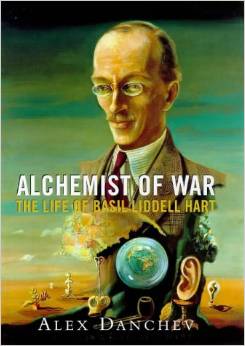
Review of Alchemist of War by Alex Danchev

downloadI’m reasonably well versed in WWI and WWII history. I’ve been a dedicated reader of Sir John Keegan’s books and various other well known war historians for years, but all through the thousands of pages of history I’ve read I don’t recall seeing the name Basil Henry Liddell Hart. I first heard the name B. H. Liddell Hart while reading Robert Greene’s 33 Strategies of War. Greene’s discussion of Liddell Hart and the quotes Greene provided of the great strategist were very interesting and stayed with me. Liddell Hart seemed more than just a war strategist. So it was a pleasure while recently scanning the shelves of a used bookstore that I came across Alchemist of War: The Life of Basil Liddell Hart by Alex Danchev. This biography is good, not only because its portrait is so interesting but because Danchev is so artful at the rendering.

Liddell Hart served as an officer in the first world war. His experience with the futility of trench warfare pushed him to find a better way “to ensure that if war came again there should be no repetition of the Somme and Passchendaele.” With theories like The Man in the Dark and the Expanding Torrent, Liddell Hart began his search to solve the problem of “continued impetus against defense in depth.” The problem, as the tactics of WWI showed, was once an attacking army penetrated the defensive lines (trenches) of the enemy, the attacking force quickly lost momentum as it bogged down in layers of additional defensive works. The attacking army, at this point, then occupied a salient within the enemy line. The enemy, having better communications within it’s own lines, quickly organized their reserve forces on 3 sides of the attaching armies salient and either stalled the break-through, defeated it entirely, or beat it back while inflicting heavy casualties. This would happen over and over in WWI. Successful breaks in the enemy line or “exploitations” could not be properly followed up and exploited fully. Decisive victory, hence, was illusive. The war would be a stalemate, a bloody war of attrition in the “mausoleums of mud.”

Liddell Hart would eventually develop the Indirect Approach. This theory involved the mechanization of the army, with infantry tactics playing support instead of the leading role. Liddell Hart wrote: “Of all the qualities of war it is speed which is dominant.” Celeritas, speed and swiftness, are the primary virtues of a successful army and the thinking of a successful commander. You must be able to stay ahead of your enemy in movement and decision making. WWI Infantry tactics were no match for the advances in weaponry. Weapons like the machine gun changed warfare forever and so tactics had to evolve to avoid needless slaughter and stalemate. 

The Tank would be the answer to the tactical and strategic mobility needed on the battlefield to exploit a break-through in the enemy line. The Tank would be the battleship of the battlefield. A force of heavily armored Tanks could penetrate enemy lines and quickly exploit the break-through by driving further and further into the enemy’s defenses, disrupting communications and, more importantly in Liddell Hart’s view, affecting the mind of the opposing commander. Getting to victory is more than just defeating the enemy forces. The Indirect Approach was very much an attitude of mind and a psychology more so than strictly a battlefield tactic. As Danchev writes: “The indirect approach has usually been physical, and always psychological.”

On the battlefield, the Indirect Approach is about making the enemy commander quickly come to the realization in his mind that he’s defeated. This realization of defeat would hopefully bring the battle to a quick conclusion and avoid a needless slaughter. “In other words the strategy of the Indirect Approach is not so much to seek battle as to seek a strategic situation so advantageous that if it does not of itself produce the decision, its continuation by a battle is sure to achieve this.” As Ardant Pu Picq said: “Loss of hope rather than loss of life is what decides the issues of war.” The Indirect Approach is meant to bring the enemy commander to a quick realization that defeat is inevitable. As the battle quickly turns on the defeated commander and he sees the collapse of his defenses, the loss of communications, his mind comes to see the only option left.

The Indirect Approach would be Liddell Hart’s signature contribution to strategic theory. Like so many philosophical insights Liddell Hart saw the application of the Indirect Approach as applying to all human domains, not just warfare:

I have long come, with reflection on experience, to see that most of the fundamental military theories which I have thought out apply to the conduct of life and not merely of war — and I have learnt to apply them in my own conduct of life, e.g. the ‘man-in-the-dark,’ economy of force, the principle of ‘variability’ [flexibility], and the value of alternative objectives.

So also with the theory of the Indirect Approach, which I evolved in the realm of strategy in 1928-29, have I come gradually to perceive an ever widening application of it until I view it as something that lies at the root of practical philosophy. It is bound up with the question of the influence of thought on thought. The direct assault of new ideas sets up its own resistance, and increases the difficulty of effecting a change of outlook. Conversion is produced more easily and rapidly by the indirect approach of ideas, disarming the inherent opposition . . . Thus, reflection leads one to the conclusion that the indirect approach is a law of life in all spheres — and its fulfillment, the key to practical achievement in dealing with any problem where the human factor is predominant, and where there is room for a conflict of wills.

Whether it be in war, an argument with a friend, a discussion with your son or in the affairs of love, the Indirect Approach was a law of life that allows one who has mastered its application to overcome his opponent through adept indirect maneuvers rather than direct confrontation.

Alchemist of War is a great read. As far as I can tell it’s the only full length biography of Basil Henry Liddell Hart. Danchev does a superb job of drawing you in and holding your attention captive. At no point, in my view, did the narrative slow or become uninteresting. Danchev’s prose is entertaining for his incisive wit and verve. I found myself pulled along by my enthusiasm not only for the subject but for the enjoyment of Danchev’s style. A good biography written by a fine scribbler. 

Debts and Lessons

college classroom

We all have debts, and most of them aren’t financial either. I realized one recently while I was reading Gregory Hays’s translation of Marcus Aurelius’s ancient philosophical journal, the Meditations. Book one of the Meditations begins with a section entitled “Debts and Lessons.” In this section Marcus briefly summarizes the positive things he learned from various people in his life while growing up, and this got me to thinking about a debt I have from an earlier time in my life.

I went to college like so many high school graduates because I wanted to “get an education” and then get a job. At the time, of course, I really wasn’t sure what I wanted to do in life; most of us aren’t at that age. And I wasn’t sure exactly what getting educated really meant. So I began college by signing up for a number of general education courses at the local community college. One of the courses was Philosophy 101. At the time, I didn’t know much about philosophy and didn’t know exactly what to expect, but I did know that “Phil 101” was available and it fulfilled my general education requirements. The course description also made taking philosophy seem like a no brainer. The course catalog described the study of philosophy something like this:

The study of philosophy serves to develop intellectual abilities important for life as a whole, beyond the knowledge and skills required for any particular profession. Properly pursued, it enhances analytical, critical, and interpretive capacities that are applicable to any subject-matter, and in any human context. It cultivates the capacities and appetite for self-expression and reflection, for exchange and debate of ideas, for life-long learning, and for dealing with problems for which there are no easy answers. It also helps to prepare one for the tasks of citizenship. Participation in political and community affairs today is all too often insufficiently informed, manipulable and vulnerable to demagoguery. A good philosophical education enhances the capacity to participate responsibly and intelligently in public life. — The American Philosophical Association (APA)

After reading a course description like this I was sold. It sounded like what getting educated was all about. (To this day I would say the description above is the best and most accurate way of describing the benefits of a philosophical education.) Philosophy 101 was an introductory course, but I suspect it might have been the only philosophy course some of my unsuspecting classmates completed. Philosophy isn’t easy, even at the introductory level. You have to do something a lot of people at that young age aren’t always ready to do, and that involves thinking deeply and critically. It’s mental work of the highest order. You don’t take Philosophy “for fun” or an “easy three credits.” Those who did were quickly disabused of the notion. You stayed in the class either out of genuine intellectual interest, necessity, or sheer determination. Ultimately, if you stayed and pushed yourself it was very rewarding.

The instructor was Tom Hilton. As I recall, he was relatively new to the college (As of this writing he is still teaching there.). He was a soft spoken man with an easy manner and a gentle approach to teaching. He had a genuine love for philosophy and was a natural teacher. He made the class interesting and engaged us intellectually. He made us think in ways many of us hadn’t even vaguely reckoned at that age. Using the Socratic Method, he forced us to stretch our minds—to examine, to question, to think, to learn, and most of all, to grow. The English word “education” is a derivation of the Latin verb educes, which means “to draw forth from within.” Mr. Hilton was indeed educating us, he was prodding us to engage and exercise our critical abilities. At least that’s how I felt in his class. The very best teachers are those who can get you to engage the subject and think deeply about ideas. That’s how you grow intellectually. It has the potential to change your life. It certainly had an affect on mine.

I took two more philosophy classes from Mr. Hilton. I took Philosophy 102 and a class called Practical Reasoning. Philosophy 102 covered the existentialists. It was a very interesting and very challenging intellectually. I actually still have the text book. Existentialism is very deep, it took some real effort to understand the thoughts of Kierkegaard, Nietzsche, Sartre, Buber, and Heidegger. As with all theoretical philosophy, you had to follow extended lines of reasoning and conceptual complexity. You had to sweat, mentally.  I remember being particularly fascinated by Kierkegaard and Nietzsche. At first I struggled to see through the words to the ideas, but slowly the mental fog evaporated and I began to recognize (I believe) the deep meaning and genius of their work.

Practical Reasoning class was another awakening experience. Mr. Hilton taught us the structure of a good argument and how to detect a bad one. We learned basic logic and how to recognize the vast array of logical fallacies most people bring into everyday discussions and arguments. Mr. Hilton usually began the class with having individual students read articles from The Virginian Pilot newspaper. He would then lead the class in anatomizing the statements and arguments made by the author to determine if they were logically sound and, well, reasonable. The course made me realize just how illogical, and at times totally unreasonable, most of us can be in our everyday thinking; a realization that has been sadly confirmed—tragically and humorously—over and over throughout the years since. The theoretical philosophy I’d learned so far was interesting, but it was this course that really brought philosophy down to earth. All of us, every day, must navigate arguments. These arguments come in many forms, from TV commercial, to newspapers, the political discussion at lunch, to an employee’s explanation (or spin) of an event or problem. All of them are laced with arguments. By “argument” I mean attempts to persuade you. TV commercials about buying a product are, rhetorically, an argument for you to buy something. Our daily life is filled with arguments of some type, situations that require us (if we’re conscious) to reason effectively and decide.

Philosophy is a hard subject to define. In ancient Greek philosophia simply meant “a love of wisdom.” The ancient Greek philosophers Plato and Aristotle philosophized on just about everything. No set of ideas or inquiry was off limits, all domains of knowledge were open to inquiry. I still see the task of philosophy as Aristotle did: a synoptic vision of reality. There’s no exact, settled modern definition of philosophy. Over the centuries philosophy bracketed into various sub disciplines and schools of thought. Look at this Wiki page and you’ll see just why philosophy was once called the “Queen of all Sciences.” Philosophy is really about everything.

After Mr. Hilton’s class I began reading philosophy on my own. I spent years reading through various works of Philosophy. I didn’t end up with a degree in philosophy, if you’re wondering. My graduate and undergraduate degrees are both in management. Both of my degree programs, however, were Liberal Arts based and did contain courses in ethics. Of course I really enjoyed those courses because the discussions centered on philosophical theories and the philosophers who constructed them. I was also fortunate in graduate school to have some very fine professors for those courses. (My hat’s off to Professors Stephen Vicchio and Christopher “Aristotle is the man” Dreisbach of Johns Hopkins University, two exceptional human beings, teachers, and mentors.)

I don’t read very much pure (or theoretical) philosophy now. The truth is, as Moses Mendelssohn once said about one of Immanuel Kant’s books, it “consumes the fluid of the nerves.” You have to be in a certain mindset for that type of reading and thinking. I’m talking primarily about epistemology and logic. I still read and enjoy the practical philosophers like Aristotle, Epictetus, Marcus Aurelius & Cicero, along with the many modern philosophers. Practical philosophers are generally interested in politics, ethics, society, personal development, and many other practical affairs. It’s reading that has a direct impact on my thinking. And of course my interest in philosophy naturally led me into many other areas of the humanities, especially history.

So it was Mr. Hilton, in that community college class room (circa 1987), who first sparked my interest in philosophy, ideas, and great thinkers. It hasn’t provided me with any professional status or fame, but it has shaped my perspective in many positive ways and enriched my life. It was, as Mark Twain said, a “conspicuous link” in the chain of my being and for that I’m very thankful to Tom Hilton.